


























Views
Downloads

Grades 1-3 Animal Types — Printable No-Prep Worksheet
Paste this activity's link or code into your existing LMS (Google Classroom, Canvas, Teams, Schoology, Moodle, etc.).
Students can open and work on the activity right away, with no student login required.
You'll still be able to track student progress and results from your teacher account.
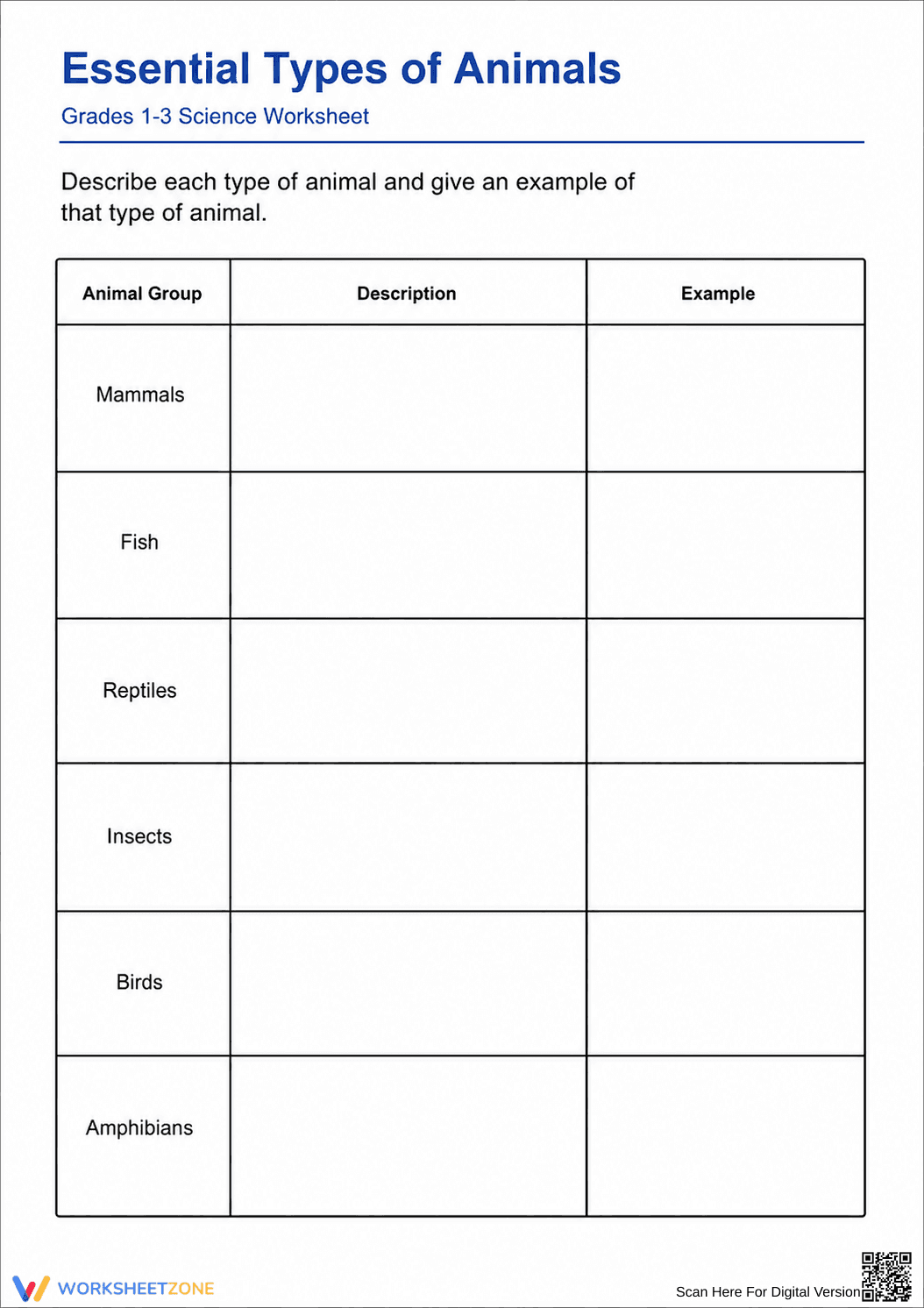
This animal classification worksheet helps early elementary students organize their scientific observations by describing distinct animal groups. By defining traits and providing examples for mammals, fish, reptiles, insects, birds, and amphibians, learners build a strong foundational understanding of biological diversity and life science concepts.
At a Glance
- Grade: 1-3 · Subject: Science
- Standard:
2-LS4-1— Make observations of animals to compare diversity- Skill Focus: Animal Classification
- Format: 1 page · 12 tasks · Answer key included · PDF
- Best For: Independent practice
- Time: 15–20 minutes
What's Inside
This single-page PDF features a clear, structured classification table with 12 total input fields. Students are presented with six major animal groups: mammals, fish, reptiles, insects, birds, and amphibians. For each category, learners must write a brief description of the group's defining characteristics and supply one specific animal example. A complete answer key is included to ensure accurate grading and support quick review.
Zero-Prep Workflow
This resource offers a highly efficient zero-prep workflow for busy educators. First, print the single-page PDF (takes about 30 seconds). Second, distribute the worksheets during your science block or center rotations (1 minute). Third, review student responses using the provided answer key for immediate feedback (5 minutes). With less than two minutes of total teacher preparation required, this activity is perfect for emergency sub plans or quick formative assessments.
Standards Alignment
This resource is aligned to 2-LS4-1, which asks students to make observations of plants and animals to compare the diversity of life in different habitats. By categorizing animals into their biological groups based on observable traits, students develop essential scientific classification skills. Both standard codes can be copied directly into lesson plans, IEP goals, or district curriculum mapping tools.
How to Use It
Deploy this worksheet as an independent practice activity following direct instruction on the animal kingdom, or use it as a summative check at the end of a living things unit. For a quick formative assessment, observe students as they complete the descriptions for amphibians and reptiles to identify any common misconceptions between these similar groups. The expected completion time ranges from 15 to 20 minutes depending on writing proficiency.
Who It's For
This resource is designed for early elementary students in Grades 1, 2, and 3. It is highly effective for visual learners who benefit from structured graphic organizers to sort information. To support developing writers, teachers can provide a word bank of animal names or trait vocabulary. This worksheet pairs naturally with an introductory animal habitat anchor chart or a read-aloud session about biological diversity.
According to the ScienceDirect TpT Analysis, structured graphic organizers significantly improve the retention of classification concepts in early elementary science education. By requiring students to actively retrieve both a definition and a concrete example for various animal groups, this worksheet facilitates dual-coding and deepens conceptual understanding. This targeted practice directly supports NGSS 2-LS4-1, ensuring students can effectively make observations of animals to compare diversity across ecosystems. The clear 12-field layout provides a visual hierarchy that helps young learners organize their scientific observations systematically. Educators can utilize this tool to gauge conceptual clarity before moving into more complex habitat studies. Ultimately, this resource serves as a foundational component for life science units, providing the empirical evidence needed for students to master animal classification. It bridges the gap between simple identification and biological reasoning, making it a reliable staple for elementary science instruction.


