


























Views
Downloads
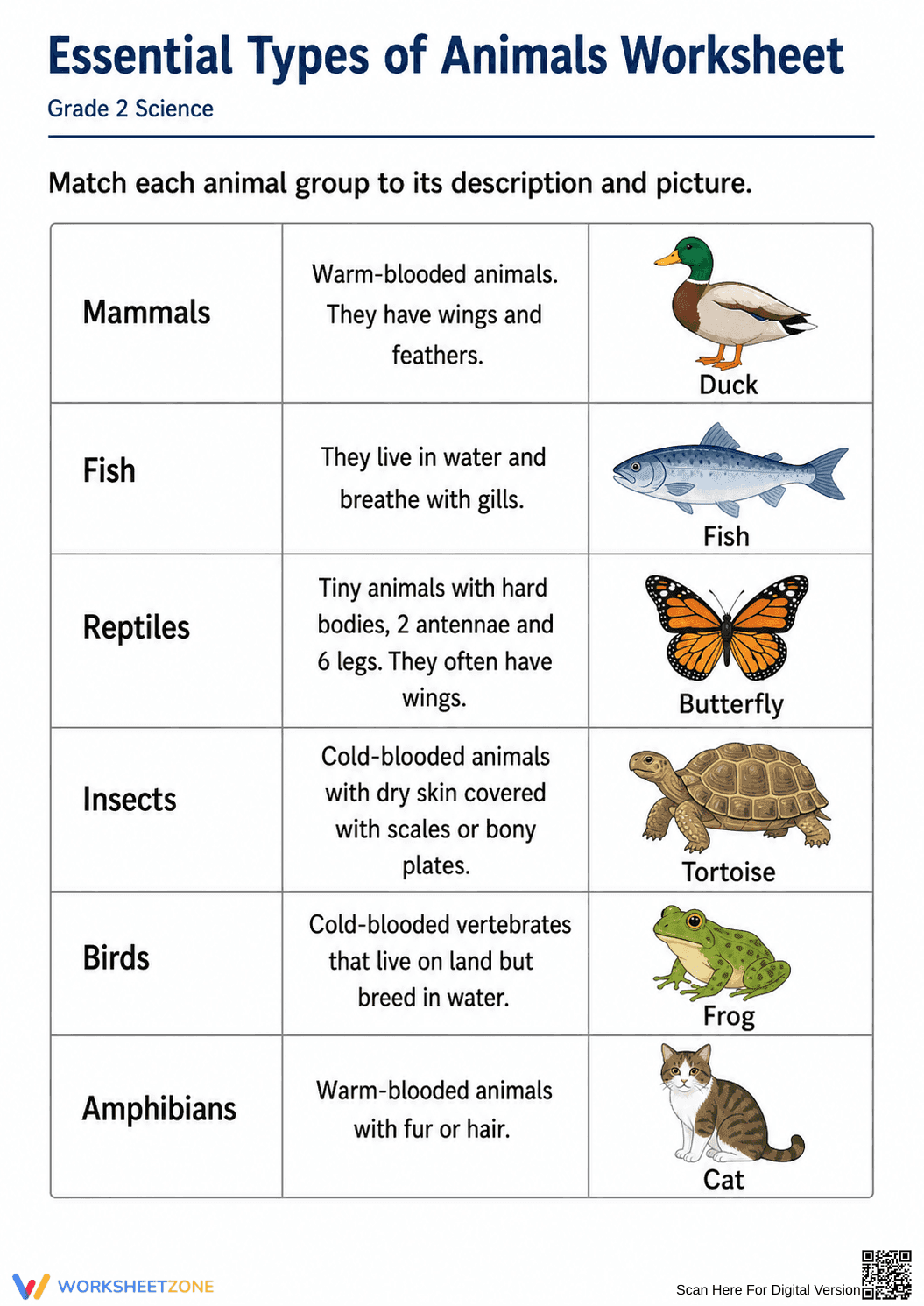

Essential Types of Animals Worksheet | Grade 2 Science
Paste this activity's link or code into your existing LMS (Google Classroom, Canvas, Teams, Schoology, Moodle, etc.).
Students can open and work on the activity right away, with no student login required.
You'll still be able to track student progress and results from your teacher account.
This Grade 2 science worksheet guides students through animal classification by matching groups to physical traits and examples. Students distinguish between mammals, fish, reptiles, insects, birds, and amphibians, building a foundation for biological understanding and systematic scientific observation in early elementary years. It provides a structured path toward mastery of diversity in living things.
At a Glance
- Grade: 2 · Subject: Science
- Standard:
2-LS4-1— Make observations of animals to compare the diversity of life in habitats- Skill Focus: Animal Group Classification
- Format: 1 page · 6 problems · Answer key included · PDF
- Best For: Independent practice or quick formative assessment
- Time: 10–15 minutes
What's Included
This single-page PDF features a matching table for clarity. It includes six animal groups paired with jumbled descriptions of physical characteristics and realistic illustrations. The worksheet includes a full answer key for rapid grading.
Zero-Prep Workflow
Integrating this resource into your science block is incredibly efficient, requiring less than two minutes of total teacher preparation. Simply print the single-page document (30 seconds), distribute it to your class (30 seconds), and facilitate a quick group review using the included answer key (1 minute). Its clear, self-explanatory format makes it an ideal choice for emergency sub plans or morning work activities.
Standards Alignment
This resource aligns directly with 2-LS4-1, requiring students to make observations of animals to compare the diversity of life. By identifying the unique characteristics of different animal types, students develop the categorical thinking necessary for higher-level biological sciences. Both standard codes can be copied directly into lesson plans, IEP goals, or district curriculum mapping tools.
How to Use It
Use this worksheet as a summative check or diagnostic tool for classification lessons. For a formative assessment tip, observe students matching 'cold-blooded' descriptions; confusion between reptiles and amphibians identifies a need for targeted small-group reteaching. Expect completion within 10 to 15 minutes.
Who It's For
Designed primarily for second-grade students, this worksheet is also appropriate for Grade 1 enrichment or Grade 3 review. It supports diverse learners through visual cues and concise text, making it accessible for English Language Learners (ELLs). Pair this activity with a classroom anchor chart detailing vertebrate characteristics for maximum instructional impact during your life sciences rotation.
According to a ScienceDirect TpT Analysis, high-quality matching tasks are essential for cognitive scaffolding in early childhood science education, specifically regarding the categorization of biological diversity. This worksheet effectively addresses the requirements of 2-LS4-1 by forcing students to reconcile visual evidence with descriptive scientific text about animal groups. By correctly identifying that mammals are warm-blooded and possess fur while reptiles have dry, scaly skin, students move beyond superficial recognition to evidence-based classification. Research highlighted in the NAEP framework suggests that early mastery of these classification schemas significantly improves long-term scientific literacy and environmental awareness. This focused 1-page resource provides exactly 6 high-leverage opportunities for students to practice this skill without the cognitive load of excessive teacher-led instruction. It serves as a reliable instrument for assessing a student's ability to categorize life forms based on observable physical traits in any Grade 2 classroom setting.


