


























Views
Downloads

Triphthongs Sorting Worksheet | Grade 5 Printable
Paste this activity's link or code into your existing LMS (Google Classroom, Canvas, Teams, Schoology, Moodle, etc.).
Students can open and work on the activity right away, with no student login required.
You'll still be able to track student progress and results from your teacher account.
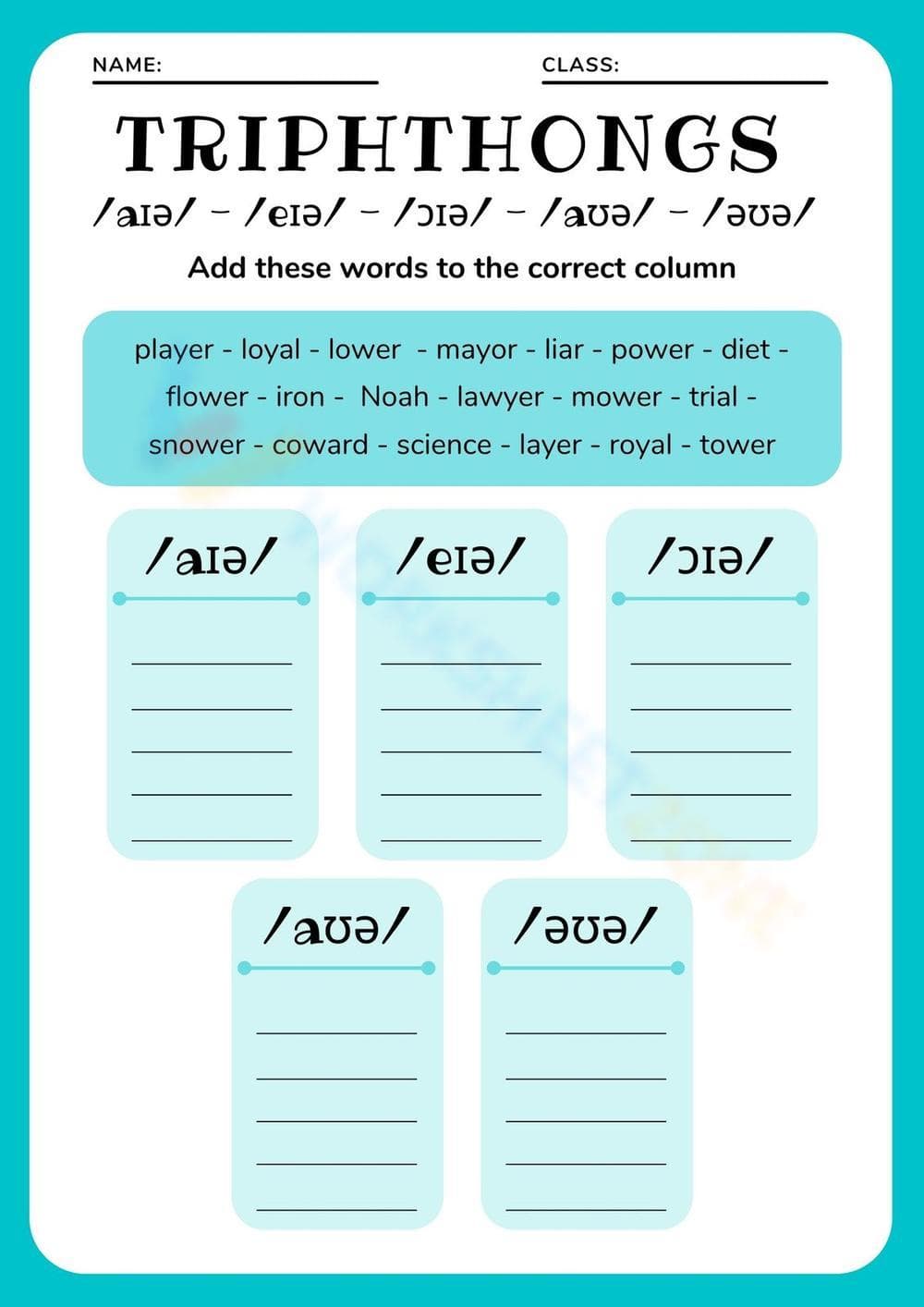
This pronunciation worksheet helps students master complex vowel sounds by categorizing words containing triphthongs. By sorting nineteen vocabulary words into five distinct phonetic columns, learners actively practice decoding and phonemic awareness. This targeted activity strengthens reading fluency and spelling accuracy for upper elementary students.
At a Glance
- Grade: 5 · Subject: ELA
- Standard:
CCSS.ELA-LITERACY.RF.5.3— Apply phonics and word analysis skills- Skill Focus: Triphthong pronunciation and categorization
- Format: 1 page · 19 problems · Answer key included · PDF
- Best For: Independent practice and phonics review
- Time: 15–20 minutes
Inside this resource, educators will find a single-page sorting activity focused on five specific triphthong sounds. The worksheet features a comprehensive word bank containing nineteen terms, such as "player," "science," and "royal." Students must read each word, identify the correct vowel sound combination, and write it under the corresponding International Phonetic Alphabet (IPA) symbol. An answer key ensures accurate grading.
This resource is designed for a highly efficient, zero-prep workflow:
- Print (1 minute): Simply download the PDF and print a class set. The clean layout requires no special formatting.
- Distribute (1 minute): Hand out the worksheet alongside standard writing utensils. The instructions are completely self-explanatory.
- Review (3 minutes): Use the included answer key to quickly check student work or project it for whole-class self-correction.
With a total teacher prep time of under two minutes, this activity is an excellent addition to any emergency sub plan or last-minute phonics center.
This activity aligns directly with CCSS.ELA-LITERACY.RF.5.3, requiring students to know and apply grade-level phonics and word analysis skills in decoding words. By matching standard English orthography to specific phonetic symbols, learners demonstrate advanced phonemic awareness. Both standard codes can be copied directly into lesson plans, IEP goals, or district curriculum mapping tools.
Teachers can deploy this worksheet during independent practice after a direct instruction lesson on complex vowel teams and triphthongs. It also serves as an effective morning work assignment to activate prior knowledge. As a formative assessment observation tip, monitor students as they read the word bank aloud; if they struggle to hear the three distinct vowel sounds in words like "flower" or "layer," they may need additional auditory discrimination practice. Expected completion time is fifteen minutes.
This worksheet is primarily designed for fifth-grade general education students, as well as English Language Learners (ELLs) who benefit from explicit phonetic instruction. To differentiate for students needing extra support, teachers can pre-highlight the vowel teams in the word bank. This activity pairs perfectly with a classroom anchor chart detailing IPA symbols or a direct instruction lesson on syllable division rules.
Mastering complex vowel sounds is a critical component of reading fluency and spelling proficiency. This resource targets CCSS.ELA-LITERACY.RF.5.3, helping students apply phonics and word analysis skills through structured categorization. According to Fisher & Frey (2014), providing students with targeted, independent practice opportunities significantly reinforces phonemic awareness and decoding automaticity. When learners actively sort vocabulary based on phonetic properties, they build stronger neural pathways for word recognition. This triphthong sorting activity offers exactly that type of focused repetition. By requiring students to map standard spelling patterns to specific phonetic symbols, the worksheet bridges the gap between auditory processing and written expression. This evidence-based approach ensures that students understand the underlying phonetic structures of the English language, leading to more confident readers.


