


























Views
Downloads
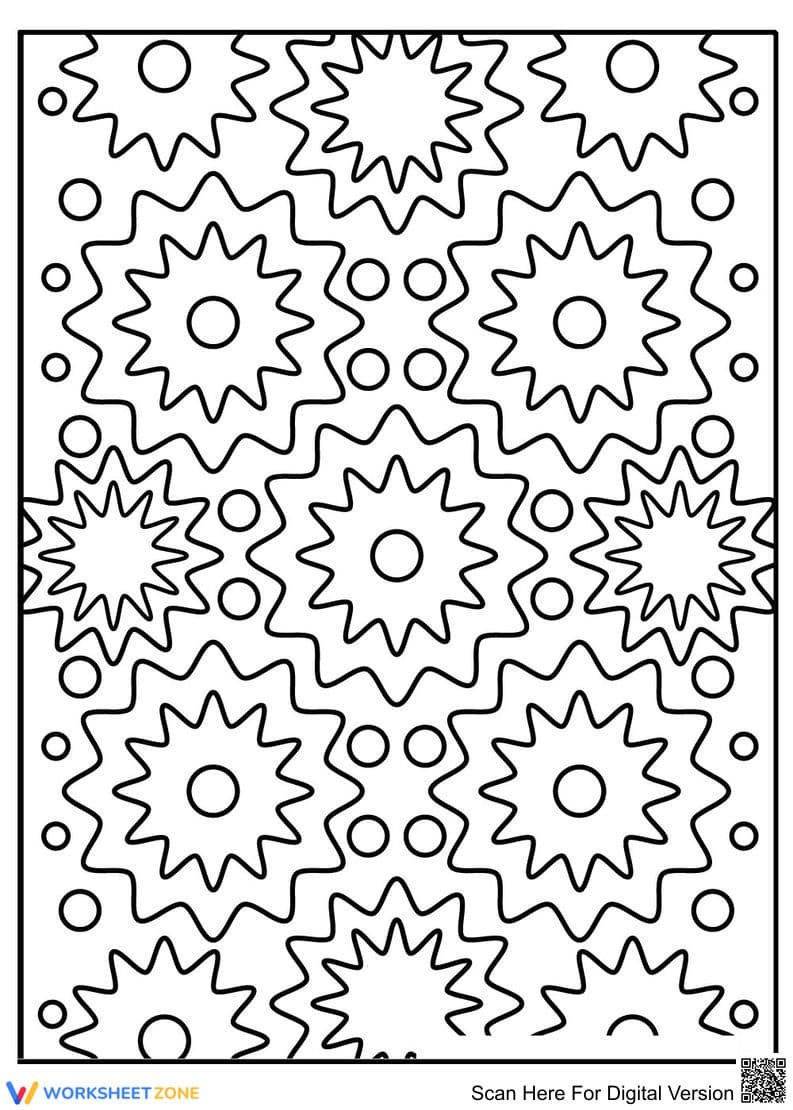

Trippy Pattern Coloring Page | Essential Fine Motor Art
Paste this activity's link or code into your existing LMS (Google Classroom, Canvas, Teams, Schoology, Moodle, etc.).
Students can open and work on the activity right away, with no student login required.
You'll still be able to track student progress and results from your teacher account.
This printable Trippy Pattern coloring page provides students with a complex geometric canvas to practice fine motor control and artistic expression. By engaging with intricate starburst and circular shapes, learners develop the precision required for handwriting and detailed craft work while enjoying a calming, creative outlet.
At a Glance
- Grade: K–5 · Subject: Arts & Crafts
- Standard:
VA:Cr2.1.Ka— Build art-making skills through experimentation with various media and approaches- Skill Focus: Fine motor precision
- Format: 1 page · 1 task · Answer key not applicable · PDF
- Best For: Morning work and mindfulness breaks
- Time: 15–25 minutes
The resource consists of a single high-resolution PDF page featuring a dense, repeating pattern of jagged starbursts and concentric circles. The varying sizes of the shapes provide different levels of challenge for coloring within lines. There are no complex instructions, making it accessible for independent work across multiple grade levels from Kindergarten through Grade 5.
Zero-Prep Workflow
- Print: Generate the single-page PDF for your entire class in under 30 seconds.
- Distribute: Hand out the sheets with crayons, colored pencils, or markers for immediate engagement.
- Review: Circulate to observe student pencil grasp and color selection with zero grading required.
Total teacher preparation time is under 2 minutes, making this an ideal solution for unexpected schedule changes or emergency sub plans.
Standards Alignment
This activity aligns with VA:Cr2.1.Ka: "Through experimentation, build skills in various media and approaches to art-making." By selecting colors and managing the application of media within defined boundaries, students demonstrate safe and proper procedures for using art tools. Both standard codes can be copied directly into lesson plans, IEP goals, or district curriculum mapping tools.
How to Use It
Use this worksheet as a "soft start" morning activity to help students transition into the school day with a focused, quiet task. It also serves as an effective formative assessment tool for occupational therapy goals; teachers can observe a student's pencil grasp and ability to cross the midline while coloring the large-format pattern. Expected completion time ranges from 15 to 25 minutes depending on the medium used.
Who It's For
This resource is designed for elementary students in Grades K-5, particularly those who benefit from mindfulness breaks or sensory regulation activities. It pairs naturally with a direct instruction lesson on geometric patterns or a read-aloud about abstract art. It is also suitable for early finishers who require a productive, quiet task that does not require additional teacher intervention.
The use of complex coloring tasks like this Trippy Pattern worksheet supports the development of visual-motor integration, a critical precursor to academic success in writing and mathematics. According to Fisher & Frey (2014), providing students with structured yet creative tasks allows for the gradual release of responsibility as they move from guided artistic exploration to independent expression. This worksheet aligns with VA:Cr2.1.Ka, focusing on the plain-English skill of building art-making skills through experimentation with media. Research from the NAEP indicates that consistent engagement in the arts correlates with improved spatial reasoning and attention to detail. By incorporating these 15-minute coloring sessions into the weekly routine, educators provide a low-stakes environment for students to refine their fine motor precision. This resource serves as a foundational tool for developing the hand-eye coordination necessary for more advanced artistic and technical endeavors in later grades.


