


























Views
Downloads
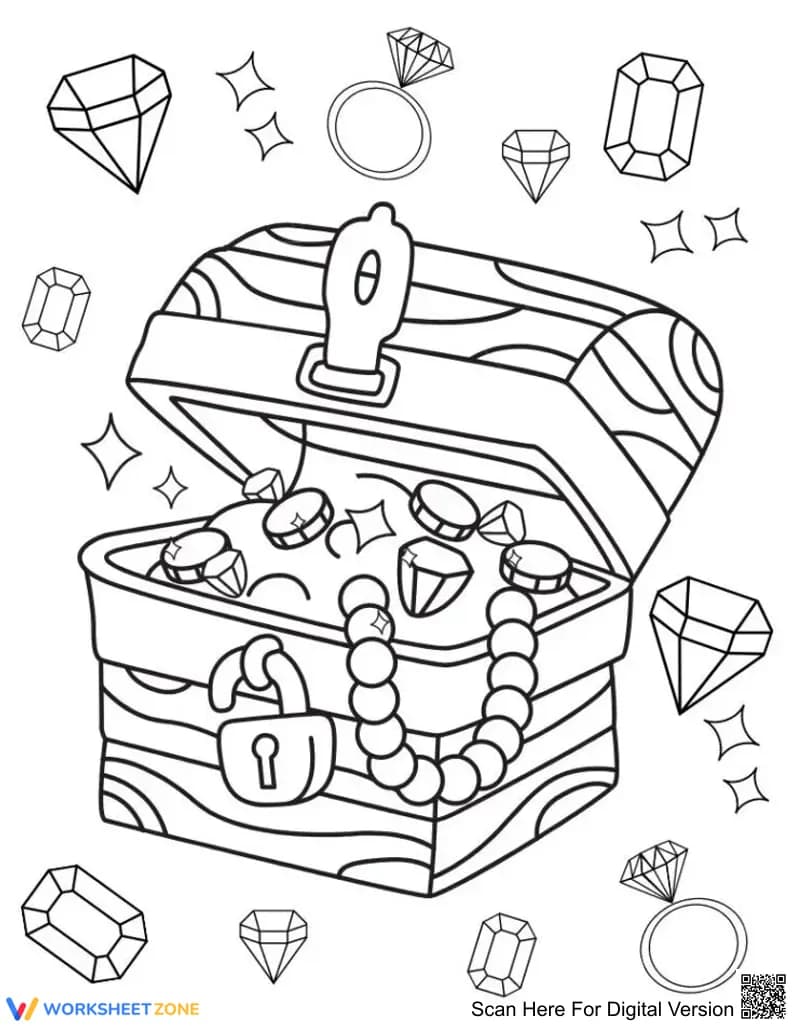

Printable Treasure Chest Coloring Page | Grade K-2 Ready
Paste this activity's link or code into your existing LMS (Google Classroom, Canvas, Teams, Schoology, Moodle, etc.).
Students can open and work on the activity right away, with no student login required.
You'll still be able to track student progress and results from your teacher account.
This printable treasure chest coloring worksheet helps early learners develop essential fine motor control and hand-eye coordination. Students engage with a detailed illustration of a pirate treasure chest overflowing with coins and jewels, providing a creative outlet while strengthening the small muscle groups required for writing and letter formation.
At a Glance
- Grade: K–2 · Subject: Arts & Crafts
- Standard:
CCSS.ELA-LITERACY.L.K.1— Demonstrate command of the conventions of standard English grammar and usage when writing- Skill Focus: Fine motor development
- Format: 1 page · 1 task · Answer key not required · PDF
- Best For: Morning work or early finishers
- Time: 15–20 minutes
This single-page PDF features a high-contrast line art illustration of a treasure chest. The image includes various shapes like circles, octagons, and organic wood grain textures. The clear borders are designed to help students practice staying within the lines, a precursor to spatial awareness in writing. No teacher setup is required beyond printing.
Zero-Prep Workflow
- Print: Select the single-page PDF and print copies for your class in under 30 seconds.
- Distribute: Hand out the sheets with crayons or markers as students enter the room (30 seconds).
- Review: Use the finished products for a bulletin board or as a creative writing prompt (60 seconds).
Total teacher prep time is under 2 minutes, making this an ideal resource for emergency sub plans or transition periods.
The primary standard addressed is CCSS.ELA-LITERACY.L.K.1. While this is a coloring activity, it directly supports the physical dexterity required to print many upper- and lowercase letters by building grip strength and precision. Both standard codes can be copied directly into lesson plans, IEP goals, or district curriculum mapping tools.
Use this worksheet during a pirate or exploration thematic unit to provide a calm, focused transition between high-energy activities. It also serves as an excellent formative assessment for observing pencil grip and pressure control in Kindergarten students. Expected completion time ranges from 15 to 20 minutes depending on student age.
This resource is ideal for Kindergarten and First Grade students, as well as occupational therapy sessions focusing on manual dexterity. It pairs naturally with a read-aloud of a pirate-themed story or an anchor chart about classroom treasures. The simple design ensures accessibility for all learners regardless of artistic experience.
Research from Fisher & Frey (2014) emphasizes the importance of scaffolded fine motor activities in early childhood to support later literacy development. This treasure chest worksheet aligns with CCSS.ELA-LITERACY.L.K.1 by providing the necessary practice for hand-eye coordination and muscle memory. According to the NAEP, students who develop strong manual dexterity in early grades show higher proficiency in written expression during later elementary years. By integrating creative coloring tasks with standard-aligned goals, educators can ensure that students are building the physical foundations for writing while remaining engaged in the classroom. This 1-page PDF is a practical tool for any early childhood educator looking to bridge the gap between artistic expression and the technical requirements of the Common Core State Standards. It provides a structured yet creative environment where students can master the grip and control needed for academic success in the primary grades.


