


























Views
Downloads

Name Tracing Practice | Essential Grade K-1 Handwriting
Paste this activity's link or code into your existing LMS (Google Classroom, Canvas, Teams, Schoology, Moodle, etc.).
Students can open and work on the activity right away, with no student login required.
You'll still be able to track student progress and results from your teacher account.
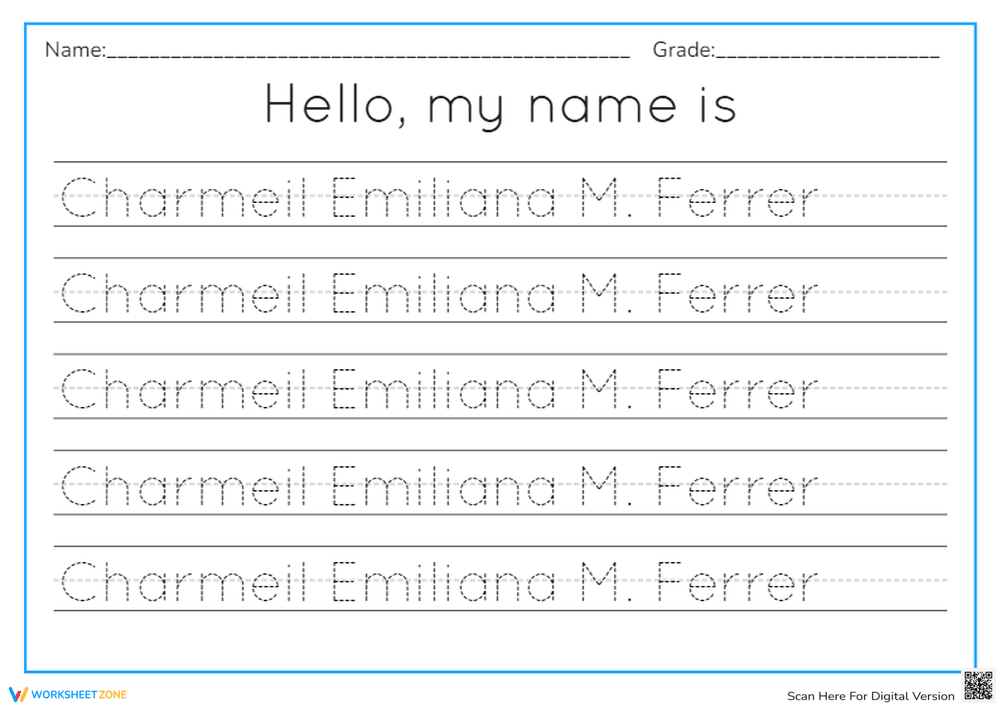
This Grade K-1 name tracing worksheet provides students with 5 structured lines to master the specific letter formations in the name Charmeil. By focusing on a personally significant word, learners engage more deeply with the mechanics of handwriting and fine motor development. This printable resource ensures that early writers build the confidence needed to transition to independent writing.
At a Glance
- Grade: Kindergarten · Subject: Handwriting
- Standard:
CCSS.ELA-LITERACY.L.K.1.A— Print many upper- and lowercase letters correctly during daily writing tasks- Skill Focus: Name recognition and letter formation
- Format: 1 page · 5 problems · Answer key included · PDF
- Best For: Morning work and daily literacy centers
- Time: 5–10 minutes
Inside this resource, you will find a clean, distraction-free layout featuring the name "Charmeil Emiliana M. Ferrer" in a clear, dashed tracing font. The worksheet includes 5 identical lines of practice to encourage repetition and mastery. The top of the page includes space for the student's name and grade, reinforcing the habit of labeling work during every classroom activity.
The zero-prep workflow for this resource is designed for maximum efficiency. First, print the single-page PDF (30 seconds). Second, distribute the worksheet to students during morning arrival or as a transition activity (1 minute). Third, review the letter formation as students trace, providing immediate verbal feedback on pencil grip and stroke direction (2 minutes). Total teacher preparation time is under 2 minutes, making this an ideal solution for substitute folders.
This worksheet is primarily aligned with `CCSS.ELA-LITERACY.L.K.1.A`, which requires students to print many upper- and lowercase letters. By tracing a full name, students practice both cases and various letter shapes in a meaningful context. Additionally, it supports CCSS.ELA-LITERACY.RF.K.1.B by helping students recognize that spoken names are represented by specific sequences of letters. Both standard codes can be copied directly into lesson plans or IEP goals.
Use this worksheet during the "I Do" or "We Do" phase of a handwriting lesson to model correct stroke order. It is particularly effective as a formative assessment tool; observe students as they work to identify those struggling with specific letter curves or pencil pressure. The expected completion time is 5 to 10 minutes, making it a perfect "bell-ringer" activity to settle the class.
This resource is designed for Kindergarten and Grade 1 students who are beginning their literacy journey. It is also highly effective for older students with fine motor delays or those working toward specific IEP handwriting goals. Pair this worksheet with a tactile alphabet anchor chart to provide a comprehensive approach to early writing development and letter recognition.
According to the RAND AIRS 2024 report on early literacy interventions, consistent tactile engagement with letter formation is a critical predictor of orthographic mapping success in primary grades. This name tracing worksheet facilitates the transition from phonemic awareness to grapheme production by providing a high-frequency, personally relevant stimulus. Research by Fisher & Frey (2014) emphasizes that scaffolded handwriting practice, such as the dashed-line tracing provided here, reduces cognitive load, allowing Kindergarten and Grade 1 students to focus on the motor planning required for precise letter construction. By repeating the specific sequence of letters in a name 5 times, students reinforce the muscle memory necessary for independent writing. This resource aligns with CCSS.ELA-LITERACY.L.K.1.A, ensuring that foundational skills are met through structured, repetitive practice. Such targeted handwriting exercises are essential for developing the fine motor control required for later academic fluency and complex composition tasks in elementary education.


