




























Views
Downloads

Letter I Tracing Worksheet | Printable Kindergarten ELA

Paste this activity's link or code into your existing LMS (Google Classroom, Canvas, Teams, Schoology, Moodle, etc.).
Students can open and work on the activity right away, with no student login required.
You'll still be able to track student progress and results from your teacher account.
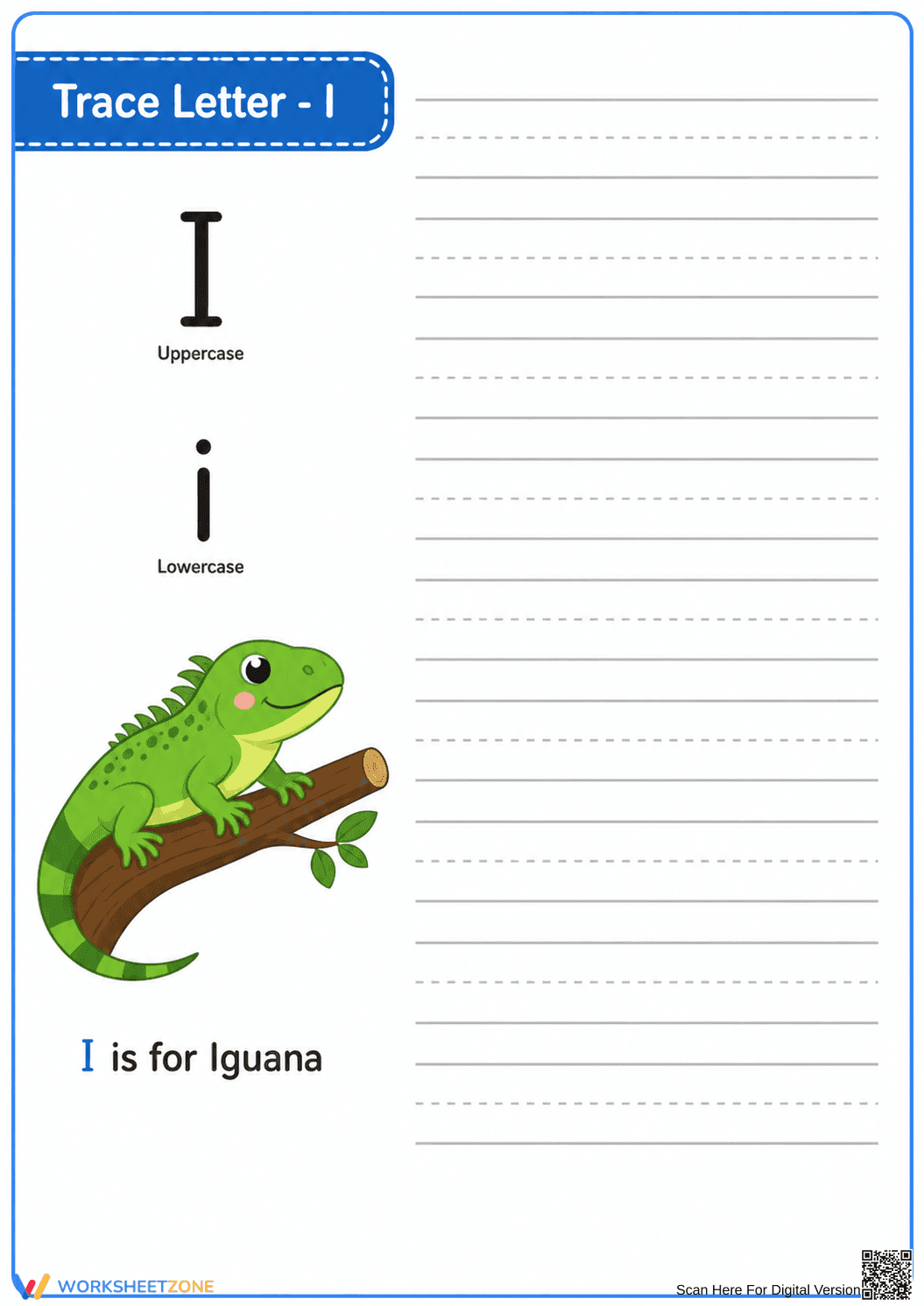
This printable Letter I tracing worksheet helps early learners master uppercase and lowercase handwriting while reinforcing beginning sound recognition. Students practice proper letter formation using guided primary lines, building essential fine motor skills and alphabet fluency. The visual anchor of an iguana connects the letter to its phonetic sound.
At a Glance
- Grade: Kindergarten · Subject: ELA
- Standard:
CCSS.ELA-LITERACY.L.K.1.A— Print upper- and lowercase letters- Skill Focus: Letter I Tracing and Handwriting
- Format: 1 page · 10 practice lines · No answer key needed · PDF
- Best For: Independent practice or morning work
- Time: 10–15 minutes
This single-page resource features clear, distraction-free formatting designed specifically for early childhood education. It includes large models of both uppercase and lowercase 'I' for visual reference, followed by ten standard primary writing lines with dashed midlines to guide letter height and placement. A colorful illustration of an iguana paired with the sentence "I is for Iguana" provides a helpful phonetic anchor, connecting the physical act of writing to beginning sound phonics.
Zero-Prep Workflow
This worksheet is designed for immediate classroom implementation with absolutely no teacher preparation required. The total setup time is under two minutes.
- Print (1 minute): Simply download the PDF and print the required number of copies.
- Distribute (1 minute): Hand out the sheets along with pencils or crayons. The intuitive layout means students immediately understand the task.
- Review (Ongoing): Monitor student grip and stroke order as they work through the ten practice lines.
Perfect for emergency sub plans or independent literacy centers.
Standards Alignment
This handwriting practice sheet is directly aligned to CCSS.ELA-LITERACY.L.K.1.A, requiring students to print many upper- and lowercase letters. It also supports foundational reading skills by reinforcing letter-sound correspondence. Both standard codes can be copied directly into lesson plans, IEP goals, or district curriculum mapping tools.
How to Use It
Morning Work Routine: Place this worksheet on student desks for immediate independent work, establishing a calm start to the day while the teacher handles attendance.
Literacy Centers: Incorporate into a handwriting station. Provide students with colored pencils to trace the letters in a "rainbow writing" style. As a formative assessment tip, observe pencil grip and starting points to ensure top-to-bottom formation. Expected completion time is 10 to 15 minutes.
Who It's For
This resource is primarily designed for kindergarten students developing their foundational handwriting and phonics skills. For differentiation, teachers can pair this worksheet with a tactile activity, such as tracing the letter 'I' in sand or shaving cream, before moving to pencil and paper. It pairs perfectly with direct instruction on short vowel sounds.
Effective handwriting instruction remains a critical component of early literacy development. According to a recent Fisher & Frey (2014) analysis, explicit instruction in letter formation significantly impacts a student's broader writing fluency and reading comprehension. When students can automatically print upper- and lowercase letters, as outlined in CCSS.ELA-LITERACY.L.K.1.A, their cognitive load is freed up to focus on higher-order tasks like spelling and sentence construction. This Letter I tracing worksheet provides the exact type of repetitive, structured practice necessary to build that automaticity. By combining guided primary lines with a phonetic visual anchor, the resource supports both the physical mechanics of writing and the cognitive recognition of beginning sounds. Consistent use of targeted tracing activities ensures early learners develop the fine motor control and letter-sound correspondence required for long-term academic success in English Language Arts.


