




























Views
Downloads
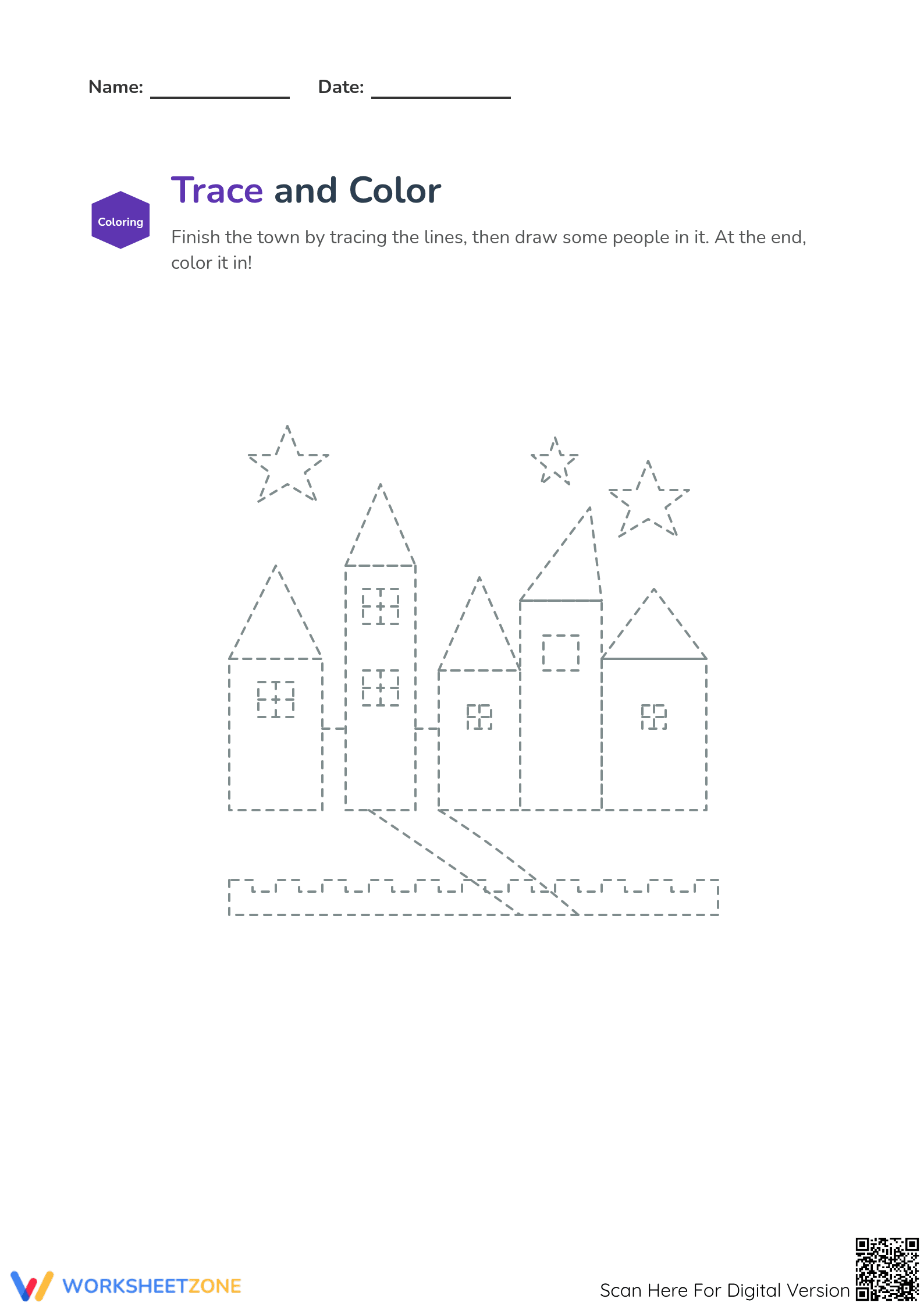

Trace and Color the City | Essential Grade K Worksheet

Paste this activity's link or code into your existing LMS (Google Classroom, Canvas, Teams, Schoology, Moodle, etc.).
Students can open and work on the activity right away, with no student login required.
You'll still be able to track student progress and results from your teacher account.
This Kindergarten tracing worksheet helps young learners develop the fine motor control necessary for writing while exploring geometric shapes in a familiar environment. By completing the cityscape, students practice steady hand movements and visual-spatial coordination. It provides a creative outlet that bridges the gap between play and formal academic preparation.
At a Glance
- Grade: Kindergarten · Subject: Early Literacy & Math
- Standard:
CCSS.MATH.CONTENT.K.G.A.1— Describe objects in the environment using names of shapes and positional terms- Skill Focus: Fine motor tracing and shape identification
- Format: 1 page · 1 scene · No answer key needed · PDF
- Best For: Morning work or fine motor centers
- Time: 10–15 minutes
The resource features a single-page printable containing a detailed cityscape composed of dashed lines. Students encounter various geometric forms, including rectangular buildings, triangular roofs, and five-pointed stars. The layout includes a dedicated space for the student's name and date, encouraging early organizational habits. There are no complex instructions, making it accessible for non-readers to begin immediately.
Zero-Prep Workflow
- Print: Generate the single-page PDF in seconds for your entire class.
- Distribute: Hand out the page along with crayons or markers to students during transitions.
- Review: Check for line accuracy and ask students to name the shapes they traced, such as the squares in the windows.
Total teacher preparation time is under 2 minutes, making it an ideal sub-plan or emergency filler activity.
Standards Alignment
The primary alignment is `CCSS.MATH.CONTENT.K.G.A.1`, which requires students to describe objects in the environment using names of shapes. As students trace the city, they interact with squares, rectangles, and triangles in a contextual setting. This activity also supports early literacy by strengthening the pincer grasp required for future letter formation. Both standard codes can be copied directly into lesson plans, IEP goals, or district curriculum mapping tools.
How to Use It
Use this worksheet during the settling in period of the morning to help students focus their energy on a quiet, tactile task. It also serves as an excellent formative assessment tool; observe how students grip their writing utensils and whether they can follow the dashed lines accurately. This observation helps identify students who may need additional occupational therapy support or extra practice with pre-writing strokes.
Who It's For
This resource is tailored for Preschool and Kindergarten students who are in the early stages of writing readiness. It is particularly effective for English Language Learners (ELLs) as it uses visual cues rather than heavy text. Pair this worksheet with a read-aloud about city life or a math lesson on basic 2D shapes to reinforce the vocabulary used during the tracing process.
Research from Fisher & Frey (2014) emphasizes the importance of scaffolded fine motor activities in early childhood to support later literacy development. This worksheet utilizes a gradual release of creative control, allowing students to first follow a structured path (tracing) before engaging in independent expression (drawing people and coloring). By integrating shape recognition with motor practice, the activity aligns with NAEP frameworks for early childhood mathematics and literacy. The use of environmental contexts, such as a city, helps children ground abstract geometric concepts in real-world observations. This dual-purpose approach ensures that instructional time is maximized, addressing both physical development and cognitive standards simultaneously. Educators can confidently implement this tool as part of a comprehensive pre-writing curriculum that values the intersection of art and academic skill-building.


