


























Views
Downloads

Touch Dot Math Error Analysis | Grade 1 Printable
Paste this activity's link or code into your existing LMS (Google Classroom, Canvas, Teams, Schoology, Moodle, etc.).
Students can open and work on the activity right away, with no student login required.
You'll still be able to track student progress and results from your teacher account.
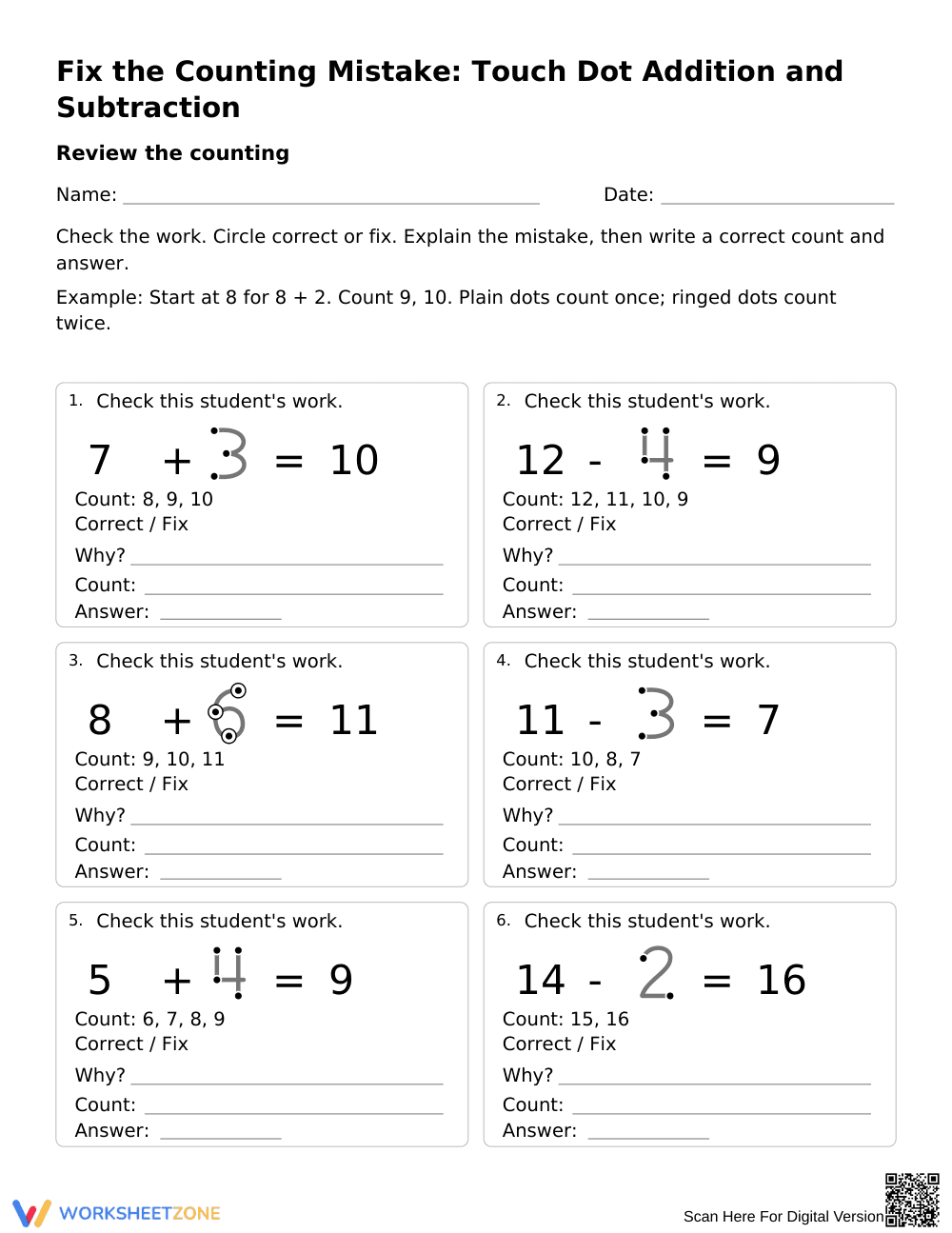
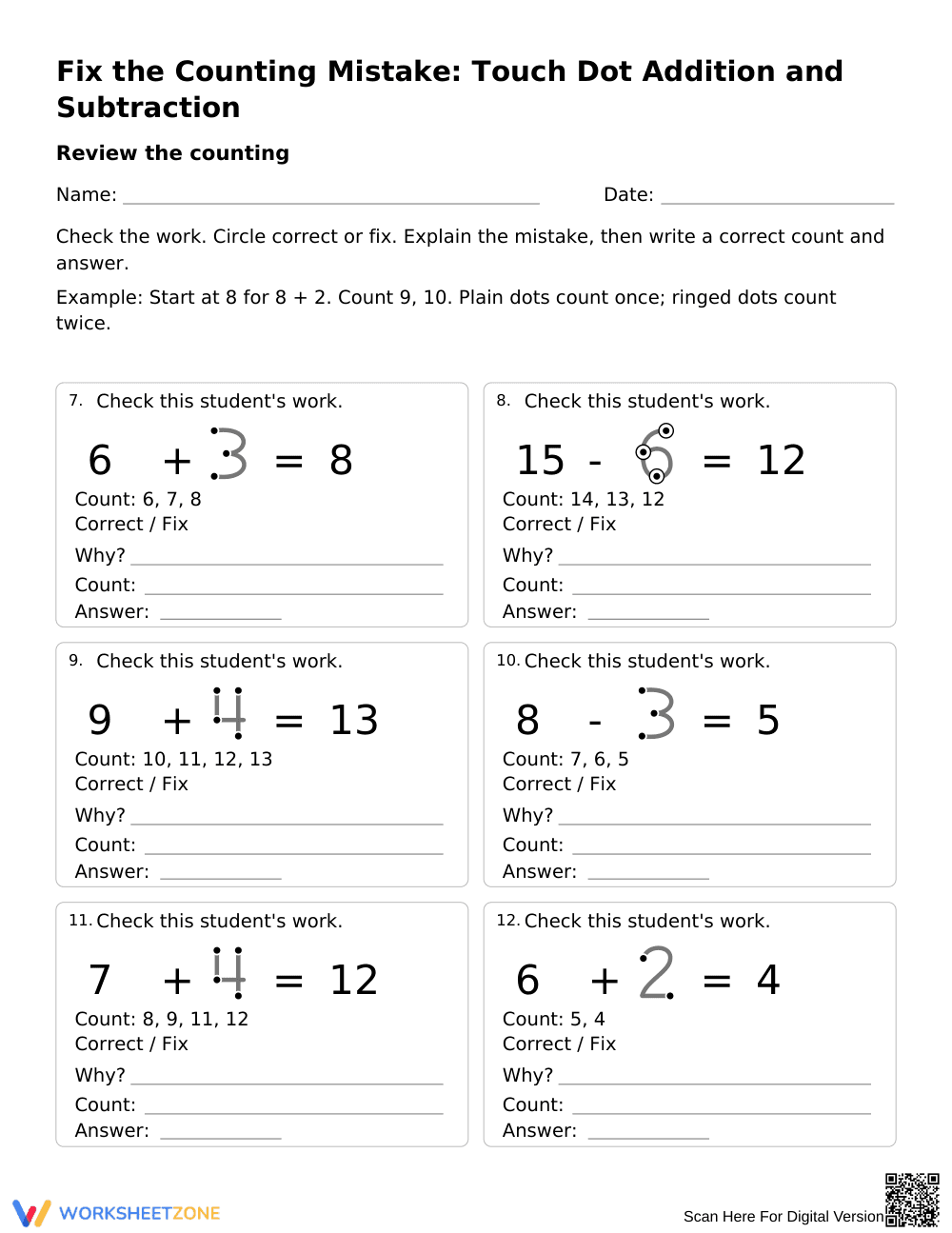
This Grade 1 math worksheet helps students master addition and subtraction strategies by identifying and correcting counting mistakes in touch dot visual representations. Learners examine sample work, determine if the solution path is accurate, explain the error, and write the corrected count and final answer. By critiquing student work, children build deeper numerical fluency and foundational reasoning skills.
At a Glance
- Grade: 1 · Subject: Math
- Standard:
CCSS.MATH.CONTENT.1.OA.C.5— Relate counting to addition and subtraction by counting on or counting back.- Skill Focus: Touch dot counting error analysis
- Format: 2 pages · 12 problems · Answer key included · PDF
- Best For: Independent practice and error correction
- Time: 15–20 minutes
What's Inside: This 2-page visual math resource features 12 multi-step error analysis problems covering single-digit and double-digit addition and subtraction within 20 using touch dot cues. Each item presents a worked student example with written counting sequences, requiring learners to evaluate accuracy, articulate specific mistakes like counting starting numbers or skipping dots, write the correct sequence, and record the true sum or difference. A comprehensive answer key detailing specific error types is included for fast grading.
Skill Progression:
- Guided practice: Problems 1–4 present explicit worked examples where students evaluate basic single-digit addition and subtraction with clear touch dot prompts.
- Supported practice: Problems 5–8 introduce common counting pitfalls, such as failing to double-count ringed dots or counting in the wrong direction across teen numbers.
- Independent practice: Problems 9–12 challenge students to independently analyze complex sequences, justify mathematical corrections, and compute final equations accurately.
This structured progression follows the gradual-release framework, scaffolding student understanding from basic verification to independent mathematical critique.
Standards Alignment:
This worksheet aligns directly with CCSS.MATH.CONTENT.1.OA.C.5, which requires students to relate counting to addition and subtraction by counting on to add and counting back to subtract. It also supports CCSS.MATH.CONTENT.1.OA.C.6 by reinforcing computational fluency within 20. Both standard codes can be copied directly into lesson plans, IEP goals, or district curriculum mapping tools.
How to Use It:
Deploy this worksheet during the independent practice portion of a lesson after reviewing touch dot counting rules. Alternatively, use it as a targeted exit ticket to evaluate error recognition. During practice, observe whether students identify root mistakes—like counting starting numbers—or simply recalculate answers without evaluating the process. Expected completion time ranges between 15 and 20 minutes depending on writing support needs.
Who It's For:
This printable activity is designed for first-grade students learning addition and subtraction, as well as second-grade intervention groups needing multi-sensory math reinforcement. It offers built-in visual differentiation for tactile learners and pairs effectively with touch point number charts, manipulative counters, or small-group direct instruction lessons.
Evaluating student errors in multi-sensory counting models directly strengthens early numerical comprehension and conceptual understanding. Research by Fisher & Frey (2014) highlights that structured error analysis tasks promote metacognitive processing by requiring learners to explain why a calculation is incorrect rather than merely computing a result. Aligning with standard CCSS.MATH.CONTENT.1.OA.C.5, this resource requires Grade 1 students to evaluate touch dot addition and subtraction sequences, articulate root counting mistakes—such as skipping values or misinterpreting double-count ringed dots—and generate corrected solutions. By combining visual touch point cues with explicit written justification, this 12-problem worksheet bridges concrete visual counting strategies and abstract arithmetic fluency. Incorporating routine error identification into foundational math instruction builds resilient problem-solving skills, reduces persistent counting misconceptions, and equips young learners for complex place value and operational reasoning in higher elementary grades.


