


























Views
Downloads
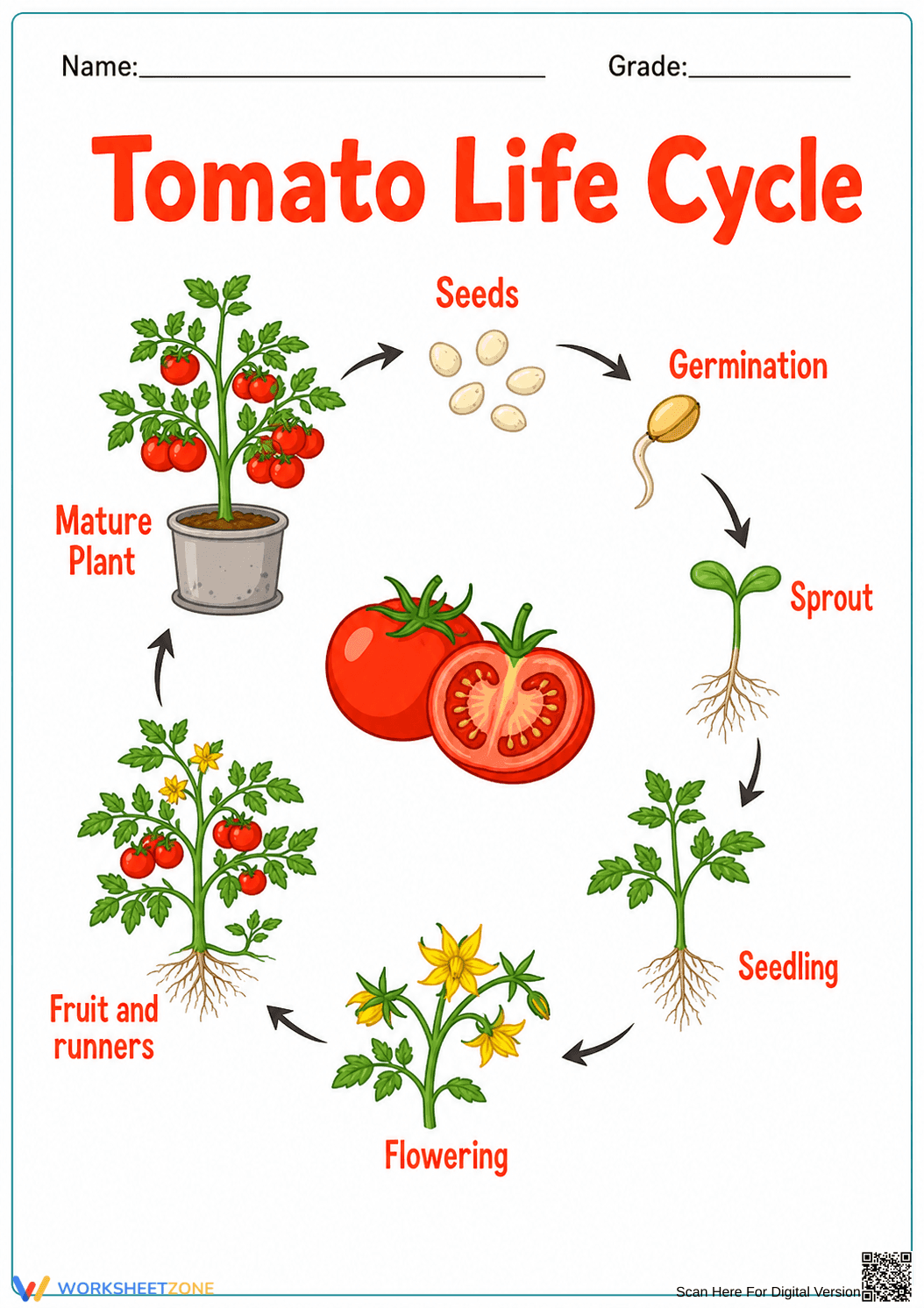

Tomato Life Cycle Diagram | Grade 5 Science Printable
Paste this activity's link or code into your existing LMS (Google Classroom, Canvas, Teams, Schoology, Moodle, etc.).
Students can open and work on the activity right away, with no student login required.
You'll still be able to track student progress and results from your teacher account.
This Grade 5 science reference diagram provides students with a clear visual representation of the tomato plant life cycle. By illustrating each phase from seed to mature plant, this resource helps learners identify specialized plant structures and understand the continuous process of growth and reproduction in flowering plants.
At a Glance
- Grade: 5 · Subject: Science
- Standard:
MS-LS1-4— Identify plant structures that affect successful reproduction- Skill Focus: Life Cycle Analysis
- Format: 1 page · 1 task · No answer key required · PDF
- Best For: Visual reference and science notebooks
- Time: 5–10 minutes
This single-page printable features a full-color, labeled diagram of a tomato plant's life cycle. It maps out seven key developmental stages: seeds, germination, sprout, seedling, flowering, fruit and runners, and the mature plant. Directional arrows guide students through the cyclical progression, while detailed illustrations highlight specific anatomical changes occurring as the plant prepares for reproduction.
Integrating this visual aid into your science block is straightforward.
- Print (1 minute): Generate color or grayscale copies for each student.
- Distribute (1 minute): Hand out diagrams as a companion to your life science lesson.
- Review (3 minutes): Walk through the stages together, pointing out how flowers transition into fruit.
With minimal prep time, this resource is an excellent addition to interactive science notebooks, a reliable anchor chart, or a quick visual supplement for substitute plans.
Aligned to standard MS-LS1-4: "Use argument based on empirical evidence and scientific reasoning to support an explanation for how characteristic animal behaviors and specialized plant structures affect the probability of successful reproduction of animals and plants respectively." It also supports 5-LS1-1 by illustrating growth stages where plants require air and water to build mass. Both codes can be copied directly into lesson plans.
This diagram is highly versatile for science instruction. Teachers can use it for interactive notebooks; have students glue this diagram into their journals at the start of a botany unit, allowing them to add annotations or color-code structures during direct instruction. It also serves as a strong formative assessment prompt. After reviewing the diagram, cover the labels and ask students to verbally explain the transition from the flowering stage to the fruit stage. Reviewing and annotating typically takes 5–10 minutes.
This resource is ideal for Grade 5 and 6 students exploring plant biology. The clear visual scaffolds make it accessible for English Language Learners (ELLs) and students benefiting from graphic organizers. It pairs perfectly with hands-on gardening projects or direct instruction on angiosperm reproduction.
Understanding plant development is crucial for mastering ecological concepts. Standard MS-LS1-4 requires students to identify plant structures affecting reproduction, like flowers and fruit. Providing students with explicit visual models improves their ability to construct scientific explanations and retain biological vocabulary. When learners trace the pathway from seed to mature plant, they build stronger mental schemas for biological processes. By using this tomato life cycle diagram, educators give students a concrete reference point bridging abstract botanical concepts and observable natural phenomena, ensuring deeper comprehension of how living organisms grow and reproduce.


