


























Views
Downloads



Essential 3D Shapes Practice Worksheet | Grades 1-5
Paste this activity's link or code into your existing LMS (Google Classroom, Canvas, Teams, Schoology, Moodle, etc.).
Students can open and work on the activity right away, with no student login required.
You'll still be able to track student progress and results from your teacher account.
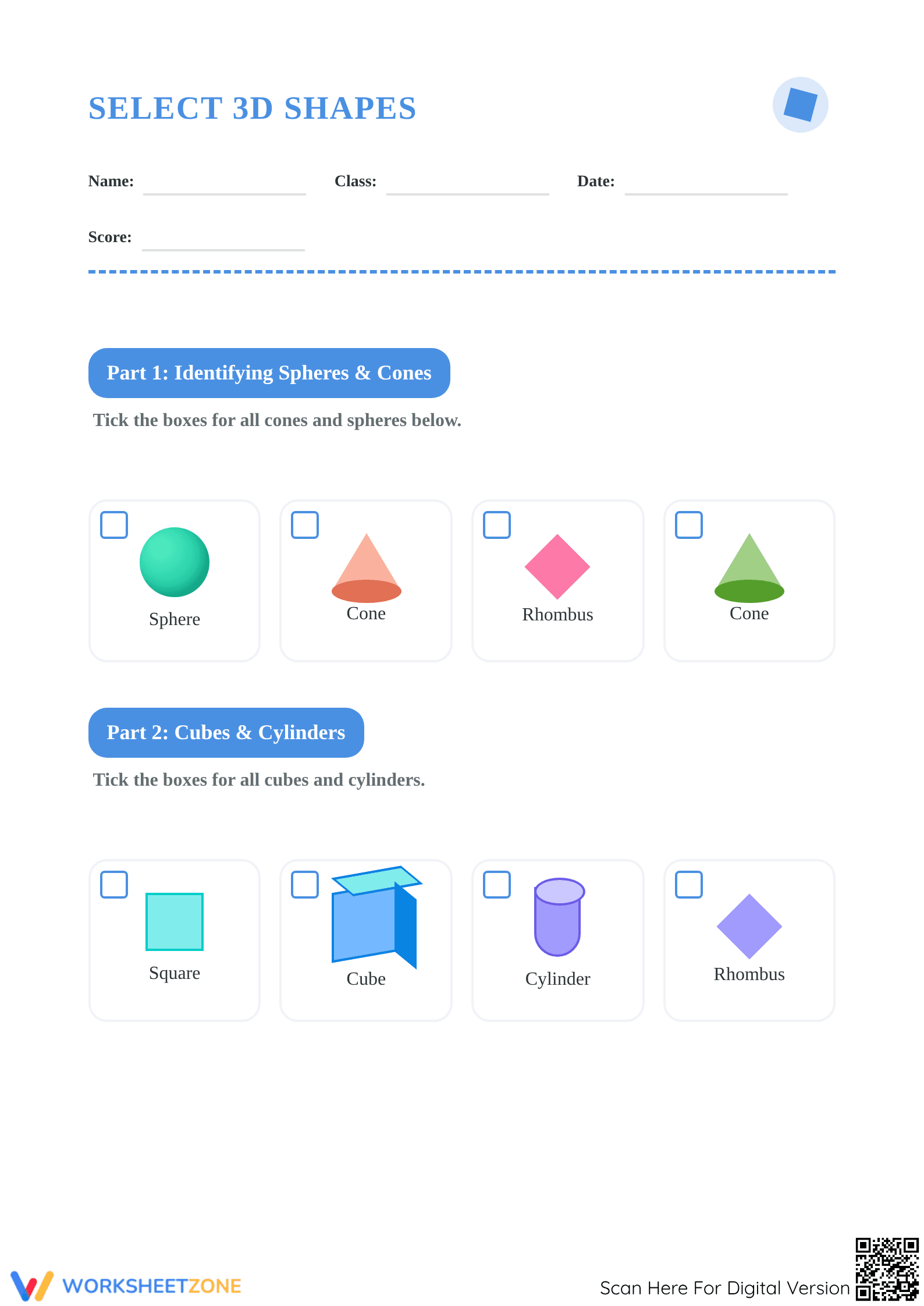
This comprehensive three-dimensional shapes worksheet provides students with targeted practice in identifying and distinguishing between common geometric solids. By engaging with 36 distinct visual identification tasks, learners build the spatial awareness necessary to recognize spheres, cubes, cones, cylinders, pyramids, and prisms in various orientations, ensuring a solid foundation for advanced geometry and spatial reasoning.
At a Glance
- Grade: 1–5 · Subject: Geometry
- Standard:
CCSS.MATH.CONTENT.2.G.A.1— Recognize and draw shapes having specified attributes and identify specific 3D solids- Skill Focus: 3D Shape Identification
- Format: 3 pages · 36 problems · Answer key included · PDF
- Best For: Independent practice or quick geometry review
- Time: 15–25 minutes
This packet contains three pages of high-quality geometry practice, totaling 36 identification exercises. Each page features a clear 3x4 grid of tasks where students must color, circle, or mark specific 3D shapes among various distractors. The worksheet covers essential solids including spheres, cubes, cones, cylinders, and pyramids. A complete answer key is provided to facilitate rapid grading and student self-correction during independent work time.
Implementing this resource into your math block requires minimal effort. First, print the three-page PDF (under 1 minute). Second, distribute the sheets to students as a morning work assignment or center activity (30 seconds). Finally, use the included answer key for a quick whole-class review or individual grading (under 1 minute). Total teacher preparation time is less than two minutes, making it an ideal choice for busy classrooms or sudden sub plans.
The primary focus is `CCSS.MATH.CONTENT.2.G.A.1`: "Recognize and draw shapes having specified attributes, such as a given number of angles or a given number of equal faces. Identify triangles, quadrilaterals, pentagons, hexagons, and cubes." It also supports the G1 and G3 geometry strands through visual recognition of composite attributes. Both standard codes can be copied directly into lesson plans, IEP goals, or district curriculum mapping tools.
This resource is ideal for use during the independent practice portion of a geometry lesson. Assign it after direct instruction on the properties of 3D solids to check for student understanding and mastery of geometric vocabulary. For a formative assessment tip, observe which shapes students struggle to differentiate—often cones versus pyramids—and use that data to guide your small-group instruction or review session. Completion typically takes between 15 and 25 minutes depending on student grade level.
Designed for elementary students in Grades 1 through 5, this worksheet is particularly effective for those needing visual reinforcement of geometric concepts. It serves as an excellent resource for general education classrooms, special education support, and English Language Learners who benefit from the visual-heavy, low-text format. Pair it with physical 3D manipulatives for a multisensory learning experience that bridges the gap between concrete objects and abstract representations.
Mastering the identification of 3D shapes is a critical milestone in early mathematical development. According to a RAND AIRS 2024 analysis, consistent exposure to diverse visual representations of geometric solids significantly improves spatial reasoning skills in elementary learners. This worksheet aligns with the standard CCSS.MATH.CONTENT.2.G.A.1, which requires students to recognize and categorize shapes based on their defining attributes. By providing 36 structured identification tasks, the resource facilitates the transition from concrete observation to abstract geometric understanding. Research from Fisher & Frey (2014) emphasizes that gradual release through focused identification practice builds the requisite vocabulary for later success in calculating volume and surface area. This printable resource ensures students can accurately name and distinguish between spheres, cubes, and cylinders, providing an essential scaffold for more complex three-dimensional analysis in subsequent grade levels. Teachers can confidently integrate this aligned material into their standards-based curriculum to ensure classroom-ready results.


