


























Views
Downloads
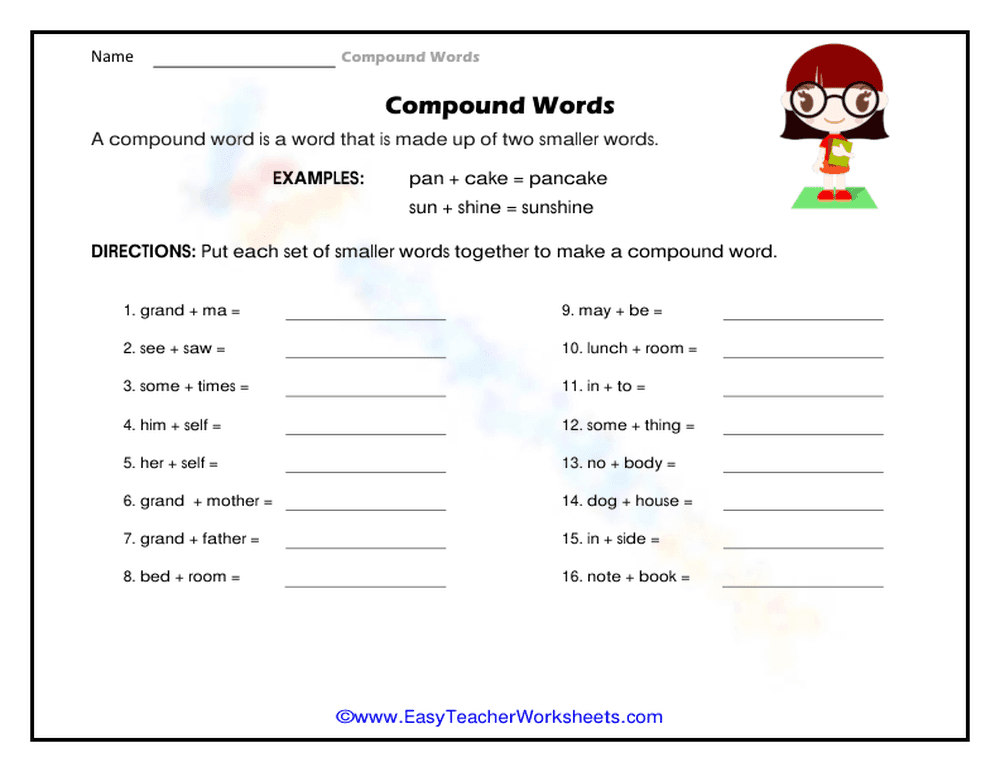

Essential Compound Words Worksheet | Grades 2-4 ELA
Paste this activity's link or code into your existing LMS (Google Classroom, Canvas, Teams, Schoology, Moodle, etc.).
Students can open and work on the activity right away, with no student login required.
You'll still be able to track student progress and results from your teacher account.
This compound words worksheet provides a direct and effective way for students to master the linguistic concept of combining two smaller words to form a new, meaningful term. By engaging with structured practice, learners strengthen their vocabulary and decoding skills, enabling them to recognize complex word structures in their independent reading and writing tasks.
At a Glance
- Grade: 2-4 · Subject: English Language Arts
- Standard:
CCSS.ELA-LITERACY.L.2.4.D— Use knowledge of individual word meanings to predict compound word meanings- Skill Focus: Compound Word Formation
- Format: 1 page · 16 problems · Answer key included · PDF
- Best For: Independent practice or vocabulary center activity
- Time: 10–15 minutes
What's Inside
The worksheet features a clear definition of a compound word followed by illustrative examples like "pancake" and "sunshine" to set a strong foundation. Students are presented with 16 numbered tasks where they must combine two base words, such as "grand + father" or "note + book," into a single compound word. The layout is spacious, providing ample room for students to write their answers clearly.
Skill Progression
- Guided Practice: The activity begins with explicit examples that model the addition process, ensuring students understand the structural logic before starting.
- Supported Practice: The first several items use highly familiar base words to build confidence and reinforce the pattern of word synthesis.
- Independent Practice: Students complete 16 unique combinations independently to demonstrate their ability to synthesize new meanings from known components.
This sequence follows a gradual-release model, moving from teacher-led modeling through shared examples to independent mastery.
Standards Alignment
This resource is specifically aligned to CCSS.ELA-LITERACY.L.2.4.D: "Use knowledge of the meaning of individual words to predict the meaning of compound words (e.g., birdhouse, lighthouse, housefly; bookshelf, notebook, bookmark)." It also supports general vocabulary acquisition goals for third and fourth grades. Both standard codes can be copied directly into lesson plans, IEP goals, or district curriculum mapping tools.
How to Use It
Use this worksheet as a quick check for understanding during a vocabulary unit or as a "do-now" activity to activate prior knowledge before a reading block. Teachers can observe students as they work to identify those who may struggle with blending the two words or who might need more support with the spelling of the final compound form. Completion typically takes between 10 and 15 minutes.
Who It's For
This printable is designed for students in grades 2, 3, and 4 who are developing their morphological awareness. It is particularly helpful for English Language Learners (ELLs) who benefit from seeing how words are built from smaller parts. This resource pairs naturally with a compound word anchor chart or a short informational passage containing the words practiced here.
Morphological awareness is a critical predictor of reading comprehension and vocabulary growth in the elementary years. According to Fisher & Frey (2014), explicit instruction in word parts helps students dismantle complex academic language and improves their ability to infer the meanings of unfamiliar texts. This worksheet targets the specific sub-skill of compound word synthesis, requiring students to actively combine known morphemes into new semantic units. By practicing with 16 distinct examples, learners internalize the logic of word formation, which is a key component of the CCSS.ELA-LITERACY.L.2.4.D standard. Research from NAEP indicates that students who possess strong word-analysis skills consistently outperform peers in standardized literacy assessments. This high-utility printable serves as a bridge between basic phonics and advanced vocabulary acquisition, providing the repetition necessary for long-term retention. It is an essential tool for any literacy block focused on building robust, independent readers who can navigate the complexities of the English language.


