


























Views
Downloads

Printable Emotional Strengths Worksheet | Grade 12
Paste this activity's link or code into your existing LMS (Google Classroom, Canvas, Teams, Schoology, Moodle, etc.).
Students can open and work on the activity right away, with no student login required.
You'll still be able to track student progress and results from your teacher account.
This Grade 12 emotional strengths worksheet helps students identify and articulate their personal resilience and social-emotional skills. By completing a structured self-assessment and guided reflection questions, learners build critical self-awareness and self-esteem. The activities encourage deep introspection, allowing young adults to recognize their positive qualities and areas for personal growth.
At a Glance
- Grade: 12 · Subject: Social Skills
- Standard:
CCSS.ELA-LITERACY.W.11-12.4— Produce clear and coherent writing appropriate to the task.- Skill Focus: Self-Awareness and Reflection
- Format: 3 pages · 39 problems · No answer key · PDF
- Best For: Independent reflection and SEL
- Time: 20–30 minutes
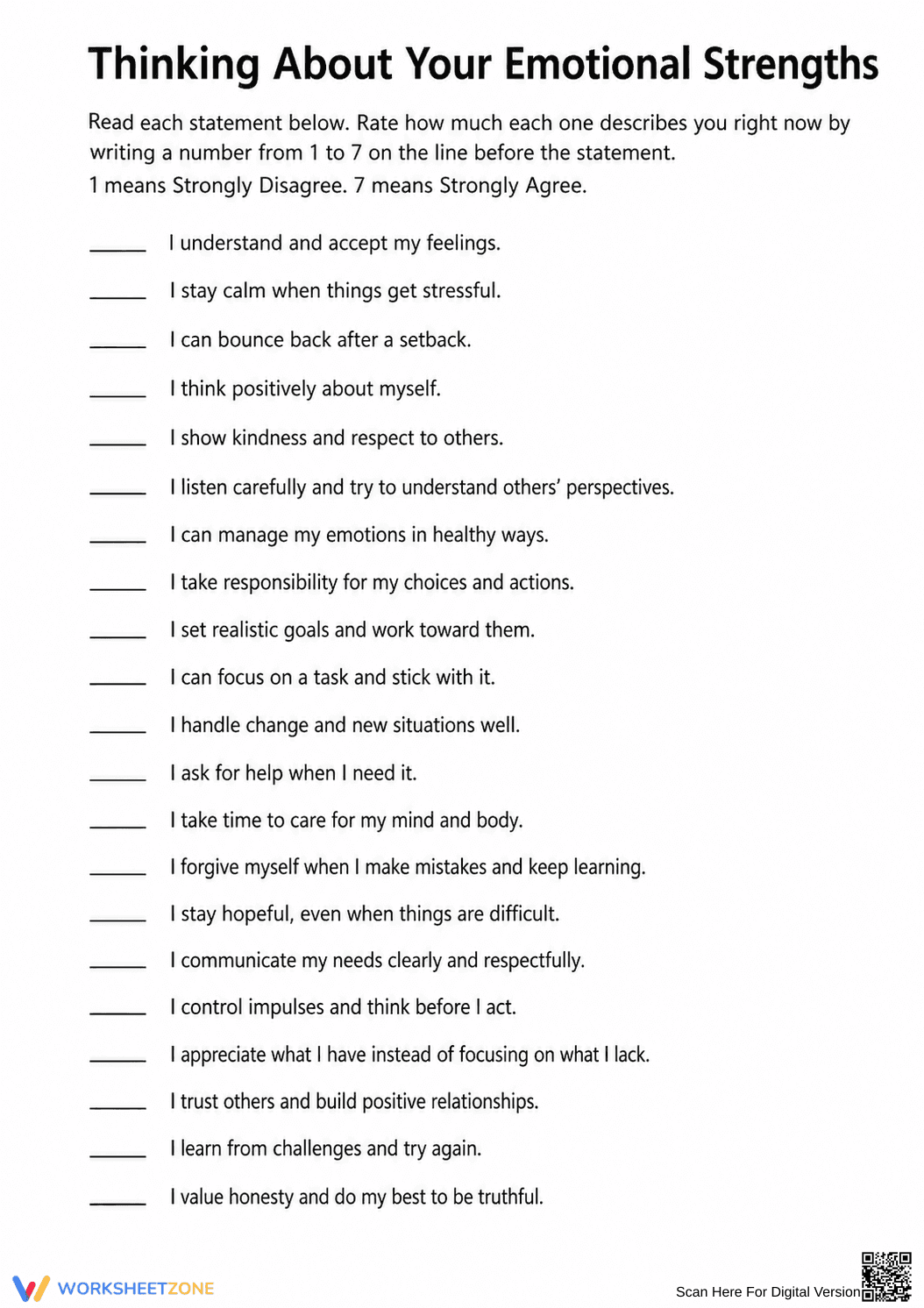
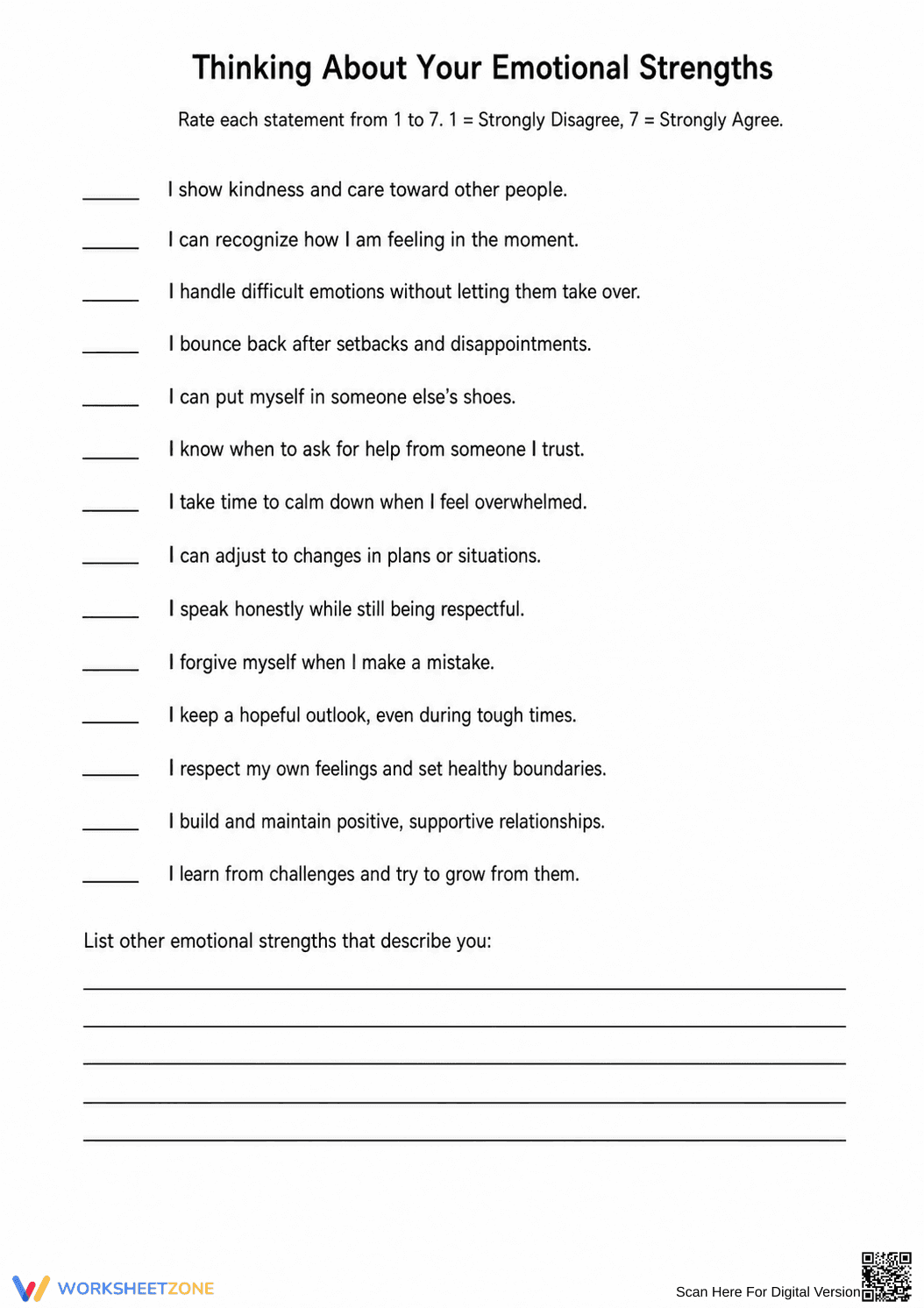
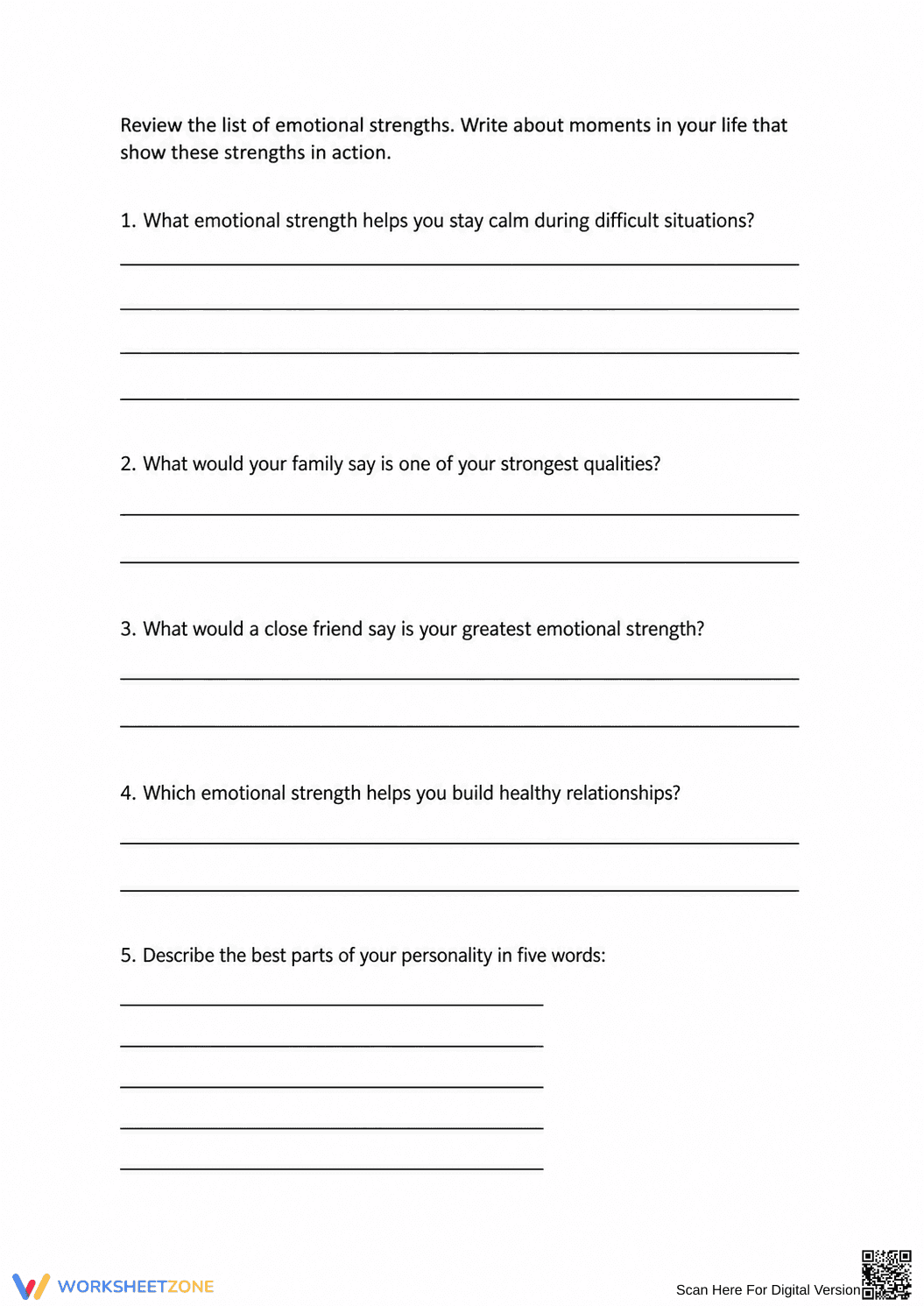
This comprehensive three-page packet features a blend of quantitative self-assessment and qualitative reflection. The first two pages contain 33 Likert-scale statements where students rate their emotional responses from 1 (Strongly Disagree) to 7 (Strongly Agree), plus an open-ended list for additional strengths. The final page provides five short-answer prompts requiring students to describe specific life moments that demonstrate their emotional resilience, relationship-building skills, and core personality traits. Because responses are highly personal, no answer key is required.
Zero-Prep Workflow
- Print (1 minute): Download the PDF and print the three-page packet for each student. No special materials or prior setup are required.
- Distribute (1 minute): Hand out the worksheets at the beginning of an advisory period, counseling session, or homeroom block.
- Review (5 minutes): Briefly explain the 1-to-7 rating scale and encourage honest, thoughtful responses on the short-answer section.
Total teacher prep time is under two minutes. This self-explanatory format makes it an excellent resource for substitute teacher plans or independent study days.
Standards Alignment
This resource aligns with CCSS.ELA-LITERACY.W.11-12.4: Produce clear and coherent writing in which the development, organization, and style are appropriate to task, purpose, and audience. By requiring students to articulate their emotional strengths through written reflection, the worksheet reinforces expressive writing skills. Both standard codes can be copied directly into lesson plans, IEP goals, or district curriculum mapping tools.
How to Use It
This worksheet is highly effective as a standalone activity during social-emotional learning (SEL) blocks or advisory periods. Teachers can assign it before a larger unit on personal narrative writing to help students brainstorm core character traits and personal anecdotes. As a formative assessment observation tip, educators can review the short-answer responses to gauge a student's ability to connect abstract emotional concepts to concrete life experiences. Expected completion time ranges from 20 to 30 minutes.
Who It's For
This resource is designed for high school seniors, college students, and adults focusing on social skills and emotional intelligence. The straightforward rating scale provides built-in scaffolding for learners who may struggle to generate ideas from scratch, while the open-ended questions offer extension opportunities for advanced writers. It pairs perfectly with a direct instruction lesson on growth mindset or personal resilience.
Integrating structured self-reflection into the curriculum significantly impacts student well-being and academic engagement. This resource targets the development of self-awareness and reflection, requiring students to produce clear and coherent writing appropriate to the task as outlined in CCSS.ELA-LITERACY.W.11-12.4. According to a RAND AIRS 2024 report, explicit instruction and guided practice in social-emotional competencies lead to measurable improvements in both classroom climate and individual student resilience. By utilizing a standardized rating scale alongside open-ended narrative prompts, educators provide a balanced approach to emotional literacy. This method not only supports personal growth but also reinforces essential communication skills necessary for post-secondary success. The combination of quantitative self-assessment and qualitative writing ensures that learners actively process their emotional strengths, fostering a more profound understanding of their interpersonal dynamics and self-worth.


