


























Views
Downloads
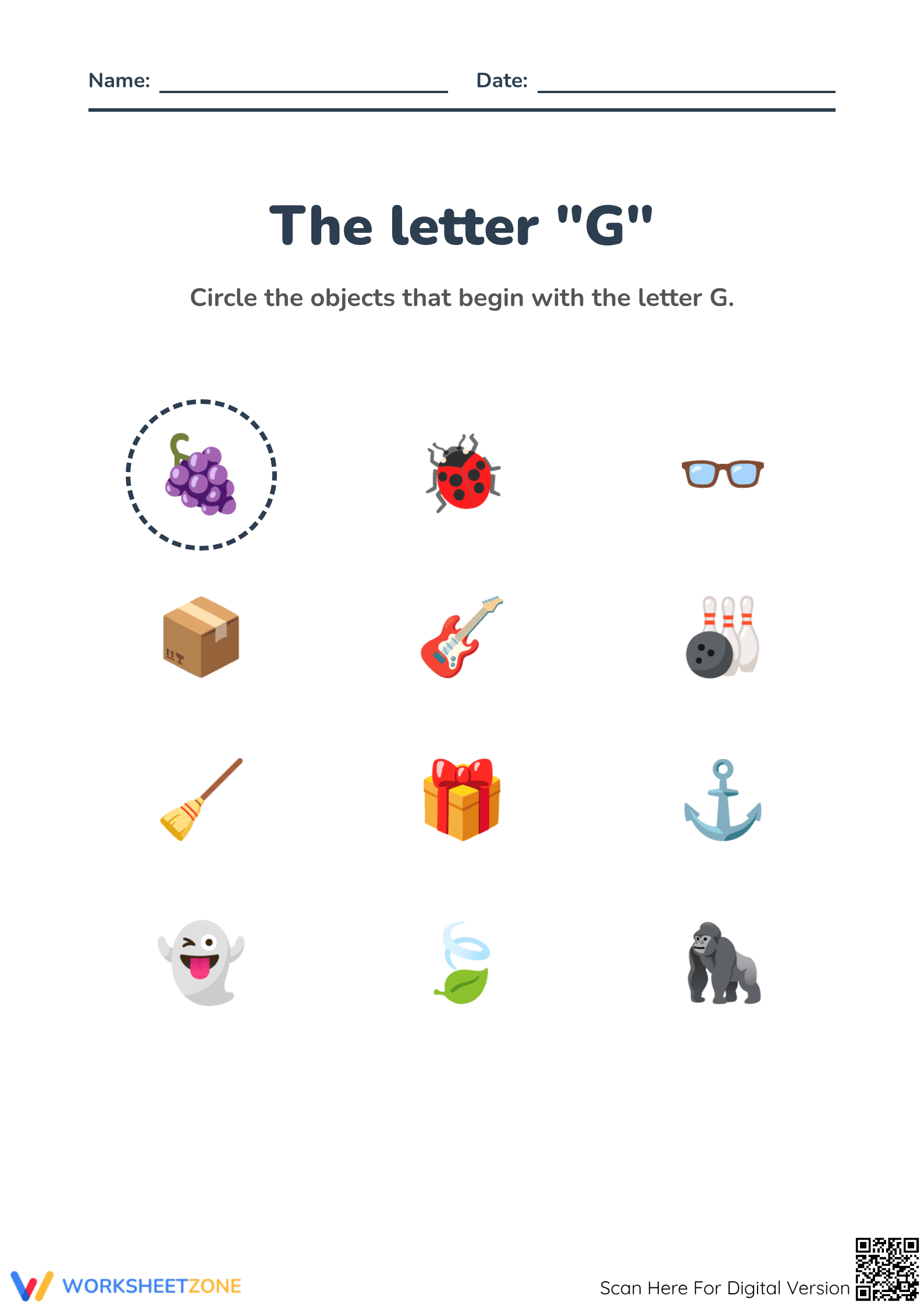

Printable Letter G Beginning Sounds Worksheet | Pre-K
Paste this activity's link or code into your existing LMS (Google Classroom, Canvas, Teams, Schoology, Moodle, etc.).
Students can open and work on the activity right away, with no student login required.
You'll still be able to track student progress and results from your teacher account.
This foundational phonics worksheet helps early learners identify the beginning sound of the letter G. By evaluating a series of familiar images and circling the correct objects, students build essential phonemic awareness and letter-sound correspondence skills. This simple, engaging activity sets the stage for future reading and spelling success.
At a Glance
- Grade: Pre-K · Subject: ELA
- Standard:
CCSS.ELA-LITERACY.RF.K.3.A— Identify primary sounds for consonants- Skill Focus: Beginning Sounds (Letter G)
- Format: 1 page · 12 problems · Answer key included · PDF
- Best For: Independent practice or morning work
- Time: 5–10 minutes
This single-page resource features twelve colorful, easily recognizable illustrations, including items like grapes, a guitar, and a ghost. Students are tasked with looking at each picture, saying the word aloud, and circling only the objects that start with the hard "G" sound. A complete visual answer key is provided to ensure quick and accurate grading for educators or parents.
This worksheet is designed for immediate classroom implementation with absolutely zero teacher setup required.
- Print (1 minute): Simply download the PDF and print a class set. The clear layout requires no special formatting.
- Distribute (1 minute): Hand out the sheets along with crayons or markers. The visual instructions are intuitive for early learners.
- Review (3 minutes): Use the included answer key to quickly check student work or project it on a smartboard for whole-class review.
With a total prep time of under two minutes, this activity is an excellent addition to any emergency sub plan or busy morning routine.
This activity is aligned to primary standard CCSS.ELA-LITERACY.RF.K.3.A: Demonstrate basic knowledge of one-to-one letter-sound correspondences by producing the primary sound or many of the most frequent sounds for each consonant. It also supports early vocabulary development as students name each pictured object. Both standard codes can be copied directly into lesson plans, IEP goals, or district curriculum mapping tools.
Educators can utilize this worksheet during small group literacy centers to reinforce letter of the week concepts. It serves as an excellent follow-up activity after direct instruction on the letter G. Alternatively, it functions well as a quick formative assessment; teachers can observe whether a student struggles to differentiate between the "G" sound and similar consonant sounds while they work independently. Expect students to complete this task within five to ten minutes.
This resource is primarily designed for preschool and kindergarten students developing their foundational phonics skills. It is also highly effective for English Language Learners (ELLs) who benefit from the strong visual supports paired with vocabulary practice. For a comprehensive lesson, pair this worksheet with a read-aloud book that heavily features the letter G or a classroom anchor chart displaying "G" words.
Mastering early phonemic awareness is a critical predictor of future reading proficiency. By practicing with targeted resources like this one, students learn to identify primary sounds for consonants, directly supporting CCSS.ELA-LITERACY.RF.K.3.A. According to Fisher & Frey (2014), providing students with focused, visually supported tasks significantly enhances their ability to isolate and identify initial phonemes. This letter G beginning sounds worksheet offers exactly that type of structured repetition. When early learners consistently practice matching visual representations to their corresponding phonetic sounds, they build the cognitive pathways necessary for decoding words later in their educational journey. This simple yet effective activity ensures that young students receive the evidence-based practice required to solidify their understanding of consonant sounds, setting a strong foundation for comprehensive literacy development.


