


























Views
Downloads
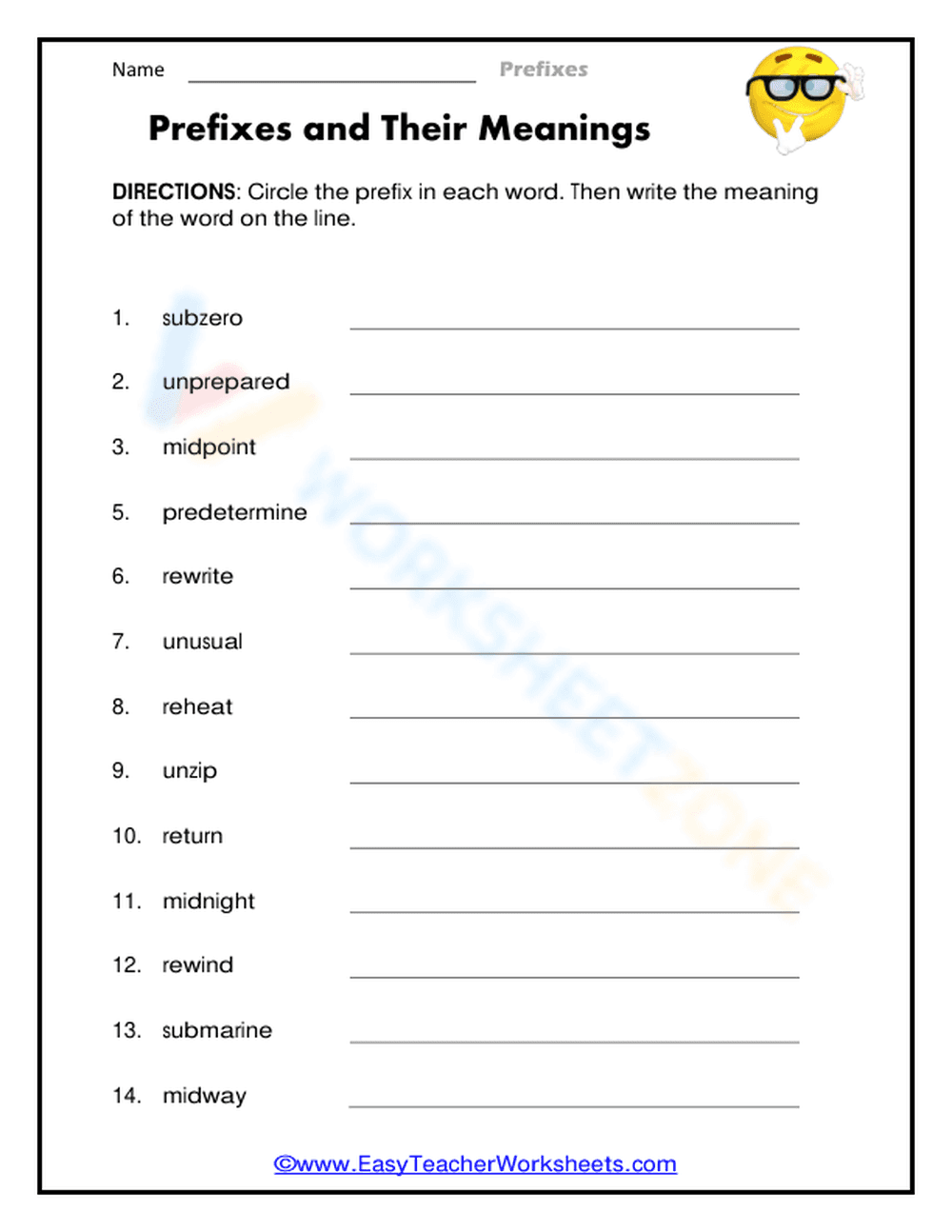

Prefixes and Their Meanings | Essential Grade 3 Worksheet
Paste this activity's link or code into your existing LMS (Google Classroom, Canvas, Teams, Schoology, Moodle, etc.).
Students can open and work on the activity right away, with no student login required.
You'll still be able to track student progress and results from your teacher account.
This Grade 3 prefixes worksheet helps students master word structure by identifying common affixes and defining their roles in context. By circling prefixes and writing definitions for 13 essential vocabulary words, learners build a foundation for decoding complex texts independently. It is an effective tool for improving reading comprehension and language precision.
At a Glance
- Grade: 3 · Subject: English Language Arts
- Standard:
CCSS.ELA-LITERACY.L.3.4.B— Determine the meaning of words formed when a known affix is added- Skill Focus: Prefix Identification and Word Meaning
- Format: 1 page · 13 problems · Answer key included · PDF
- Best For: Independent practice or morning work
- Time: 15–20 minutes
What's Inside
The worksheet features a clean, one-page layout designed for immediate classroom application. It contains 13 specific tasks where students must isolate the prefix from words like "subzero," "unusual," and "rewrite." Beside each word, a writing line is provided for students to record the combined meaning. A clear instruction block guides students through the process, and a full answer key is provided for efficient grading.
Zero-Prep Workflow
The zero-prep workflow for this resource allows teachers to integrate vocabulary practice with minimal effort. Print the single-page PDF, distribute the sheets for a quick morning activity, and review answers using the provided key. Total preparation time is under two minutes, making it ideal for busy school days or emergency sub plans where teacher instruction time is limited.
Standards Alignment
This resource is strictly aligned with CCSS.ELA-LITERACY.L.3.4.B, which requires students to determine the meaning of the new word formed when a known affix is added to a known word. It specifically focuses on common prefixes such as un-, re-, mid-, and sub-. This practice ensures that students can break down multi-syllabic words into their morphological components. Both standard codes can be copied directly into lesson plans, IEP goals, or district curriculum mapping tools.
How to Use It
Use this worksheet as a formative assessment during your word study unit to gauge student understanding of affixes before moving to more complex suffixes. It works well as a quiet-entry task in the morning or as a targeted exit ticket after a direct instruction lesson on word parts. Teachers should observe if students are correctly identifying the "starter portion" versus the root word to provide immediate corrective feedback during the session.
Who It's For
This printable is designed for third-grade students developing their literacy skills, though it remains a valuable review for Grade 4 and a challenging extension for advanced Grade 2 learners. It provides necessary scaffolding for English Language Learners (ELLs) by focusing on high-frequency prefixes. Pair this worksheet with a classroom anchor chart on prefixes or a reading passage that features these specific vocabulary words for a comprehensive lesson.
According to Fisher & Frey (2014), morphological awareness is a primary driver of academic vocabulary growth in the elementary years. This worksheet supports this development by requiring students to deconstruct words into prefixes and roots. Research indicates that students who receive explicit instruction in affixes significantly outperform peers on standardized reading assessments. By practicing with common prefixes like "un-" and "pre-," students gain structural clues needed to navigate unfamiliar text. This Grade 3 resource fulfills the CCSS.ELA-LITERACY.L.3.4.B requirement for determining word meaning through affix analysis. This focused approach ensures that vocabulary instruction remains measurable and aligned with evidence-based literacy standards. National assessments highlight structural analysis as a critical bridge to fluency, making this worksheet an essential component of a standard-aligned ELA curriculum. This data-driven practice provides the repetition necessary for long-term retention of word-building rules across various subjects.


