


























Views
Downloads
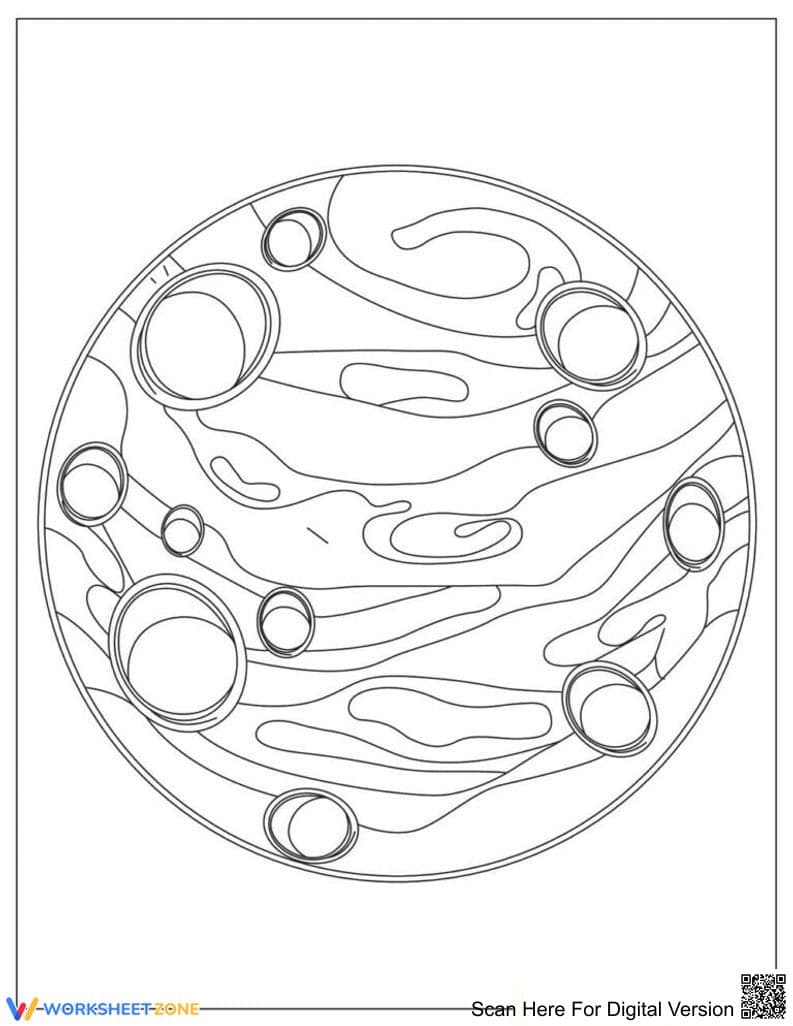

Solar System Planet Coloring Page | Essential Science
Paste this activity's link or code into your existing LMS (Google Classroom, Canvas, Teams, Schoology, Moodle, etc.).
Students can open and work on the activity right away, with no student login required.
You'll still be able to track student progress and results from your teacher account.
This printable solar system coloring page provides a creative way for young learners to engage with space science. By focusing on the textures and craters of a celestial body, students develop fine motor control while visualizing the physical characteristics of planets or moons. It serves as an excellent introductory activity for astronomy units.
At a Glance
At a Glance
- Grade: 1 · Subject: Science
- Standard:
1-ESS1-1— Use observations of the sun, moon, and stars to describe patterns- Skill Focus: Fine motor skills and celestial identification
- Format: 1 page · 1 task · No answer key required · PDF
- Best For: Early finisher activity or science center
- Time: 15–20 minutes
What's Inside
Inside this resource, you will find a high-quality, single-page illustration of a cratered planet or moon. The line art is crisp and clear, designed specifically for crayons, colored pencils, or markers. There are no complex instructions, allowing students to focus entirely on their artistic interpretation of the solar system and its many diverse surfaces.
Zero-Prep Workflow
The zero-prep workflow for this worksheet is designed for maximum efficiency in busy classrooms. First, print the single PDF page (30 seconds). Second, distribute the sheets to students along with coloring supplies (1 minute). Finally, review the student work by having them describe the surface they created (30 seconds). Total teacher preparation time is under two minutes, making it a perfect sub plan.
Standards Alignment
This worksheet aligns with `1-ESS1-1`, which requires students to use observations of objects in the sky to describe patterns that can be predicted. While primarily an artistic tool, it supports the observational component of the standard by highlighting surface features like craters and ridges. Both standard codes can be copied directly into lesson plans, IEP goals, or district curriculum mapping tools.
How to Use It
Use this worksheet as a hook at the beginning of a lesson about the Moon or Mercury to pique student interest. Alternatively, it works well as a formative assessment tool; ask students to use specific colors to represent different geological features they have learned about in class. Expected completion time for most primary students is approximately 15 to 20 minutes.
Who It's For
This resource is ideal for Kindergarten through Grade 2 students who are developing their grip and pressure control. It is particularly effective for kinesthetic learners who benefit from tactile engagement with science topics. Pair this with a short informational text about the solar system or an anchor chart showing the planets to provide a natural instructional pairing.
According to the RAND AIRS 2024 report, integrating creative arts into core science instruction significantly increases engagement levels among early elementary students. This solar system coloring page addresses the 1-ESS1-1 standard by encouraging students to observe and represent the physical characteristics of celestial bodies. Research by Fisher & Frey (2014) suggests that visual representation tasks serve as a vital bridge between abstract scientific concepts and concrete understanding. By providing a structured yet open-ended canvas, this worksheet allows educators to assess a student's ability to recognize patterns in space while simultaneously strengthening the fine motor skills necessary for writing. The 1-page format ensures that the cognitive load remains focused on the subject matter rather than complex navigation. This resource is a reliable addition to any primary science curriculum, offering a research-backed method for reinforcing astronomical vocabulary and observational skills in a classroom setting.


