


























Views
Plays

The Reformation Printable Worksheet | Grade 7 History
Paste this activity's link or code into your existing LMS (Google Classroom, Canvas, Teams, Schoology, Moodle, etc.).
Students can open and work on the activity right away, with no student login required.
You'll still be able to track student progress and results from your teacher account.
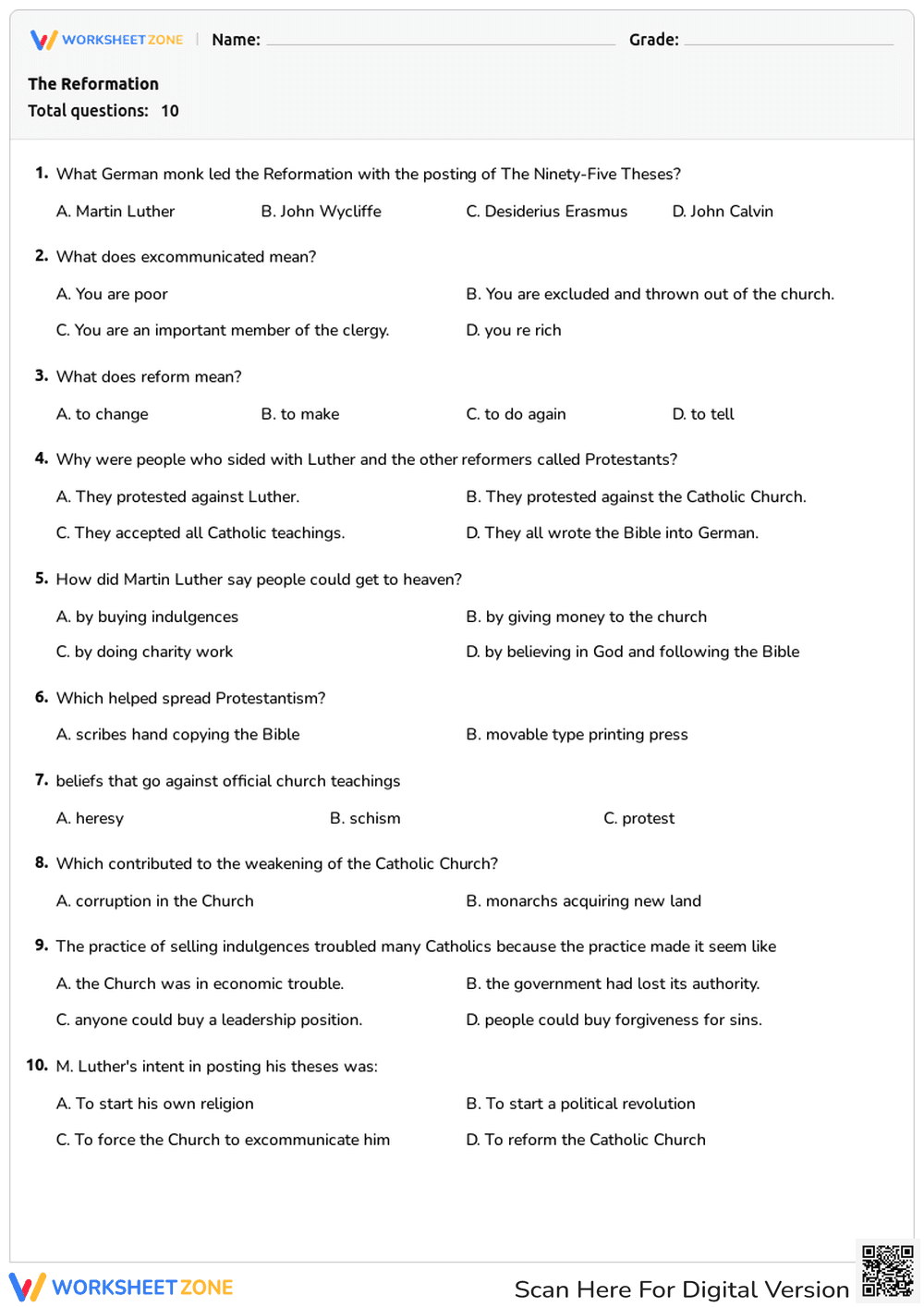
This middle school history worksheet provides a focused review of the Protestant Reformation, helping students solidify their understanding of key historical figures and vocabulary. By answering targeted questions about Martin Luther, the Catholic Church, and the printing press, learners demonstrate their grasp of this pivotal era.
At a Glance
- Grade: 7 · Subject: History
- Standard:
CCSS.ELA-LITERACY.RH.6-8.4— Determine the meaning of historical vocabulary words.- Skill Focus: The Protestant Reformation
- Format: 1 page · 10 problems · Answer key included · PDF
- Best For: Quick assessment or review
- Time: 10–15 minutes
Inside this resource, educators will find a single-page, ten-question multiple-choice quiz designed for straightforward assessment. The questions cover essential historical concepts, including the definition of terms like excommunication and heresy, the impact of the movable type printing press, and the motivations behind Martin Luther's Ninety-Five Theses. A complete answer key is provided to ensure grading is fast and objective.
This resource is built for a highly efficient, zero-prep workflow.
- Print (1 minute): The single-page layout means you can run off a class set in moments without worrying about stapling or double-sided alignment.
- Distribute (1 minute): Hand out the assessment as a quick warm-up, exit ticket, or independent practice activity.
- Review (3 minutes): Use the included answer key to grade the quizzes rapidly, or have students swap papers for peer grading.
Total teacher preparation time is under two minutes, making this an excellent option for emergency sub plans or last-minute lesson additions.
This worksheet is aligned to primary standard CCSS.ELA-LITERACY.RH.6-8.4, requiring students to determine the meaning of words and phrases as they are used in a text, including vocabulary specific to domains related to history/social studies. By testing terms like "reform" and "Protestant," the activity reinforces critical disciplinary literacy. Both standard codes can be copied directly into lesson plans, IEP goals, or district curriculum mapping tools.
Teachers can deploy this worksheet effectively during the middle or end of a unit on the Renaissance and Reformation. As a formative assessment, assign it immediately following direct instruction on Martin Luther to gauge initial comprehension. While students work, circulate the room and observe which vocabulary terms—such as "indulgences" or "heresy"—cause hesitation, indicating a need for reteaching. The entire activity should take students between 10 and 15 minutes to complete.
This resource is primarily designed for sixth through eighth-grade history students studying early modern Europe. The straightforward multiple-choice format provides built-in scaffolding for learners who benefit from clear, distinct options rather than open-ended writing tasks. It pairs perfectly with a primary source reading of the Ninety-Five Theses or a direct instruction lesson on the causes of the Protestant Reformation.
Integrating targeted vocabulary and factual recall activities is a fundamental component of building historical literacy in middle school classrooms. According to a recent RAND AIRS 2024 report, students who regularly engage with domain-specific vocabulary assessments demonstrate significantly higher retention of complex historical concepts compared to those who only participate in broad thematic discussions. This worksheet directly supports that evidence-based practice by aligning with CCSS.ELA-LITERACY.RH.6-8.4, challenging students to determine the meaning of historical vocabulary words in context. By isolating key terms and historical figures associated with the Protestant Reformation, educators can accurately measure foundational knowledge before moving on to higher-order analytical tasks. Consistent use of these focused, low-stakes assessments ensures that all learners develop the necessary academic language to participate fully in rigorous historical inquiry and debate.


