


























Views
Downloads




Essential Properties of Water Worksheet | Grade 6-12
Paste this activity's link or code into your existing LMS (Google Classroom, Canvas, Teams, Schoology, Moodle, etc.).
Students can open and work on the activity right away, with no student login required.
You'll still be able to track student progress and results from your teacher account.
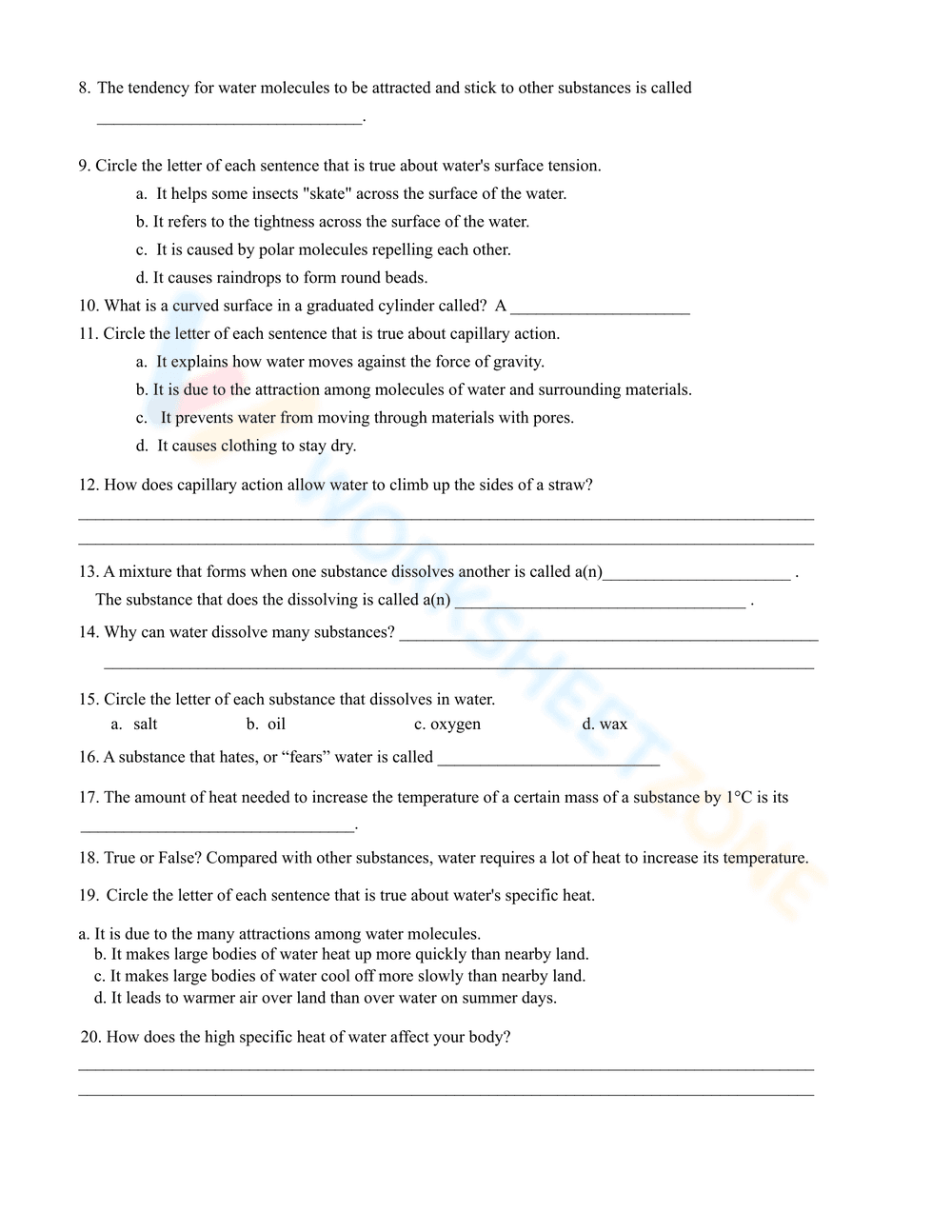
This comprehensive science worksheet provides a deep exploration of the unique chemical and physical characteristics of H2O. Students engage with a detailed reading passage before applying their knowledge through vocabulary synthesis, multiple-choice analysis, and matching exercises. It ensures students understand why water is essential for life and physical processes.
At a Glance
- Grade: 6-12 · Subject: Science
- Standard:
MS-PS1-1— Develop models to describe the atomic composition of simple molecules and extended structures- Skill Focus: Molecular polarity and hydrogen bonding
- Format: 4 pages · 34 problems · Answer key included · PDF
- Best For: Independent study or emergency sub plans
- Time: 45–60 minutes
The resource contains a one-page informational text covering polarity, cohesion, adhesion, capillary action, surface tension, and specific heat. Following the text, students complete 7 key term definitions, 20 mixed-format questions (multiple choice and short answer), and a final 7-item matching review to solidify conceptual mastery.
This worksheet is designed for a zero-prep classroom workflow. Teachers can print the four-page packet in under 1 minute. Distribution takes seconds, and because the reading passage is included, no external textbooks are required. Reviewing the 34 tasks is streamlined by the structured layout, allowing for a full lesson cycle with zero teacher setup. It is an ideal resource for days when a substitute teacher is present.
Aligned to MS-PS1-1, this resource focuses on how the structure of a water molecule leads to its unique properties. It also supports HS-PS1-3 by requiring students to communicate how the chemical and physical properties of water are determined by the strength of electrical forces between particles. Both standard codes can be copied directly into lesson plans, IEP goals, or district curriculum mapping tools.
Use this as a primary instructional tool during a unit on matter or Earth's systems. It works exceptionally well as a formative assessment after an initial lecture on molecular bonding. Teachers should observe student responses to the specific heat questions to gauge understanding of thermal energy transfer. Expected completion typically takes 50 minutes for most middle school learners.
This packet is ideal for middle and high school students in General Science, Biology, or Chemistry. The clear headings and bolded vocabulary provide necessary support for English Language Learners and students with IEPs. It pairs naturally with a laboratory investigation on surface tension or a drops on a penny demonstration to provide theoretical context to hands-on data.
According to the RAND AIRS 2024 analysis of secondary science curriculum, high-quality informational texts paired with multi-modal assessment tasks significantly improve student retention of abstract chemical concepts like polarity. This worksheet addresses the MS-PS1-1 standard by bridging the gap between molecular structure and observable physical phenomena. By requiring students to define, identify, and match properties such as capillary action and specific heat, the resource facilitates the cognitive scaffolding necessary for long-term mastery. Research from Fisher & Frey (2014) emphasizes that reading to learn in the science classroom is most effective when students are prompted to immediately apply textual evidence to problem-solving tasks. This 4-page resource provides exactly that structure, ensuring that the 34 included tasks move students from basic recall to a functional understanding of how water's hydrogen bonds influence global ecosystems and biological life.


