


























Views
Downloads



Grade 9 Properties of Water — Printable No-Prep Worksheet
Paste this activity's link or code into your existing LMS (Google Classroom, Canvas, Teams, Schoology, Moodle, etc.).
Students can open and work on the activity right away, with no student login required.
You'll still be able to track student progress and results from your teacher account.
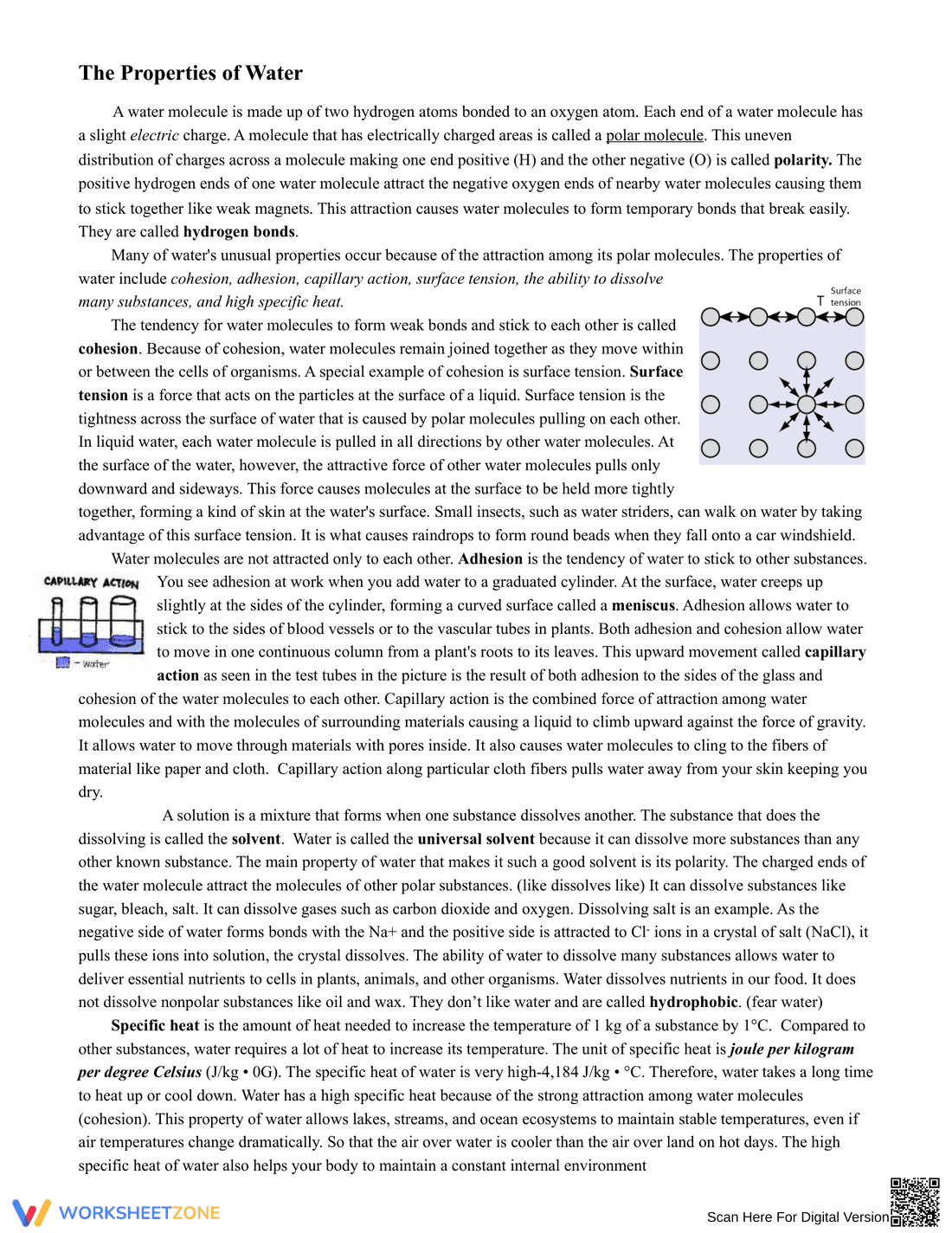
This comprehensive worksheet introduces students to the unique properties of water and tests their reading comprehension. By reading a detailed informational text and answering targeted questions, students will master concepts like polarity, cohesion, adhesion, and specific heat without needing prior direct instruction.
At a Glance
- Grade: 9 · Subject: Science
- Standard:
HS-ESS2-5— Understand the properties of water and its effects- Skill Focus: Properties of Water
- Format: 4 pages · 34 problems · PDF
- Best For: Independent practice or sub plans
- Time: 30–45 minutes
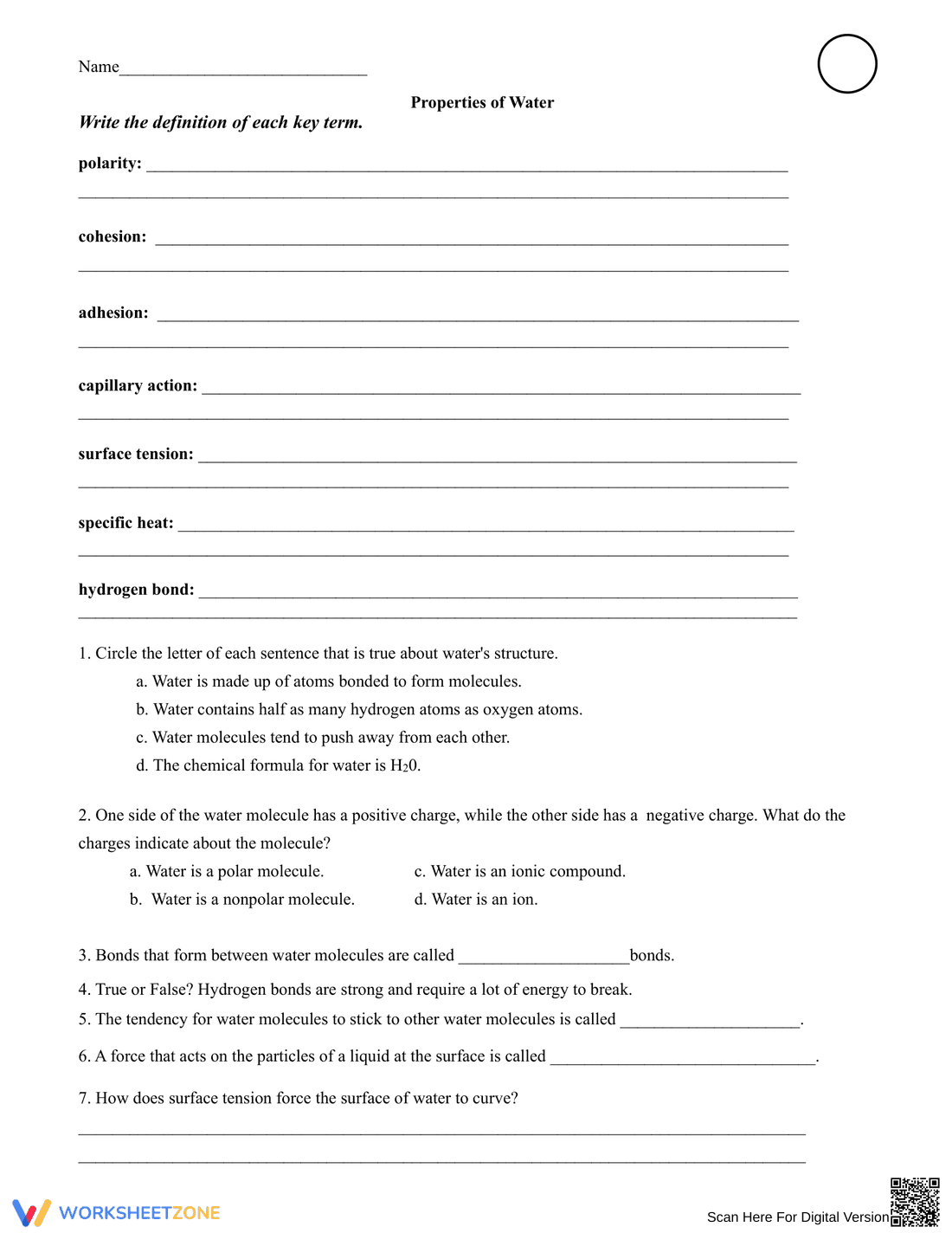
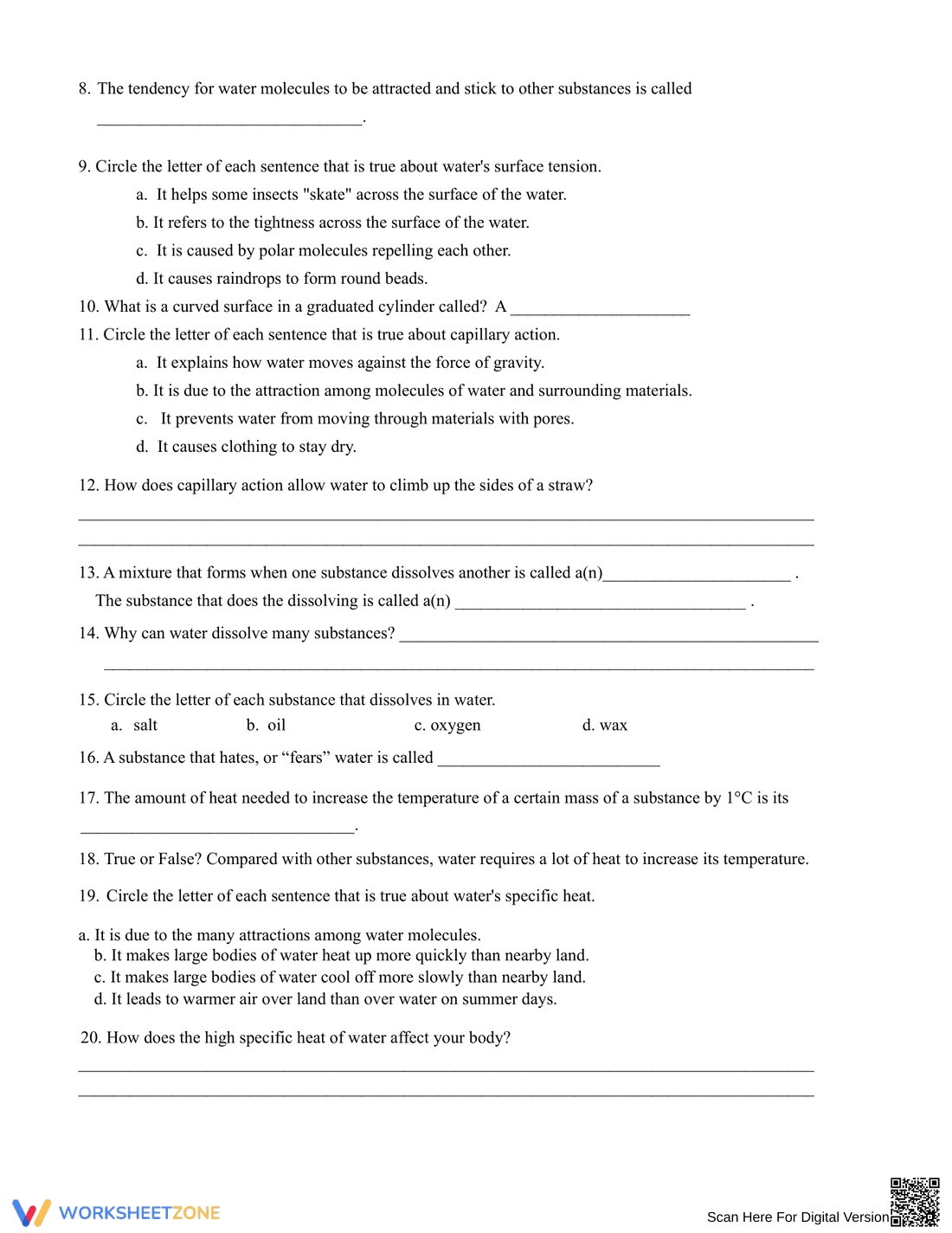
This resource features a full-page reading passage explaining the chemical and physical properties of water, followed by three pages of assessment. The 34 tasks include writing key term definitions, multiple-choice questions, short-answer explanations, and a matching review section. The built-in text ensures students have all the information required to complete the assignment successfully.
- Print (1 minute): Simply print the four-page PDF packet for each student. No additional materials are required.
- Distribute (1 minute): Hand out the packets at the start of class or leave them in your substitute folder.
- Review (5 minutes): Go over the matching and multiple-choice sections together to check for understanding.
With under two minutes of total teacher prep time, this self-contained lesson is highly suitable for emergency sub plans or quiet independent work days.
This material aligns with HS-ESS2-5, focusing on how the properties of water (such as high specific heat and polarity) affect Earth's materials and surface processes. It also supports general science literacy by requiring students to extract evidence from an informational text. Both standard codes can be copied directly into lesson plans, IEP goals, or district curriculum mapping tools.
Deploy this packet before a lab on surface tension or capillary action to provide essential background knowledge. Alternatively, use it during direct instruction as a guided reading activity where students highlight key terms. As a formative assessment tip, review students' short-answer responses to question 20 to gauge their understanding of how specific heat applies to biological systems. Expect completion to take 30 to 45 minutes.
This resource is designed for high school biology, chemistry, or earth science students. The embedded reading passage provides natural differentiation for students who need to reference text frequently while answering questions. It pairs perfectly with a hands-on water drops on a penny lab or a direct instruction lesson on molecular bonds.
Aligning instruction with HS-ESS2-5 to help students understand the properties of water and its effects is a fundamental component of high school science curricula. According to a ScienceDirect TpT Analysis, providing students with integrated reading and question sets significantly improves their ability to retain complex scientific vocabulary, such as cohesion, adhesion, and capillary action. By combining a detailed informational text directly with 34 targeted application questions, this worksheet reduces cognitive load and allows learners to immediately apply new concepts in context. This method of immediate reinforcement ensures that abstract ideas like hydrogen bonding and polarity become concrete and understandable. Educators can rely on this structured, self-contained approach to build a strong foundation for advanced topics in biology and earth science, ensuring students are fully prepared for rigorous scientific inquiry and subsequent laboratory investigations.


