


























Views
Plays
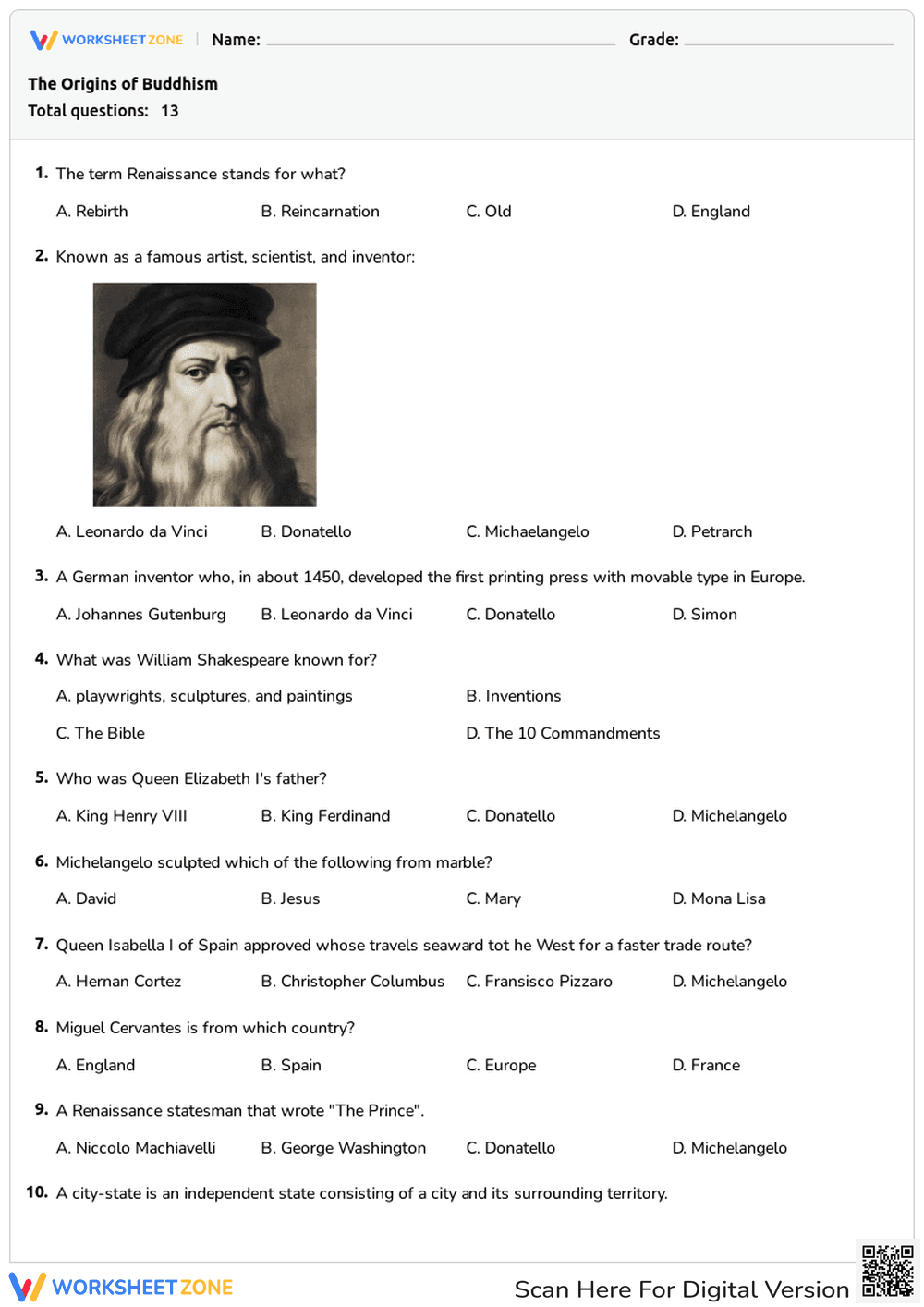
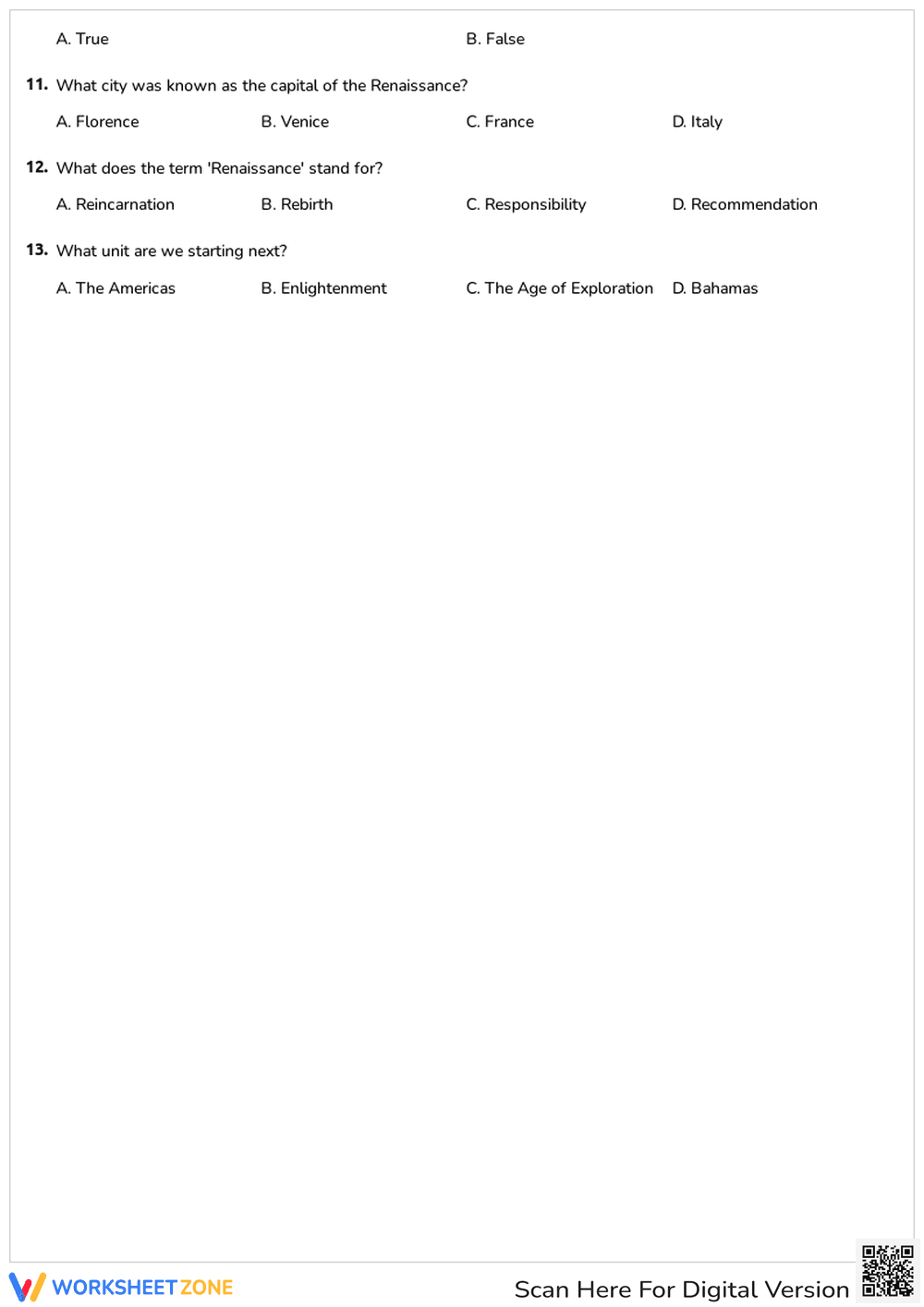

Printable Renaissance History Quiz | Grade 6-8
Paste this activity's link or code into your existing LMS (Google Classroom, Canvas, Teams, Schoology, Moodle, etc.).
Students can open and work on the activity right away, with no student login required.
You'll still be able to track student progress and results from your teacher account.
This Grade 6-8 social studies worksheet provides students with a focused assessment on key figures and concepts of the Renaissance. By completing these targeted multiple-choice questions, learners demonstrate their understanding of historical vocabulary, significant inventors, and influential artists from this pivotal era in world history.
At a Glance
- Grade: 6-8 · Subject: Social Studies
- Standard:
CCSS.ELA-LITERACY.RH.6-8.4— Determine the meaning of historical words and phrases- Skill Focus: Renaissance History & Key Figures
- Format: 2 pages · 13 problems · Answer key included · PDF
- Best For: End-of-unit assessment or review
- Time: 15–20 minutes
This resource features a straightforward, two-page assessment containing 13 multiple-choice questions. The task types require students to recall specific historical facts, identify major Renaissance figures like Leonardo da Vinci and Johannes Gutenberg, and define essential era-specific terminology. A complete answer key is provided to ensure accurate and efficient grading for educators.
Designed for immediate classroom implementation, this assessment requires minimal teacher preparation.
- Print (1 minute): Generate copies of the two-page PDF for each student.
- Distribute (1 minute): Hand out the assessment after completing your Renaissance unit.
- Review (3 minutes): Use the included answer key to quickly grade submissions or conduct a whole-class review.
Total teacher prep time is under two minutes, making this an excellent option for a reliable substitute teacher plan or a quick formative check.
This worksheet aligns with CCSS.ELA-LITERACY.RH.6-8.4, requiring students to determine the meaning of words and phrases as they are used in a text, including vocabulary specific to domains related to history/social studies. It also supports general historical knowledge retention regarding the European Renaissance. Both standard codes can be copied directly into lesson plans, IEP goals, or district curriculum mapping tools.
Teachers can deploy this quiz as a formal summative assessment after direct instruction on the Renaissance period. Alternatively, it serves well as an independent review activity before a larger unit exam. While students work, educators can observe which specific historical figures or concepts require reteaching based on the multiple-choice responses. Expected completion time ranges from 15 to 20 minutes.
This resource is primarily designed for middle school social studies students in grades 6 through 8. The clear, multiple-choice format provides built-in scaffolding for learners who benefit from structured options rather than open-ended writing tasks. It pairs perfectly with introductory reading passages about the Renaissance or a direct instruction lesson on European history.
Assessing historical knowledge through structured recall tasks plays a vital role in reinforcing foundational social studies concepts. According to a recent ScienceDirect TpT Analysis, providing students with clear, multiple-choice formats helps isolate specific gaps in content retention without the added cognitive load of extensive writing. This approach directly supports CCSS.ELA-LITERACY.RH.6-8.4, as students must determine the meaning of historical words and phrases within a specific context. When learners repeatedly engage with key terminology and significant figures from eras like the Renaissance, their overall historical literacy improves. Regular formative assessments allow educators to adjust instruction dynamically, ensuring that core concepts are firmly established before moving on to subsequent historical periods. By utilizing targeted quizzes, teachers can efficiently measure comprehension and build a stronger framework for advanced historical analysis in later grades.


