




























Views
Downloads
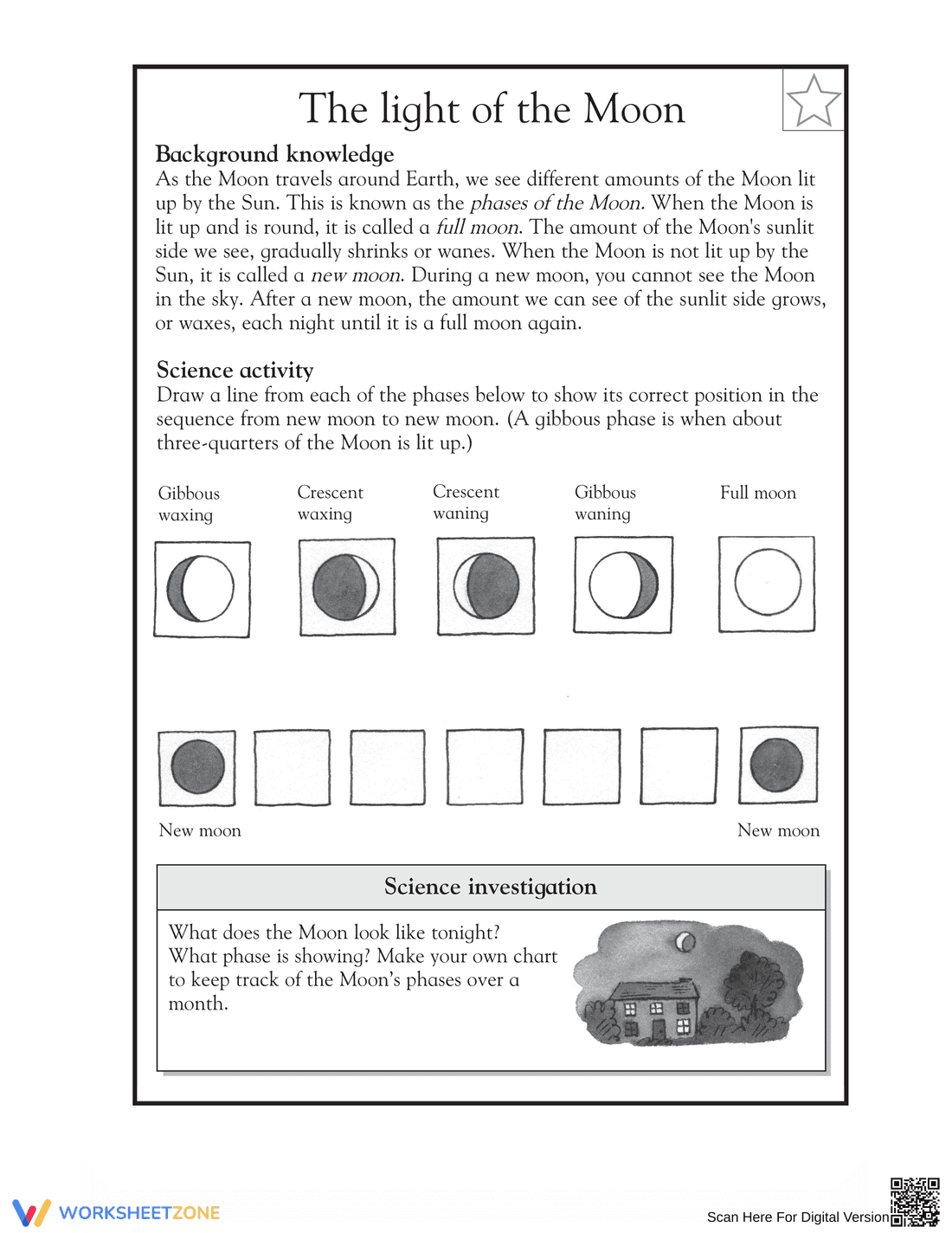


Phases of the Moon Essential Science Worksheet | Grade 3

Paste this activity's link or code into your existing LMS (Google Classroom, Canvas, Teams, Schoology, Moodle, etc.).
Students can open and work on the activity right away, with no student login required.
You'll still be able to track student progress and results from your teacher account.
This worksheet helps third-graders master the predictable patterns of the lunar cycle by identifying and sequencing the phases of the Moon. Students transition from reading background concepts like waxing and waning to applying that knowledge in a structured diagram. By the end of this activity, learners will accurately visualize how the Moon's appearance changes over time.
At a Glance
- Grade: 3 · Subject: Science
- Standard:
3-ESS1-1— Represent data to describe predictable patterns of the Moon and stars- Skill Focus: Lunar cycle and phases of the Moon
- Format: 1 page · 6 tasks · Answer key included · PDF
- Best For: Individual practice or introductory science lesson
- Time: 15–20 minutes
What's Inside
This single-page science resource features a background knowledge section that defines key terms like waxing, waning, full moon, and new moon. The primary activity requires students to draw lines matching five specific moon phases—Gibbous waxing, Crescent waxing, Crescent waning, Gibbous waning, and Full moon—to their correct chronological positions in a sequence. A science investigation extension encourages students to start a monthly observation log.
Zero-Prep Workflow
- Step 1 (Print): Print the single-page PDF for your whole class or small group (30 seconds).
- Step 2 (Distribute): Hand out the worksheet as a self-contained follow-up to a lesson on space (1 minute).
- Step 3 (Review): Use the provided answer key to review responses or allow students to self-correct their sequence (2 minutes).
The total teacher preparation time is under two minutes, making it an ideal choice for substitute folders or quick formative assessments.
Standards Alignment
This activity aligns with 3-ESS1-1, which requires students to represent data in tables and graphical displays to describe typical objects in the sky that can be predicted. By sequencing the phases of the Moon, students demonstrate their understanding of these repeating patterns. Both standard codes can be copied directly into lesson plans, IEP goals, or district curriculum mapping tools.
How to Use It
Use this worksheet as a formative assessment after a direct instruction session on the Earth-Moon-Sun system. Ask students to identify if the Moon is growing or shrinking as it moves toward the full moon phase. A great observation tip is to have students check the current moon phase tonight to ground the abstract concepts in real-world experience. Expect completion within 20 minutes.
Who It's For
This resource is designed for Grade 3 science students, but it also serves as a valuable review for older learners or an enrichment activity for Grade 2. It pairs naturally with a classroom anchor chart showing the lunar cycle or a short informational text about the Moon's orbit. It is particularly effective for visual learners who benefit from seeing shadow patterns.
The instruction of lunar patterns in elementary science is a cornerstone of developing spatial reasoning and observational skills. According to research analyzed in the NAEP framework, engaging students in graphical representations of astronomical phenomena significantly improves their ability to identify predictable natural cycles. This Grade 3 science worksheet focuses on the 3-ESS1-1 standard, guiding students through the identification of the Moon's phases from new moon to full moon. By mastering the terminology of waxing and waning, students build a foundation for more complex celestial mechanics in middle school. Practical activities that combine informational reading with visual mapping, such as this 6-task sequence, are supported by EdReports 2024 as effective methods for reinforcing standard-aligned science concepts. This self-contained resource ensures that students not only memorize names but also understand the logical progression of the lunar month through active participation and observation.


