


























Views
Downloads

Printable Nervous System Worksheet | Grade 5-6 Science
Paste this activity's link or code into your existing LMS (Google Classroom, Canvas, Teams, Schoology, Moodle, etc.).
Students can open and work on the activity right away, with no student login required.
You'll still be able to track student progress and results from your teacher account.
This comprehensive nervous system resource helps students master the complexities of the human body's messaging network. By integrating informational text with visual identification, learners develop a concrete understanding of how the brain and spinal cord coordinate responses. It simplifies abstract biological concepts into manageable, engaging tasks for upper elementary and middle school science classrooms.
At a Glance
- Grade: 5-7 · Subject: Science
- Standard:
MS-LS1-3— Explain how the body is a system of interacting subsystems composed of cells- Skill Focus: Reading comprehension and anatomical labeling
- Format: 2 pages · 4 labeling tasks · Answer key included · PDF
- Best For: Introductory body system lessons
- Time: 20–30 minutes
What's Inside
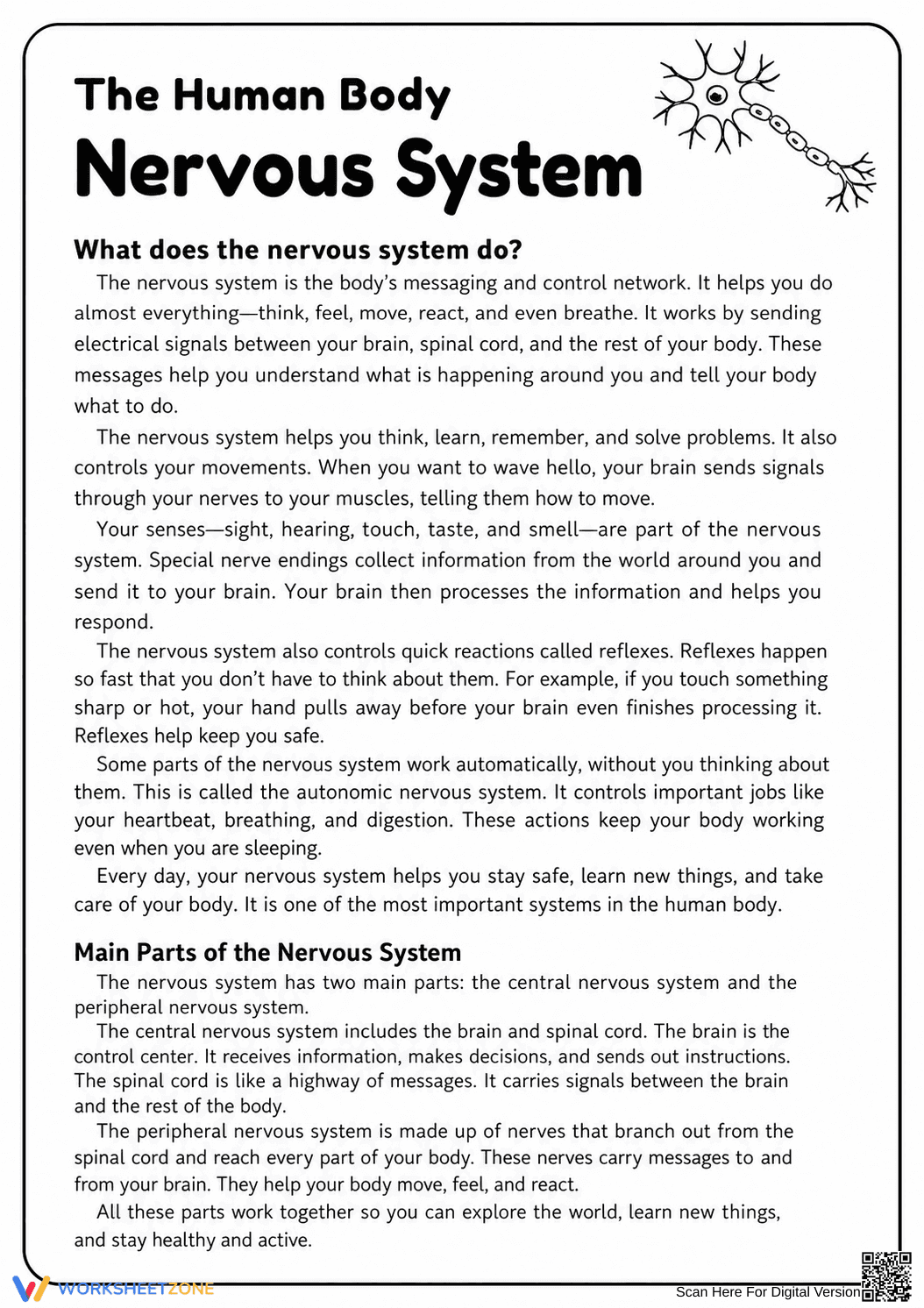
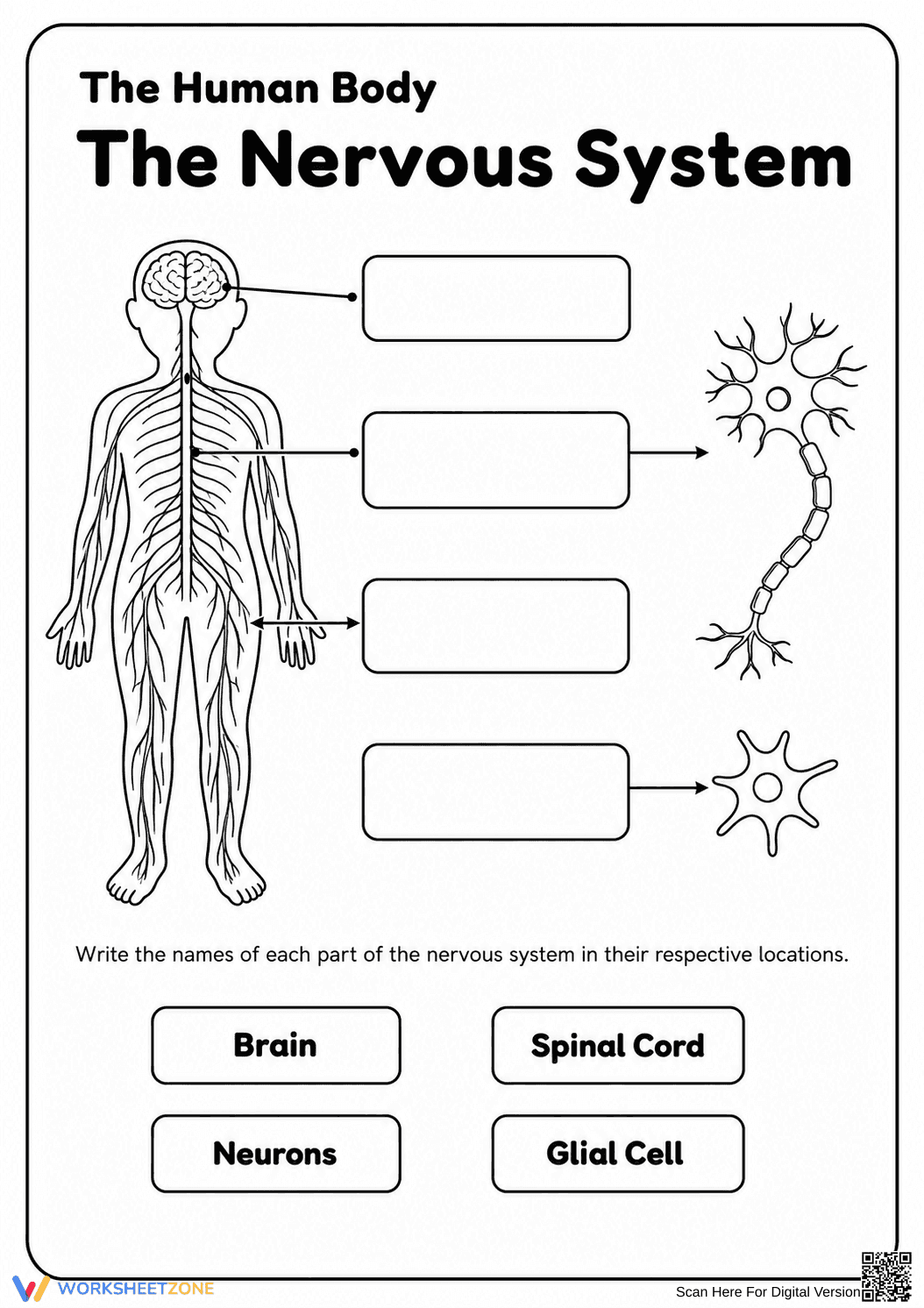
The set includes two pages designed for a cohesive learning experience. The first page provides a high-quality informational text covering the central and peripheral nervous systems, autonomic functions, and reflexes. The second page features a clear anatomical diagram of the human body and specialized cells. Students use a provided word bank to label the brain, spinal cord, neurons, and glial cells, reinforcing the vocabulary introduced in the reading.
Zero-Prep Workflow
- Print: Select the two-page PDF and print enough copies for your class in under 1 minute.
- Distribute: Hand out the reading passage first for a 10-minute silent read or group discussion.
- Review: Use the labeling page as a 5-minute formative assessment to check for anatomical recognition.
Total teacher preparation time is under two minutes, making this an ideal solution for busy mornings or substitute teacher days.
Standards Alignment
This worksheet is primarily aligned with MS-LS1-3, which requires students to provide evidence that the body is a system of interacting subsystems. By identifying the brain and spinal cord as the "control center" and "highway," students visualize the hierarchical organization of the nervous system. It also supports CCSS.ELA-LITERACY.RI.5.1 by requiring students to quote accurately from the text when explaining what the system does. Both standard codes can be copied directly into lesson plans, IEP goals, or curriculum mapping tools.
How to Use It
Use this resource during the "Explain" phase of a 5E instructional model. After students have explored basic body functions, provide the reading passage to formalize their vocabulary. It also serves as an excellent formative assessment tool; observe students as they map the word bank to the diagram to identify any misconceptions about the location of the spinal cord or the structure of a neuron. Completion typically takes 25 minutes.
Who It's For
This resource is tailored for Grade 5 through Grade 7 students, particularly those in general education or inclusive science classrooms. The clear font and structured layout support English Language Learners (ELLs) and students with processing needs. It pairs naturally with a 3D torso model or an interactive digital simulation of neural pathways to provide a multi-sensory learning experience.
The integration of literacy and science through this MS-LS1-3 aligned worksheet reflects the "Reading to Learn" framework essential for middle-grade success. Using informational texts paired with visual graphic organizers—such as the labeling diagram provided here—significantly improves the retention of complex biological terminology. By requiring students to first process the "messaging and control network" through text and then apply that knowledge to a physical map of the human body, the worksheet facilitates the transition from surface-level recognition to deeper conceptual understanding. High-quality, zero-prep materials allow educators to focus on instructional delivery rather than administrative setup, which is critical in science environments. This resource ensures that the 4 key anatomical components of the nervous system are mastered through a structured, evidence-based pedagogical approach.


