


























Views
Downloads



Printable History of Christmas Worksheet | Grade 1 ELA
Paste this activity's link or code into your existing LMS (Google Classroom, Canvas, Teams, Schoology, Moodle, etc.).
Students can open and work on the activity right away, with no student login required.
You'll still be able to track student progress and results from your teacher account.
This Grade 1 The History of Christmas worksheet provides a structured approach for students to explore the historical origins of the holiday while building essential literacy skills. By engaging with an informational text, students learn to identify key details about ancient traditions, from Scandinavia to Rome. This resource ensures that young learners achieve meaningful comprehension outcomes through guided reading.
At a Glance
- Grade: 1 · Subject: English Language Arts (ELA)
- Standard:
CCSS.ELA-LITERACY.RI.1.1— Ask and answer questions about key details in a text to demonstrate understanding.- Skill Focus: Historical reading comprehension and vocabulary
- Format: 3 pages · 9 problems · Answer key included · PDF
- Best For: Seasonal literacy centers and holiday lessons
- Time: 25–35 minutes
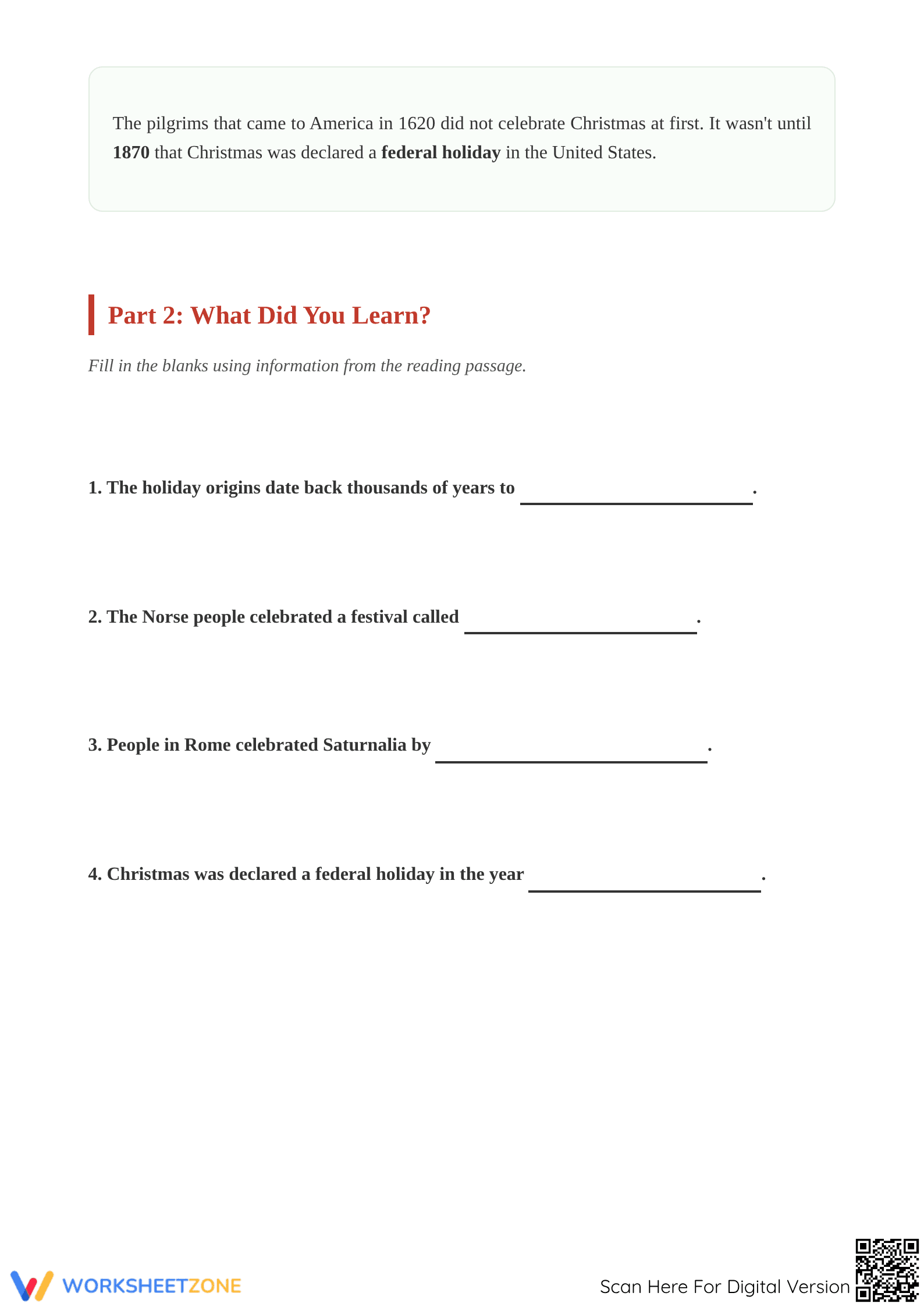
Inside this 3-page printable set, you will find a multi-paragraph reading passage that introduces concepts like Yule and Saturnalia in kid-friendly language. The activities follow the text closely, featuring 4 evidence-based fill-in-the-blank questions and 4 vocabulary matching tasks. A "Creative Corner" allows students to illustrate a fir tree branch, connecting visual arts with the reading material. A full answer key is provided for teacher reference.
This resource is designed for a seamless classroom experience. First, print the 3-page PDF (less than 1 minute). Next, distribute the packets to your Grade 1 students for independent or small-group work (under 2 minutes setup). Finally, review the answers using the provided key to assess student mastery. This zero-prep workflow makes it an ideal choice for busy teachers or sudden substitute teacher plans during the hectic holiday season.
The primary focus of this worksheet is CCSS.ELA-LITERACY.RI.1.1: "Ask and answer questions about key details in a text." It also supports CCSS.ELA-LITERACY.RI.1.4 by requiring students to match domain-specific words like "solstice" and "federal" to their meanings. Both standard codes can be copied directly into lesson plans, IEP goals, or district curriculum mapping tools to ensure instructional accountability and alignment.
Use this worksheet during your December literacy block as a direct application of informational text strategies. It serves as an excellent formative assessment tool after a group read-aloud; observe how students navigate back to the text to find specific dates or names. Students typically complete the reading and comprehension tasks within 30 minutes, making it a perfect fit for a structured rotation or a quiet morning work activity.
This packet is built for first-grade students who are developing their fluency and ability to cite text evidence. It is particularly helpful for early readers who benefit from bolded keywords within the passage to scaffold their comprehension. Pair this resource with an anchor chart about "Text Evidence" or a short video about winter traditions to provide a comprehensive, multi-modal learning experience for all students.
According to the research in Fisher & Frey (2014) regarding the gradual release of responsibility, providing young students with structured informational texts and corresponding evidence-based questions is critical for long-term reading success. This worksheet targets the CCSS.ELA-LITERACY.RI.1.1 standard by requiring students to extract and apply specific facts about the history of Christmas. By engaging with 9 distinct tasks, including vocabulary acquisition and reading for detail, students build a foundation for analyzing more complex non-fiction in later grades. The inclusion of Tier 2 and Tier 3 vocabulary words such as "federal" and "solstice" aligns with current best practices for academic language development. This resource provides the necessary scaffolding to move learners from literal understanding to inferential thinking, ensuring they meet grade-level expectations for informational text analysis. Educational data from RAND AIRS 2024 emphasizes that high-quality, printable materials remain essential for developing fine motor skills and reading focus in early elementary classrooms.


