


























Views
Downloads

Hero's Journey Worksheet | Essential Grade 9-12 Guide
Paste this activity's link or code into your existing LMS (Google Classroom, Canvas, Teams, Schoology, Moodle, etc.).
Students can open and work on the activity right away, with no student login required.
You'll still be able to track student progress and results from your teacher account.
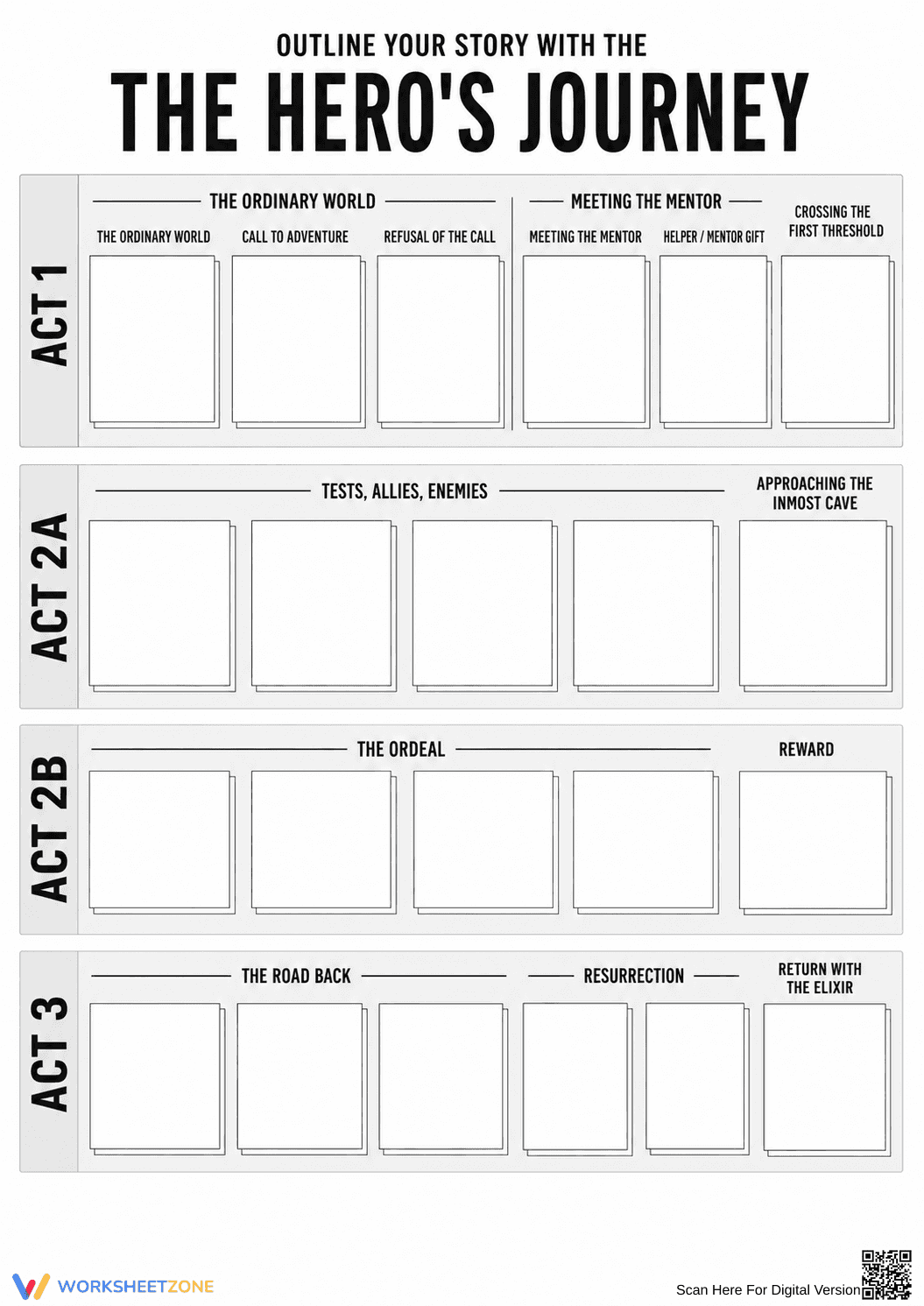
This Grade 9-12 Hero's Journey worksheet empowers students to architect complex narratives by mapping plot points across seventeen distinct stages. By utilizing this structured graphic organizer, writers transform abstract ideas into a cohesive three-act story arc, ensuring every character motivation and plot twist serves the overarching theme and narrative goal.
At a Glance
- Grade: 9-12 · Subject: English
- Standard:
CCSS.ELA-LITERACY.W.9-10.3— Write narratives to develop real or imagined experiences using effective technique- Skill Focus: Narrative structure and plot outlining
- Format: 1 page · 17 tasks · Graphic Organizer · PDF
- Best For: Creative writing and novel planning
- Time: 45–60 minutes
This single-page PDF features a comprehensive visual map of the monomyth. It is divided into four primary horizontal tracks: Act 1, Act 2A, Act 2B, and Act 3. Within these tracks, students find seventeen dedicated workspace boxes covering essential milestones like the "Refusal of the Call," "The Ordeal," and the "Return with the Elixir." The clean, minimalist design provides ample room for handwritten notes or bulleted plot points without visual clutter, perfect for initial story architecture.
Zero-Prep Workflow
- Print: Print enough copies for your class in under 30 seconds.
- Distribute: Hand out organizers during the pre-writing phase; students can begin brainstorming immediately.
- Review: Walk the room to provide instant feedback on plot pacing and character arcs. This is an ideal resource for planned lessons and emergency sub plans.
This resource aligns with CCSS.ELA-LITERACY.W.9-10.3, which requires students to "Write narratives to develop real or imagined experiences or events using effective technique, well-chosen details, and well-structured event sequences." By forcing students to consider the "Crossing of the First Threshold" and the "Resurrection," the worksheet ensures they meet the standard's demand for a logical sequence of events. This standard code can be copied directly into lesson plans, IEP goals, or district curriculum mapping tools.
Use this worksheet during the pre-writing phase of a creative writing unit. Before students begin their first drafts, have them map their protagonist's journey to identify potential pacing issues or weak character motivations. As a formative assessment, review the "Ordeal" and "Reward" boxes to ensure students have established a high-stakes climax. Completion typically takes 45 to 60 minutes of focused brainstorming depending on the complexity of the student's story idea.
This tool is designed for high school English students, aspiring novelists, and creative writing electives. It serves as an excellent scaffold for students who struggle with story organization or those who need a visual representation of Joseph Campbell’s framework. Pair this worksheet with a mentor text passage or a Hero's Journey anchor chart to provide a complete instructional cycle for your writers.
The use of graphic organizers for narrative planning is supported by research into cognitive load and writing proficiency. Providing students with structural scaffolds like the Hero's Journey map allows them to focus cognitive energy on word choice and character development rather than struggling to remember standard plot components. This worksheet addresses CCSS.ELA-LITERACY.W.9-10.3 by breaking down the complex monomyth into 17 manageable segments. By externalizing story structure, students are more likely to produce narratives demonstrating well-structured event sequences required by national standards. This approach aligns with evidence-based practices in secondary literacy instruction, where visual mapping bridges initial ideation and sophisticated prose production. Teachers can use completed maps to track progress toward mastery of narrative techniques.


