


























Views
Downloads
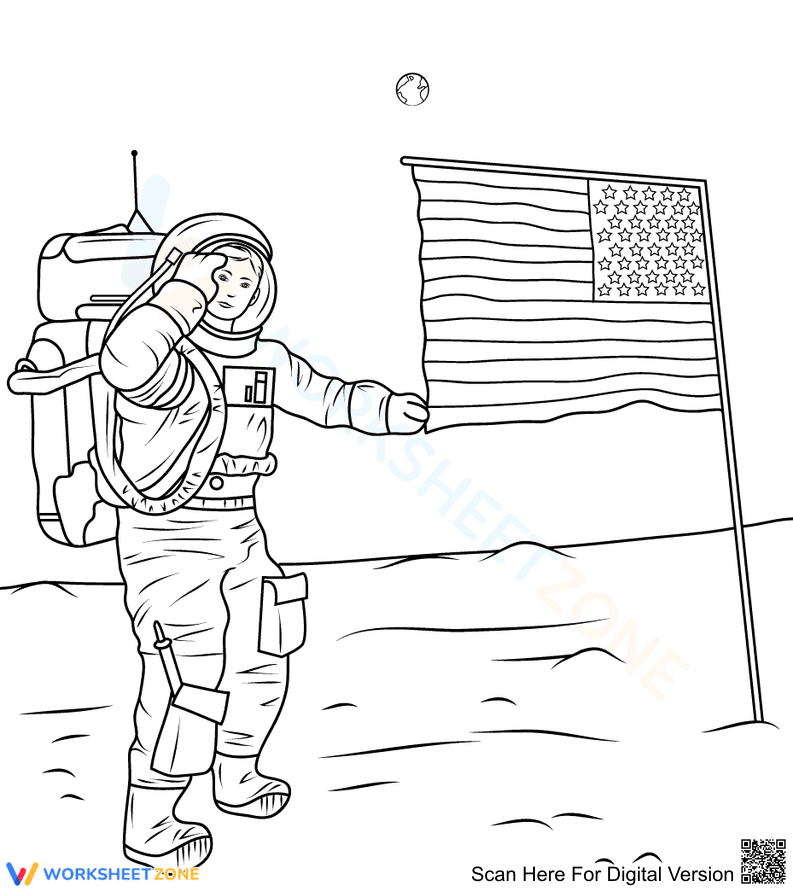

First Man on the Moon Coloring Page | Grade 1 Essential
Paste this activity's link or code into your existing LMS (Google Classroom, Canvas, Teams, Schoology, Moodle, etc.).
Students can open and work on the activity right away, with no student login required.
You'll still be able to track student progress and results from your teacher account.
This Grade 1 history coloring page provides a visual entry point for students to identify Neil Armstrong and the historic Apollo 11 mission. By engaging with the iconic imagery of the first man on the moon, learners develop fine motor control while building foundational knowledge about American space exploration and historical milestones.
At a Glance
- Grade: 1 · Subject: Social Studies
- Standard:
CCSS.ELA-LITERACY.RI.1.3— Describe the connection between individuals and historical events in informational contexts- Skill Focus: Historical Recognition & Fine Motor Skills
- Format: 1 page · 1 task · No answer key required · PDF
- Best For: Early finisher activity or history introduction
- Time: 15–20 minutes
This resource features a high-quality, single-page illustration of an astronaut saluting the American flag on the lunar surface. The clear, bold lines are designed for young learners, ensuring success for various grip strengths. The scene includes the lunar module, the Earth in the distance, and the American flag, providing multiple talking points for a classroom discussion on the 1969 moon landing.
The zero-prep workflow for this activity is designed for maximum efficiency. First, print the single-page PDF (30 seconds). Second, distribute the sheets along with crayons or colored pencils to your students (1 minute). Third, review the historical significance of the image by asking students to identify the astronaut and the flag (2 minutes). Total teacher preparation time is under 2 minutes, making this an ideal choice for emergency sub plans or transition periods.
This worksheet aligns with CCSS.ELA-LITERACY.RI.1.3, which requires students to describe the connection between individuals and events. By coloring this specific scene, students visually process the relationship between Neil Armstrong and the event of the first lunar walk. This standard code can be copied directly into lesson plans, IEP goals, or district curriculum mapping tools.
Use this worksheet as a hook at the beginning of a unit on space or famous Americans. As students color, walk around the room to perform a formative assessment by asking, "Why is there a flag on the moon?" This allows you to gauge prior knowledge. Alternatively, assign this as a quiet-time activity after reading a short biography of Neil Armstrong. Expected completion time is 15 to 20 minutes.
This resource is primarily for Grade 1 students but is appropriate for Kindergarten through Grade 2. It serves as an excellent differentiation tool for students who require visual or kinesthetic engagement to retain historical facts. Pair this coloring page with a non-fiction picture book about the Apollo 11 mission or a short video clip of the original moon landing footage.
Research by Fisher & Frey (2014) emphasizes the importance of visual literacy and non-linguistic representations in early childhood education. Integrating coloring activities with historical content helps students create mental models of complex events like the 1969 moon landing. This worksheet supports the CCSS.ELA-LITERACY.RI.1.3 standard by providing a concrete visual anchor for the abstract concept of space exploration. By focusing on the first man to walk on the moon, educators can bridge the gap between simple identification and historical understanding. Studies from the NAEP suggest that early exposure to historical figures through varied media improves long-term retention of social studies concepts. This printable resource offers a low-stakes, high-engagement method for introducing significant American achievements while simultaneously supporting the development of fine motor skills necessary for early writing and artistic expression.


