


























Views
Downloads

Grade 1 Europe Continent — Printable No-Prep Worksheet
Paste this activity's link or code into your existing LMS (Google Classroom, Canvas, Teams, Schoology, Moodle, etc.).
Students can open and work on the activity right away, with no student login required.
You'll still be able to track student progress and results from your teacher account.
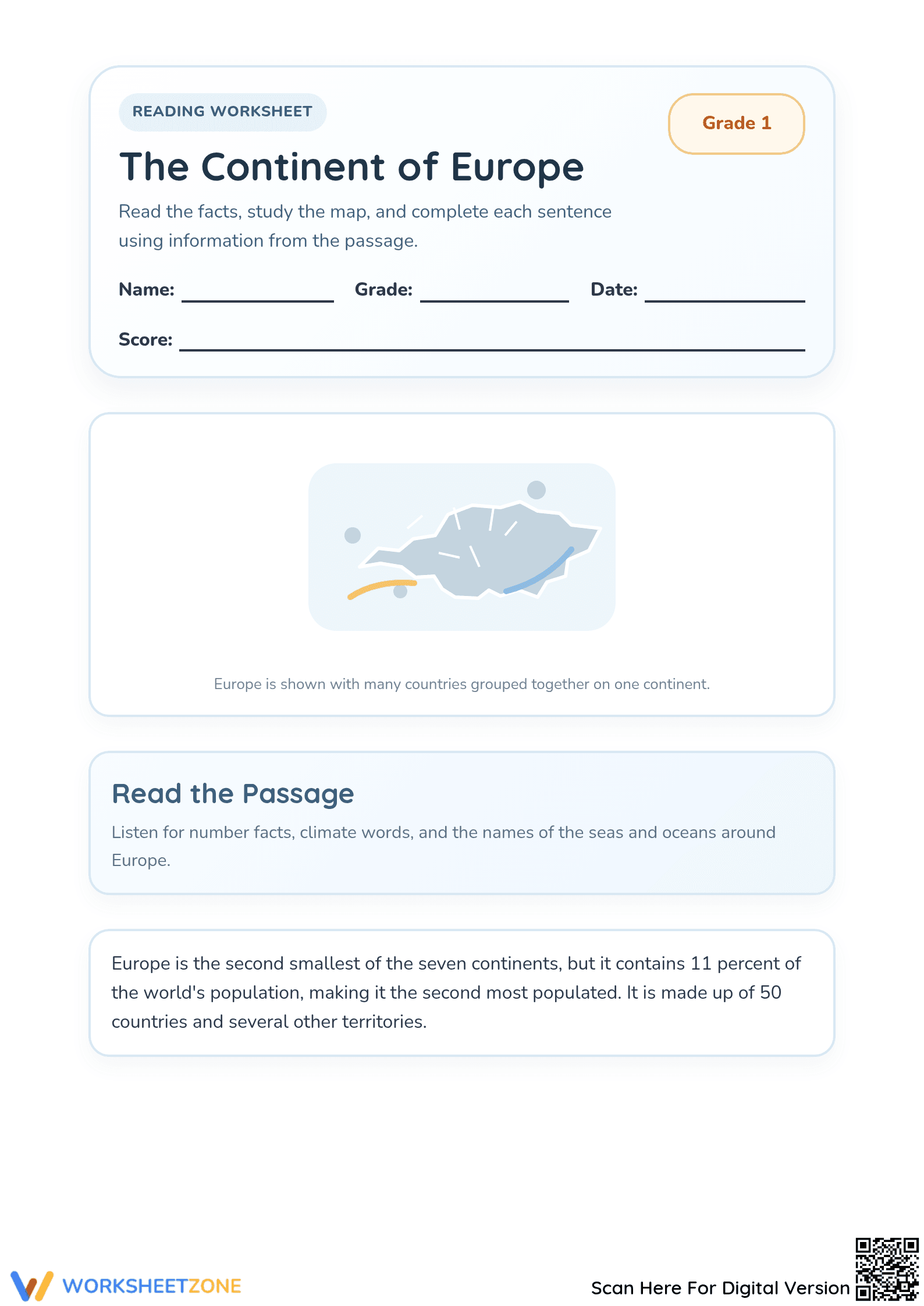
Mastering foundational reading skills is essential for Grade 1 students as they transition to more complex informational texts. This printable Europe continent worksheet provides a focused reading experience that helps children identify key facts about geography while building their reading stamina. Students will learn about landmasses, populations, and climates while practicing text-dependent answering techniques.
At a Glance
- Grade: Grade 1 · Subject: ELA
- Standard:
RI.1.1— Ask and answer questions about key details in an informational text- Skill Focus: Information extraction and reading comprehension
- Format: 2 pages · 6 problems · Answer key included · PDF
- Best For: Social studies integration and morning work
- Time: 15–20 minutes
This two-page resource contains a structured informational passage about the continent of Europe followed by a dedicated assessment page. The reading section introduces learners to vocabulary regarding climates, bodies of water, and population statistics. The second page features six fill-in-the-blank questions designed to test literal comprehension. A complete answer key is provided to facilitate rapid grading and student self-correction.
The zero-prep design of this worksheet ensures that teachers can integrate it into their schedules without any setup. Step one is a 10-second print of the two-page document, which includes the reading passage and the question sheet. Step two involves distributing the worksheet for 15 minutes of independent reading practice. Step three is a quick review using the provided answer key for immediate feedback. This efficient workflow makes it an ideal choice for substitute teacher plans or classroom fillers.
This worksheet is strictly aligned to CCSS.ELA-LITERACY.RI.1.1, which requires students to ask and answer questions about key details in a text. It focuses on literal comprehension and the ability to locate specific facts within a short informational passage. This standard code can be copied directly into lesson plans, IEP goals, or district curriculum mapping tools.
Use this worksheet as a post-instructional activity after a direct lesson on continents or geography. It serves as a strong formative assessment to observe which students can independently locate facts versus those who need guided support. Expect students to complete both pages within 15 to 20 minutes of quiet work time.
This resource is designed for first-grade students but serves as an excellent intervention tool for second-grade learners who need practice with informational text. It pairs naturally with a classroom wall map or a digital globe activity. Teachers will find it particularly useful during literacy centers or as a homework assignment.
This informational text resource aligns with CCSS.ELA-LITERACY.RI.1.1, focusing on the essential primary grade skill of answering questions about key details in a text. By integrating geographic facts with literacy practice, the worksheet supports the development of non-fiction reading stamina and evidence-based response techniques. Research from Fisher & Frey (2014) emphasizes the importance of utilizing informational complex texts in early childhood to build background knowledge and academic vocabulary. The worksheet's structure—featuring a concise passage followed by text-dependent questions—mirrors the NAEP frameworks for reading assessment, ensuring that students practice the specific cognitive processes required for academic success. This practice prepares students for higher-order analysis by solidifying their ability to locate and extract explicit information from fact-dense passages. Teachers can use this tool to bridge the gap between social studies and English Language Arts, fostering a multidisciplinary approach that improves information retention.


