


























Views
Downloads

Essential Learning Styles Worksheet | Grades 9-12 Ready
Paste this activity's link or code into your existing LMS (Google Classroom, Canvas, Teams, Schoology, Moodle, etc.).
Students can open and work on the activity right away, with no student login required.
You'll still be able to track student progress and results from your teacher account.
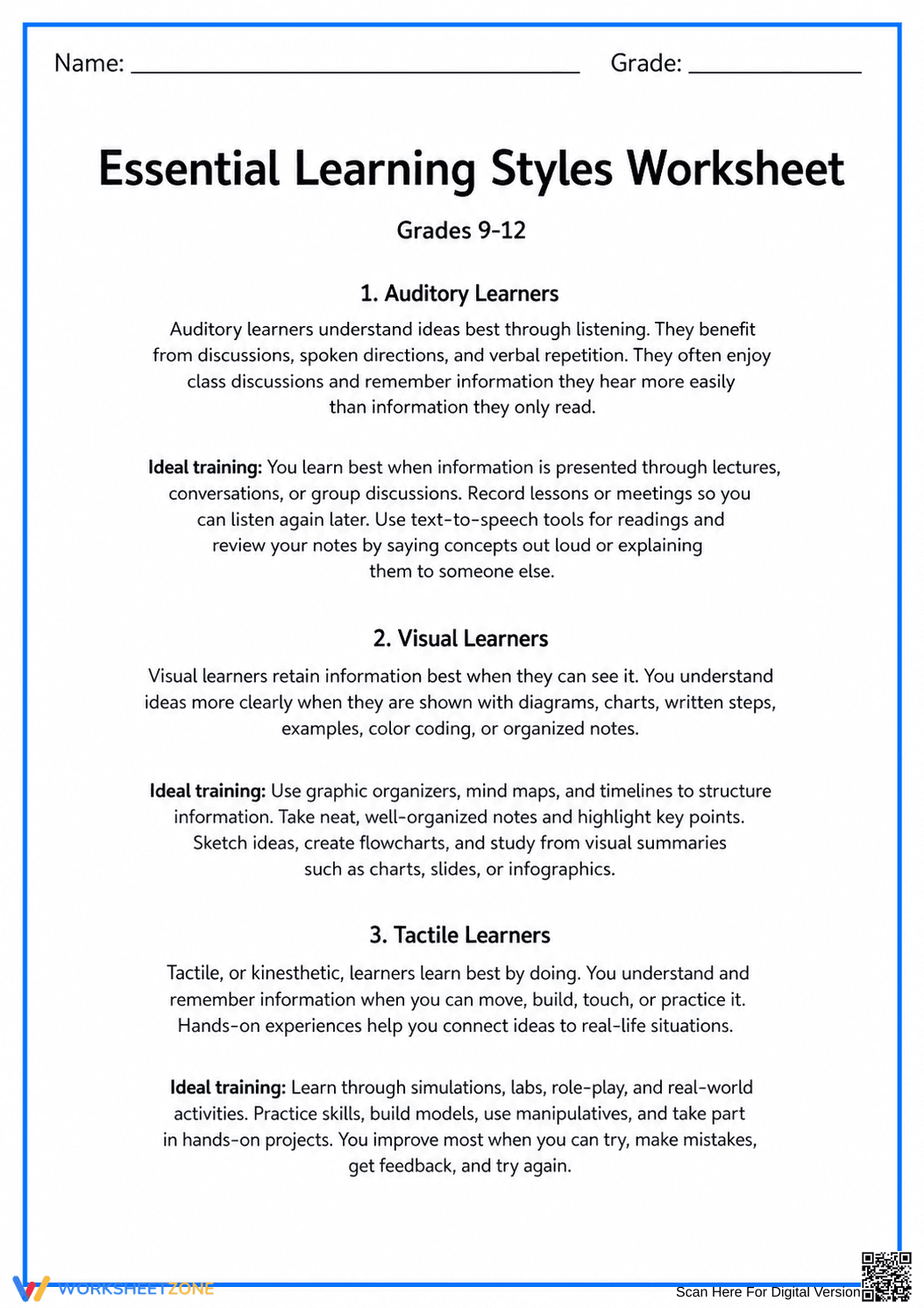
This high school behavior and communication worksheet helps students identify their primary learning modality to improve academic and professional performance. By analyzing auditory, visual, and tactile styles, learners gain the self-awareness necessary to advocate for their needs in the classroom or workplace. Students read detailed descriptions before completing a targeted reflection.
At a Glance
- Grade: 9-12 · Subject: Social Skills
- Standard:
CCSS.ELA-LITERACY.RI.11-12.1— Cite strong and thorough textual evidence to support analysis of what the text says- Skill Focus: Metacognition & Learning Styles
- Format: 2 pages · 4 problems · Answer key included · PDF
- Best For: Advisory, Study Skills, or Career Prep
- Time: 20–30 minutes
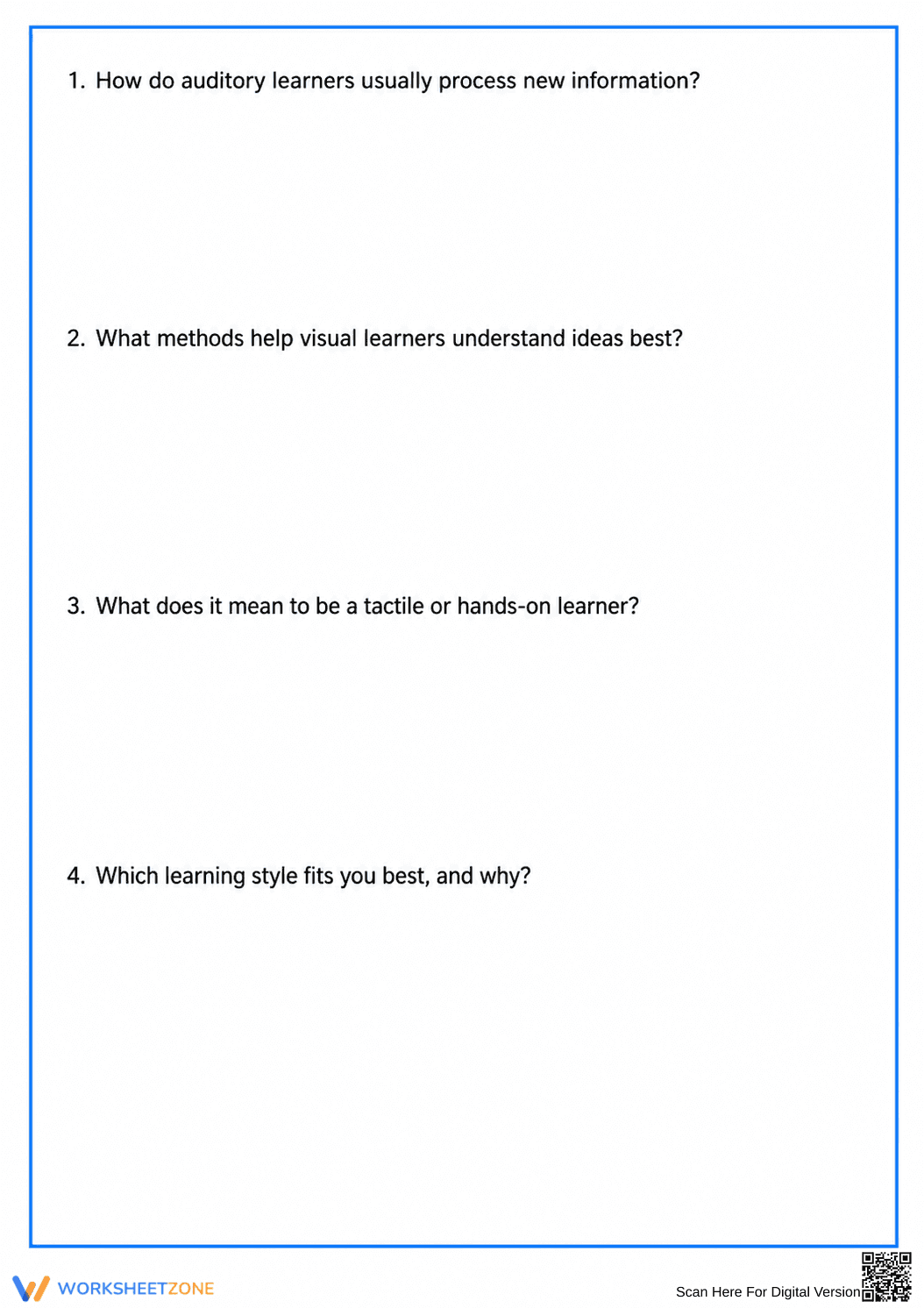
The resource consists of a two-page PDF. The first page features comprehensive informational text defining the three major learning modalities: auditory, visual, and tactile. It includes specific "Ideal Training" scenarios tailored for older students and young professionals. The second page provides four open-ended comprehension and reflection questions designed to facilitate personal connection with the material.
This resource is designed for immediate implementation with a total teacher prep time of under 2 minutes. First, print the two-page document for your cohort. Second, distribute the sheets during an advisory period or study skills block, allowing 15 minutes for reading. Third, review the reflection questions as a whole-group discussion to help students share their identified styles and study strategies.
This worksheet aligns with CCSS.ELA-LITERACY.RI.11-12.1, requiring students to cite strong and thorough textual evidence to support their analysis of the text. It also supports CCSS.ELA-LITERACY.SL.11-12.1 by providing a foundation for collaborative discussion about personal learning preferences. Both standard codes can be copied directly into lesson plans, IEP goals, or district curriculum mapping tools.
Use this worksheet at the start of a semester to help students build a "learner profile." It serves as an excellent formative assessment for teachers to understand how to differentiate future instruction. Completion typically takes 25 minutes. Observe whether students naturally gravitate toward the visual charts or auditory descriptions mentioned in the text to confirm their self-identified style.
This is ideal for high school students in Grades 9-12, particularly those in transition programs or career-technical education (CTE) tracks. It pairs naturally with a "How to Study" anchor chart or a direct instruction lesson on executive functioning. It is also highly effective for students with IEPs focusing on self-advocacy and communication skills.
Metacognitive awareness is a critical component of secondary education, as students who understand their own cognitive processes are better equipped to manage complex tasks. According to Fisher & Frey (2014), the gradual release of responsibility model is most effective when students possess the self-regulatory tools to identify how they best absorb new information. This worksheet targets the CCSS.ELA-LITERACY.RI.11-12.1 standard by asking students to extract specific characteristics of auditory, visual, and tactile learners from a technical text. Research from the NAEP suggests that high schoolers who engage in regular self-reflection regarding their study habits demonstrate higher levels of academic persistence. By providing 4 structured reflection tasks, this resource bridges the gap between reading comprehension and real-world application. It offers a practical framework for students to transition from passive recipients of information to active, self-aware participants in their own educational and professional development.


