


























Views
Downloads


Thanksgiving Science Worksheet | Grade 5-8 Essential
Paste this activity's link or code into your existing LMS (Google Classroom, Canvas, Teams, Schoology, Moodle, etc.).
Students can open and work on the activity right away, with no student login required.
You'll still be able to track student progress and results from your teacher account.
This Thanksgiving science worksheet transforms holiday dinner into a rigorous biology and chemistry lesson. Students analyze the nutritional profile of traditional dishes, identifying key molecules like tryptophan, antioxidants, and carbohydrates. By connecting seasonal traditions to scientific concepts, learners develop a deeper understanding of how food provides the energy and matter necessary for life.
At a Glance
- Grade: 5-8 · Subject: Science
- Standard:
MS-LS1-7— Develop a model to describe how food is rearranged through chemical reactions- Skill Focus: Nutritional Chemistry & Vocabulary
- Format: 2 pages · 18 problems · Answer key included · PDF
- Best For: Holiday-themed science supplement or sub plan
- Time: 25–35 minutes
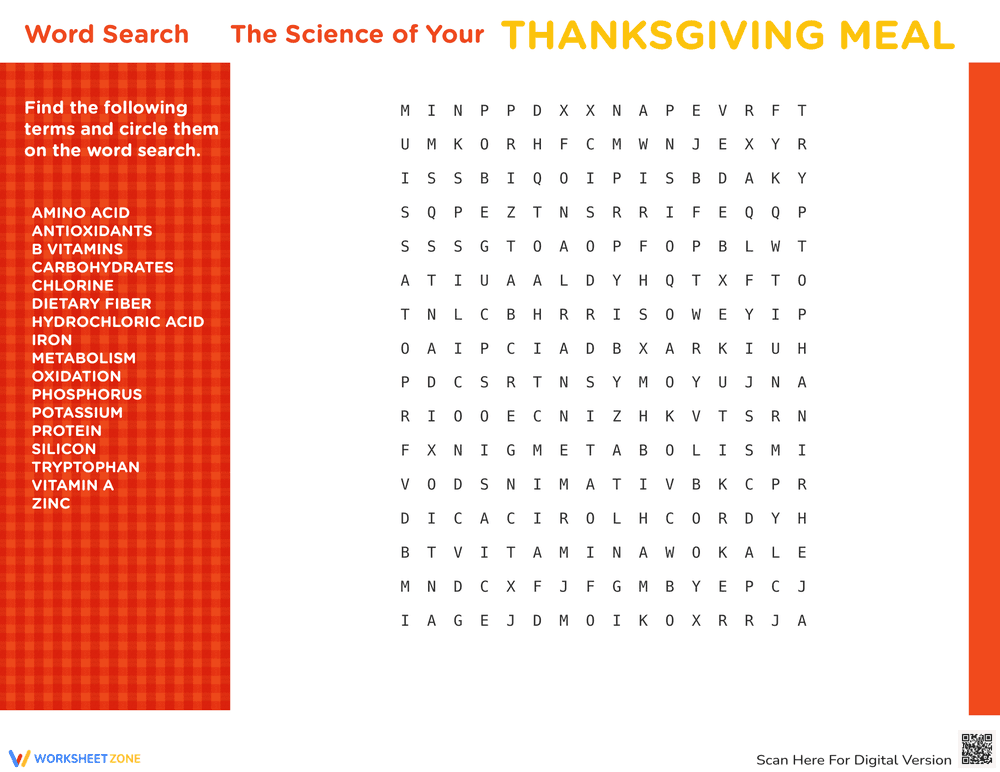
The resource contains two distinct pages designed for immediate classroom use. The first page is a high-density infographic detailing the chemical properties of ten Thanksgiving staples, from the potassium in pumpkin pie to the phosphorus in Brussels sprouts. The second page features a word search containing 18 complex scientific terms found in the text, reinforcing vocabulary acquisition and spelling accuracy.
This resource is designed for a zero-prep workflow. Teachers can print the two-page PDF in under 2 minutes. Distribution takes seconds, as the infographic serves as the primary text source, requiring no external textbooks or supplementary materials. Reviewing the word search and discussing the nutritional facts takes approximately 10 minutes, making this an ideal solution for the busy days leading up to school breaks or as an emergency sub plan.
Aligned to MS-LS1-7, this worksheet focuses on how food provides energy and building blocks for organisms. It specifically highlights metabolism and the role of various minerals and vitamins in bodily functions. Supporting standard CCSS.ELA-LITERACY.RI.6.7 is also addressed as students integrate information from a visual infographic. Both standard codes can be copied directly into lesson plans, IEP goals, or district curriculum mapping tools.
Use this worksheet as a hook during a unit on the digestive system or as a standalone holiday activity. For formative assessment, observe students as they locate terms; their ability to find oxidation or tryptophan indicates familiarity with the text technical vocabulary. Expected completion time is 30 minutes, fitting perfectly into a standard middle school period without requiring additional teacher setup.
This activity is tailored for middle school students in grades 5 through 8. It provides enough complexity for eighth graders while remaining accessible to fifth graders through visual cues and clear definitions. It pairs naturally with a lesson on the periodic table or a nutrition unit, providing a practical application for abstract chemical concepts.
According to the RAND AIRS 2024 report on seasonal curriculum integration, contextualizing scientific concepts within familiar cultural events significantly increases student engagement and long-term retention of technical vocabulary. This worksheet applies these findings by mapping the MS-LS1-7 standard—which requires students to understand how food molecules are broken down and rearranged—onto a traditional Thanksgiving meal. By identifying 18 specific chemical components such as antioxidants, amino acids, and dietary minerals, students move beyond abstract definitions to concrete biological applications. Research from Fisher & Frey (2014) suggests that using infographics as primary texts supports literacy in the science classroom by providing visual scaffolds for complex informational content. This resource ensures that students can articulate the relationship between chemical intake and metabolic processes, providing a robust foundation for high school biology while maintaining the festive spirit of the holiday season.


