


























Views
Downloads

Thanksgiving Sink or Float Science | Essential Grade 5
Paste this activity's link or code into your existing LMS (Google Classroom, Canvas, Teams, Schoology, Moodle, etc.).
Students can open and work on the activity right away, with no student login required.
You'll still be able to track student progress and results from your teacher account.
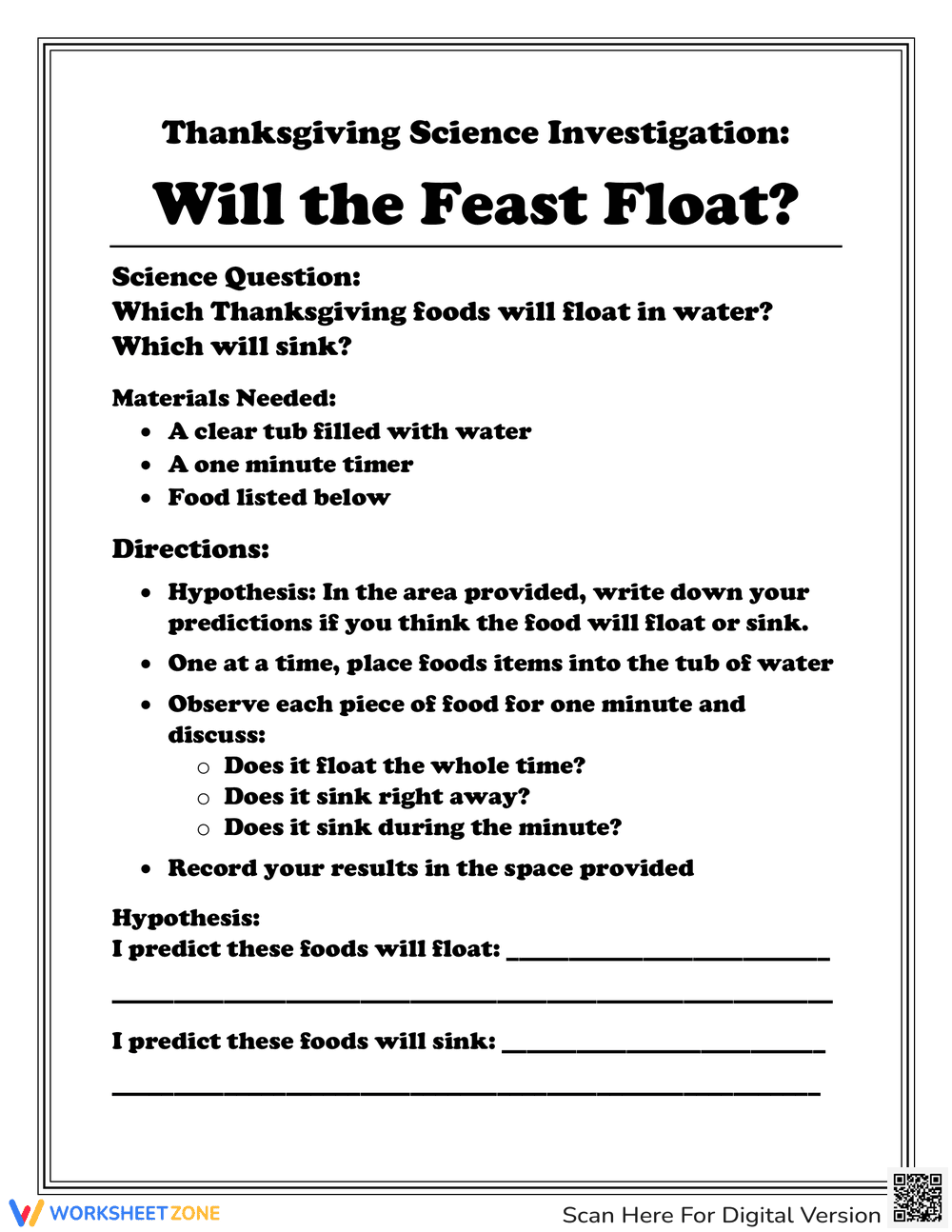
This Grade 5 Thanksgiving science worksheet guides students through a hands-on investigation of buoyancy and density using seasonal food items. Students practice the scientific method by forming hypotheses, conducting timed observations, and recording data to determine which feast items sink or float. It transforms a holiday theme into a rigorous physical science lesson.
At a Glance
- Grade: 5 · Subject: Science
- Standard:
5-PS1-3— Make observations and measurements to identify materials based on their properties- Skill Focus: Buoyancy and Density
- Format: 2 pages · 15 tasks · Answer key included · PDF
- Best For: Seasonal science labs and holiday rotations
- Time: 30–45 minutes
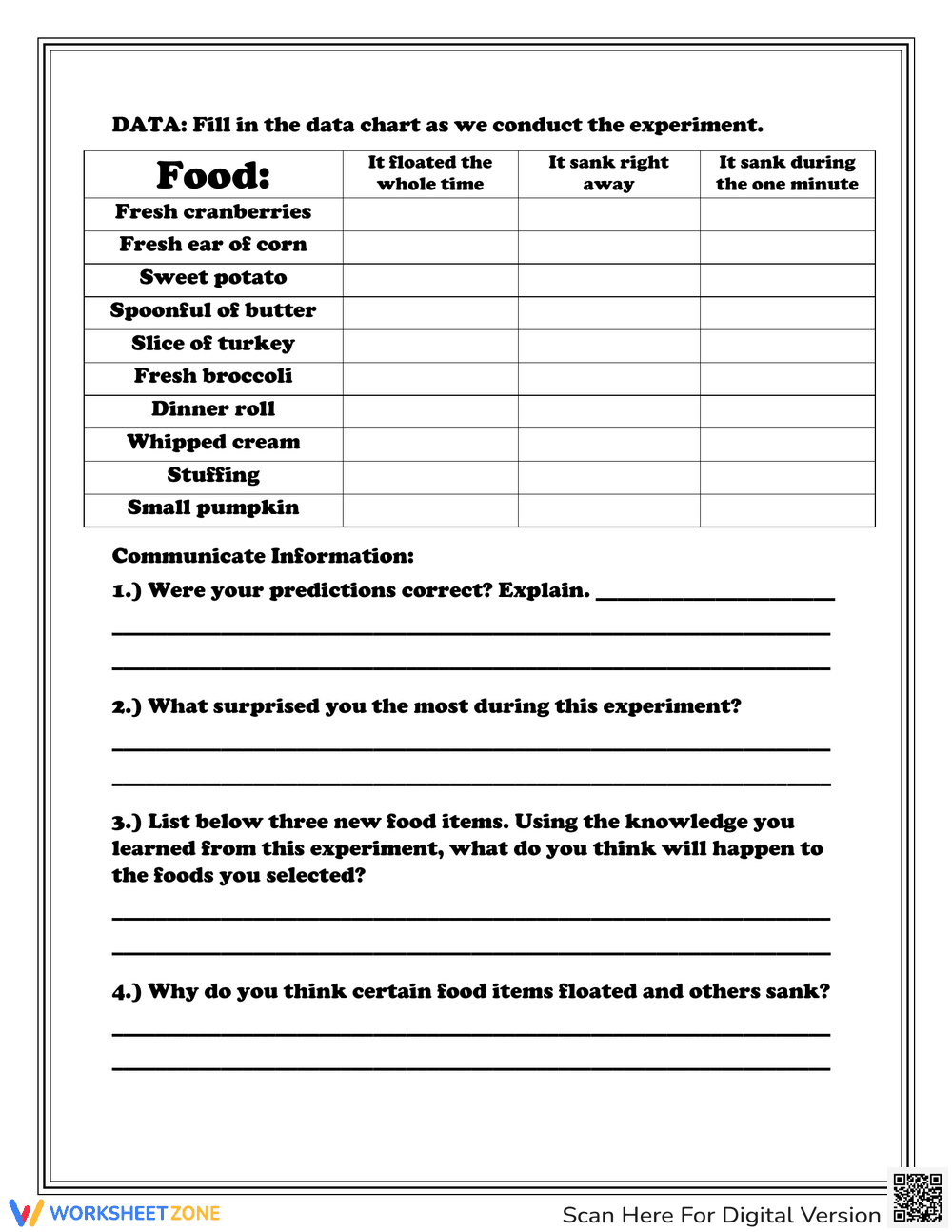
The 2-page PDF includes a structured lab report format. Page one features a clear Science Question, a materials list, and dedicated space for students to write their initial hypotheses. Page two contains a comprehensive data table for 10 specific food items—ranging from cranberries to small pumpkins—and four critical thinking questions that require students to communicate their findings and predict future outcomes.
- Print: Select the 2-page PDF and print enough copies for your lab groups (30 seconds).
- Distribute: Hand out the worksheets and set up a clear tub of water with the listed food items (1 minute).
- Review: Use the included reflection questions to facilitate a whole-class discussion on density and displacement (5 minutes). Total teacher preparation time is under 2 minutes, making this an ideal sub plan or last-minute holiday activity.
This resource aligns with `5-PS1-3`, which requires students to make observations and measurements to identify materials based on their properties. By testing various foods, students gather empirical evidence about physical properties like density. This standard code can be copied directly into lesson plans, IEP goals, or district curriculum mapping tools.
Use this activity during a unit on the properties of matter to provide a concrete example of buoyancy. It works best as a collaborative lab where students observe the items together. For a formative assessment, observe students during the one-minute timer phase to see if they can distinguish between items that sink immediately versus those that lose buoyancy over time.
This worksheet is designed for general education Grade 5 students but is easily adaptable for Grade 3-8. It is particularly effective for English Language Learners due to the visual nature of the experiment and the structured data table. Pair this with a density anchor chart or a short video on Archimedes' principle for a complete lesson.
According to the RAND AIRS 2024 report, hands-on science investigations significantly improve student retention of abstract physical concepts like density. This worksheet addresses the 5-PS1-3 standard by requiring students to identify materials based on observable properties through a structured 15-task lab. By engaging in the Will the Feast Float? experiment, students move beyond rote memorization to active inquiry. Research from Fisher & Frey (2014) suggests that seasonal themes reduce cognitive load by anchoring new scientific vocabulary in familiar contexts. This 2-page PDF provides a scaffolded framework for data collection and evidence-based reasoning, ensuring that holiday activities remain academically rigorous. The inclusion of a hypothesis section and reflection questions mirrors the professional scientific process, preparing students for middle school laboratory requirements while maintaining a high level of engagement through interactive, real-world testing.


