


























Views
Downloads

Thanksgiving Alphabet Challenge | Essential Grade 3-5 ELA
Paste this activity's link or code into your existing LMS (Google Classroom, Canvas, Teams, Schoology, Moodle, etc.).
Students can open and work on the activity right away, with no student login required.
You'll still be able to track student progress and results from your teacher account.
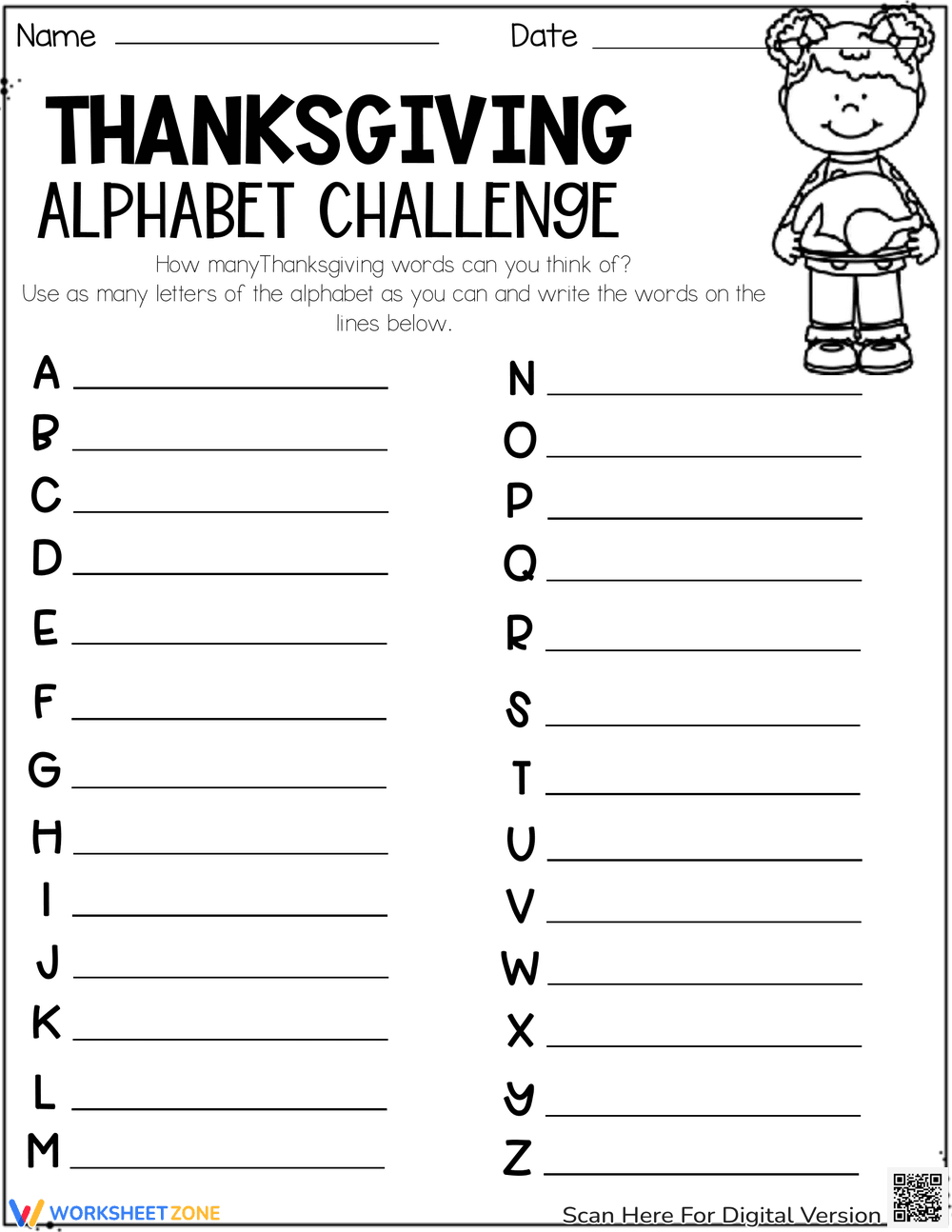
This Thanksgiving Alphabet Challenge worksheet helps students expand their holiday-themed vocabulary through a structured brainstorming activity. By identifying words for every letter of the alphabet, learners practice word retrieval and spelling while exploring seasonal adjectives and nouns. It is an ideal tool for reinforcing domain-specific language in a fun, engaging format.
At a Glance
- Grade: 3-5 · Subject: ELA
- Standard:
CCSS.ELA-LITERACY.L.3.6— Acquire and use accurately grade-appropriate conversational and domain-specific words- Skill Focus: Thanksgiving Vocabulary Brainstorming
- Format: 1 page · 26 problems · Answer key not required · PDF
- Best For: Morning work or seasonal ELA centers
- Time: 15–20 minutes
Inside this single-page PDF, students find a clean, organized layout featuring all 26 letters of the alphabet. Each letter is paired with a dedicated writing line, encouraging students to think critically about Thanksgiving-related terms. The worksheet includes a festive illustration and clear instructions, making it entirely self-explanatory for independent student work or small group competitions.
Zero-Prep Workflow
This resource is designed for immediate classroom implementation with three simple steps:
- Print (30 seconds): Generate enough copies for your class or a small group center.
- Distribute (30 seconds): Hand out the sheets as students enter the room for a quiet morning transition.
- Review (1 minute): Have students share their most unique words to build a collective class word wall.
Total teacher preparation time is under two minutes, making this an excellent emergency sub plan or filler activity.
This worksheet aligns with CCSS.ELA-LITERACY.L.3.6, which requires students to acquire and use accurately grade-appropriate conversational, general academic, and domain-specific words and phrases. By focusing on Thanksgiving-themed vocabulary, students practice retrieving specific nouns and adjectives that describe the holiday's cultural and historical context. Both standard codes can be copied directly into lesson plans, IEP goals, or district curriculum mapping tools.
Use this worksheet as a "Bell Ringer" during the week of Thanksgiving to settle students and activate prior knowledge. Alternatively, use it as a collaborative "Gallery Walk" activity where students move around the room to find words from peers to fill their own sheets. Teachers should observe which letters (like Q, X, or Z) cause the most difficulty to identify gaps in phonetic awareness or vocabulary breadth. Expected completion time is 15 to 20 minutes.
This resource is perfect for general education students in grades 3, 4, and 5, as well as English Language Learners (ELL) who benefit from themed vocabulary practice. It pairs naturally with a Thanksgiving-themed reading passage or an anchor chart listing seasonal adjectives.
The Thanksgiving Alphabet Challenge leverages the cognitive benefits of categorized brainstorming to enhance lexical retrieval. According to Fisher & Frey (2014), structured word-generation tasks help students organize their mental lexicons and improve the fluency of domain-specific language use. By requiring a word for every letter, the worksheet pushes students beyond high-frequency terms into more complex vocabulary, supporting the requirements of CCSS.ELA-LITERACY.L.3.6. Research indicates that seasonal, high-interest themes increase student engagement and retention of new terms. This activity provides a low-stakes environment for students to experiment with spelling and word choice, which is essential for developing writing stamina in the upper elementary grades. The 26-task format ensures comprehensive coverage of the alphabet, providing a diagnostic look at a student's ability to access specific phonemic categories under a thematic constraint.


