


























Views
Downloads
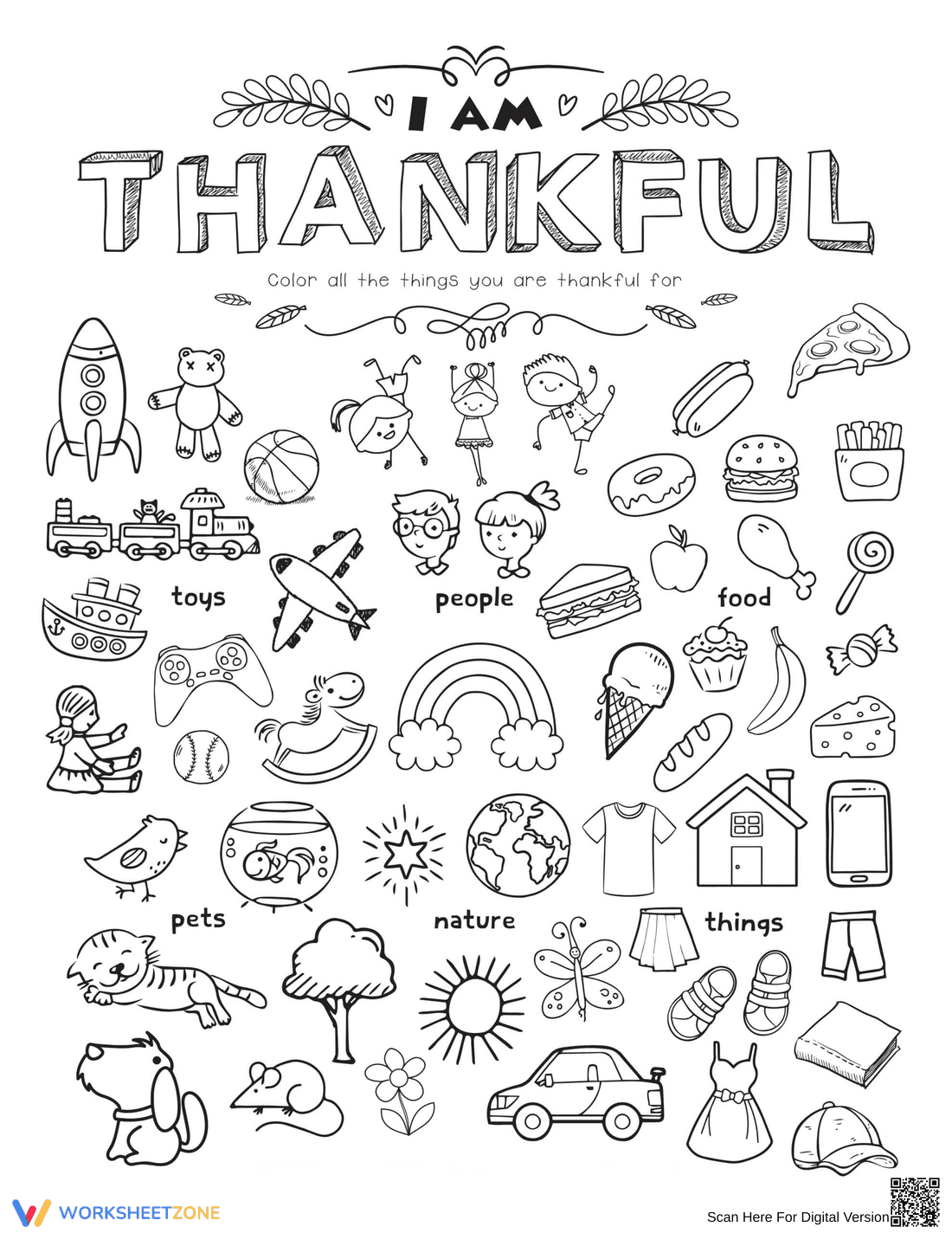

Printable Thankful Coloring Page: Grade 3-4 Gratitude
Paste this activity's link or code into your existing LMS (Google Classroom, Canvas, Teams, Schoology, Moodle, etc.).
Students can open and work on the activity right away, with no student login required.
You'll still be able to track student progress and results from your teacher account.
This printable gratitude activity helps third and fourth-grade students identify and reflect on things they value. By coloring categorized illustrations representing family, nature, pets, and toys, learners build self-awareness and vocabulary. This worksheet serves as an engaging social-emotional learning tool that prompts meaningful classroom discussions about appreciation.
At a Glance
- Grade: Grade 3, Grade 4 · Subject: Behavior & ELA
- Standard:
CCSS.ELA-LITERACY.SL.3.1— Engage in collaborative discussions about personal gratitude topics- Skill Focus: Gratitude reflection and categorization
- Format: 1 page · 35 items · Open-ended response · PDF
- Best For: Morning work or Thanksgiving SEL activity
- Time: 15–20 minutes
This single-page PDF features a clean, hand-drawn layout with the central heading "I Am Thankful" surrounded by 35 distinct illustrations. The items are organized into six clear categories: toys, people, food, pets, nature, and everyday things. Students review the visual options and color only the elements that represent what they are personally grateful for, creating a customized visual representation of their appreciation.
Teachers can integrate this activity into their daily routine with zero advance preparation. First, print the single-page PDF for your class, taking less than 1 minute. Second, distribute the sheets along with crayons or colored pencils, taking another minute. Finally, review the completed pages by hosting a brief sharing circle where students explain their choices. The total teacher preparation time is under 2 minutes, making this resource an excellent option for emergency sub plans, morning work, or transition periods.
This activity aligns with CCSS.ELA-LITERACY.SL.3.1, which requires students to engage effectively in a range of collaborative discussions, building on others' ideas and expressing their own clearly. It also supports CCSS.ELA-LITERACY.W.3.8 by prompting students to recall information from their personal experiences to categorize and select items. Both standard codes can be copied directly into lesson plans, IEP goals, or district curriculum mapping tools.
Use this worksheet during morning meetings or at the start of a social-emotional learning unit on mindfulness. Introduce the activity before direct instruction on gratitude to activate prior knowledge and personal connections. For a formative assessment, observe which categories students select most frequently and note their ability to categorize items accurately. Students typically complete the coloring and reflection process within 15 to 20 minutes.
This resource is designed for general education students in grades 3 and 4, but it works well for English language learners who benefit from visual vocabulary support. Teachers can differentiate by asking advanced students to write sentences explaining their choices on the back of the page. Pair this worksheet with a read-aloud book about thankfulness or an anchor chart listing descriptive emotion words.
According to research analyzed in the ScienceDirect TpT Analysis, integrating visual arts with reflective writing or speaking tasks significantly improves student engagement and emotional self-regulation in elementary classrooms. This worksheet leverages that connection by combining coloring with personal reflection. By identifying specific items they value across six distinct categories, students practice critical categorization skills while building self-awareness. The activity directly supports standard CCSS.ELA-LITERACY.SL.3.1 by providing a concrete visual prompt that scaffolds subsequent peer-to-peer discussions. Teachers can use this structured format to help students organize their thoughts before speaking, ensuring more productive and inclusive classroom conversations. This evidence-based approach demonstrates that simple, low-prep creative activities can serve as powerful entry points for complex social-emotional learning and language development in third and fourth-grade environments.


