


























Views
Downloads

Essential Living and Non-Living Things Worksheet | Grade 1
Paste this activity's link or code into your existing LMS (Google Classroom, Canvas, Teams, Schoology, Moodle, etc.).
Students can open and work on the activity right away, with no student login required.
You'll still be able to track student progress and results from your teacher account.
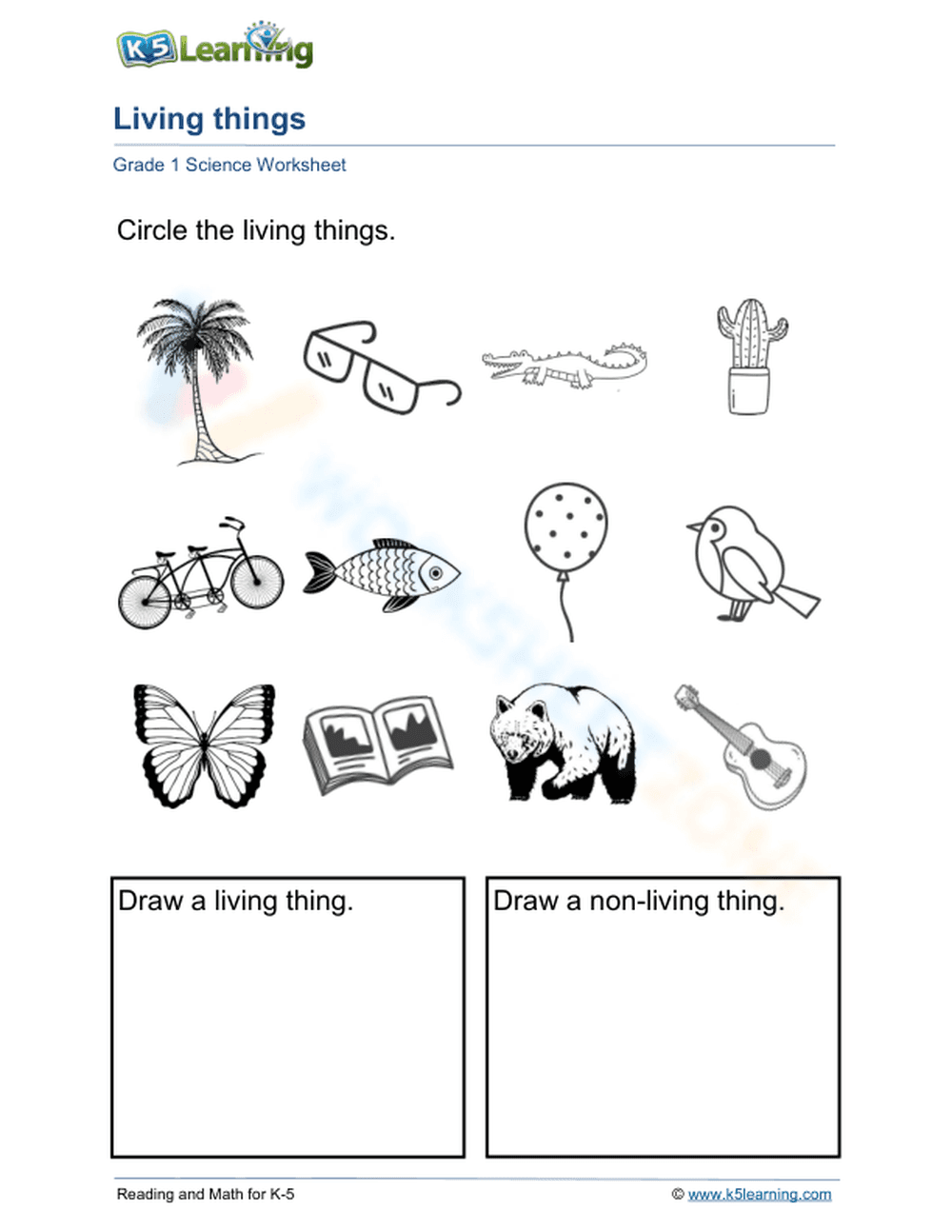
This Grade 1 science worksheet provides a structured approach to identifying living and non-living things through visual classification and creative drawing. By engaging with familiar objects, students develop the foundational ability to distinguish biological organisms from inanimate matter. This printable resource ensures young learners master the essential characteristics that define life.
At a Glance
- Grade: 1 · Subject: Science
- Standard:
1-LS1-1— Distinguish between living organisms and non-living objects through visual classification- Skill Focus: Living vs. Non-living Classification
- Format: 1 page · 14 problems · Answer key included · PDF
- Best For: Independent Science Centers and Sub Plans
- Time: 10–15 minutes
What's Inside
This single-page PDF includes 12 visual identification tasks where students circle living organisms, such as birds and palm trees, from a mixed set of objects. Additionally, two open-ended drawing prompts encourage students to synthesize their knowledge by illustrating their own examples of living and non-living things. A comprehensive answer key is provided for quick grading and immediate student feedback.
Zero-Prep Workflow
Teachers can implement this worksheet in under two minutes of total prep time. Step 1: Print the single-page PDF for your entire class (30 seconds). Step 2: Distribute the worksheet during a science block transition or as a focused center activity (1 minute). Step 3: Review the completed work as a group or collect it for a quick formative check. This resource is highly suitable for emergency sub-plans or morning work routines.
Standards Alignment
The primary alignment is 1-LS1-1, which focuses on how plants and animals use their parts to survive and grow. By classifying living things, students identify the biological entities that possess these survival traits. This worksheet also supports basic scientific observation and evidence-based reasoning skills. Both standard codes can be copied directly into lesson plans, IEP goals, or district curriculum mapping tools.
How to Use It
Use this as a mid-lesson check for understanding after discussing the basic needs of plants and animals. During the activity, observe if students correctly identify the alligator and palm tree as living despite their different physical appearances. The expected completion time is 10 to 15 minutes, making it perfect for a quick exit ticket or reinforced independent practice during science rotations.
Who It's For
This resource is designed for Grade 1 students but is also suitable for Kindergarten enrichment or Grade 2 review. The visual nature of the tasks provides natural differentiation for English Language Learners and students requiring reading support. It pairs naturally with a short informational passage or an anchor chart describing life processes such as growth, movement, and nutrition.
The classification of objects into living and non-living categories is a fundamental milestone in early childhood science education, providing the conceptual scaffolding necessary for later studies in biology and ecology. According to Fisher & Frey (2014), visual sorting tasks help students develop category knowledge by forcing them to identify defining attributes rather than relying on surface-level similarities. This Grade 1 science worksheet aligns with standard 1-LS1-1 by requiring students to recognize the organisms that interact with their environments to survive. By combining circling tasks with drawing prompts, the resource addresses multiple learning modalities and ensures high levels of cognitive engagement. Such structured practice is essential for moving students from simple observation to the systematic classification required in the Next Generation Science Standards (NGSS). This 14-task activity serves as a reliable formative assessment tool for elementary classrooms, ensuring students distinguish between biological processes and inanimate objects.


