


























Views
Downloads

Exploring Tenths Worksheet | Printable Grade 4 Math
Paste this activity's link or code into your existing LMS (Google Classroom, Canvas, Teams, Schoology, Moodle, etc.).
Students can open and work on the activity right away, with no student login required.
You'll still be able to track student progress and results from your teacher account.
Mastering decimal place value is a foundational skill for fourth-grade mathematicians. This "Exploring Tenths" worksheet provides a comprehensive introduction to decimals, moving from visual shading models to abstract conversions and real-world word problems. Students will build a robust conceptual understanding of tenths, ensuring they can visualize and identify decimal values.
At a Glance
- Grade: 4 · Subject: Math · Decimals
- Standard:
CCSS.MATH.CONTENT.4.NF.C.6— Use decimal notation for fractions with denominators 10 or 100 accurately- Skill Focus: Introduction to Tenths and Decimal Place Value
- Format: 3 pages · 14 problems · Answer key included · PDF
- Best For: Initial instruction and guided practice for decimals
- Time: 25–35 minutes
What's Inside
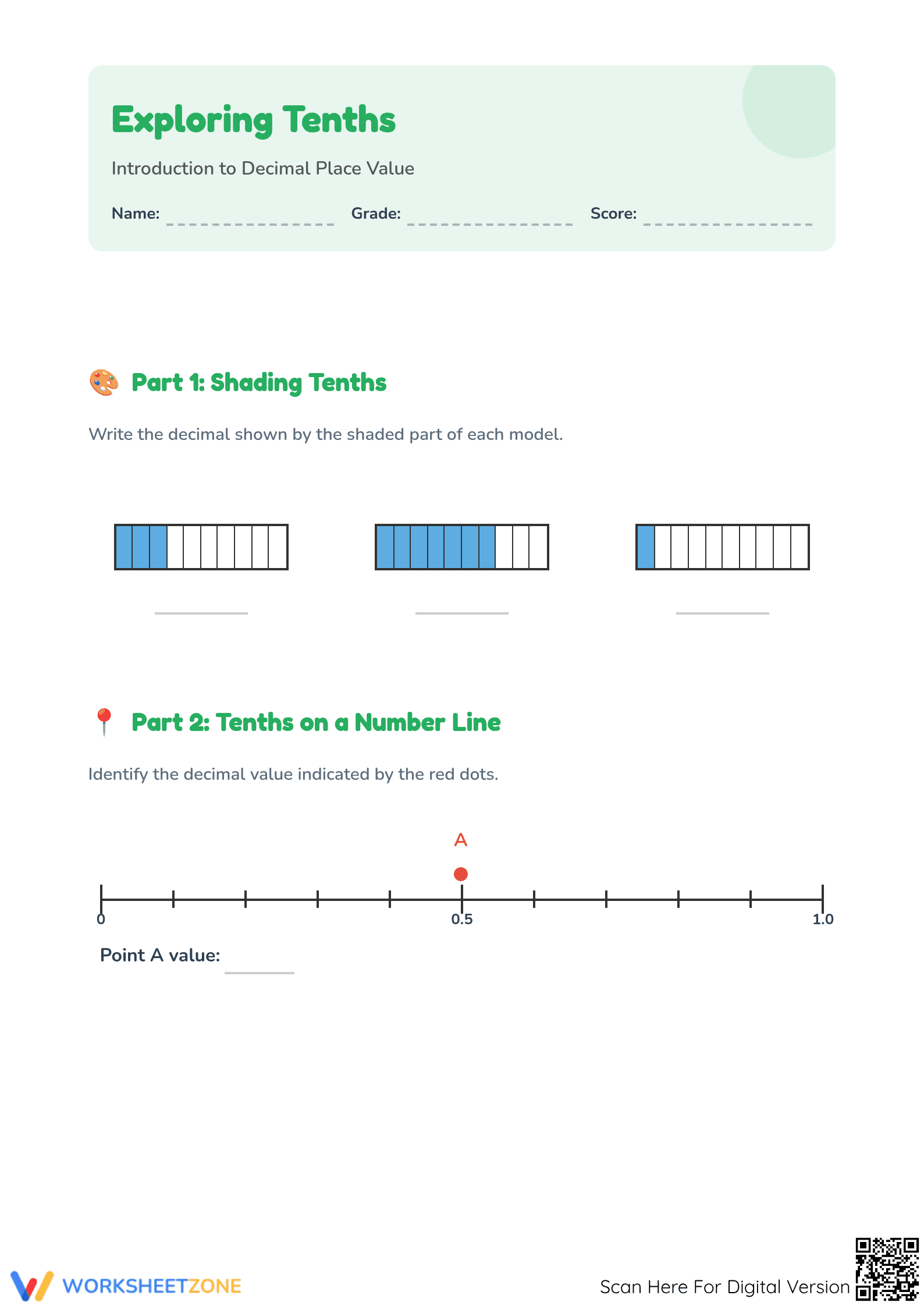
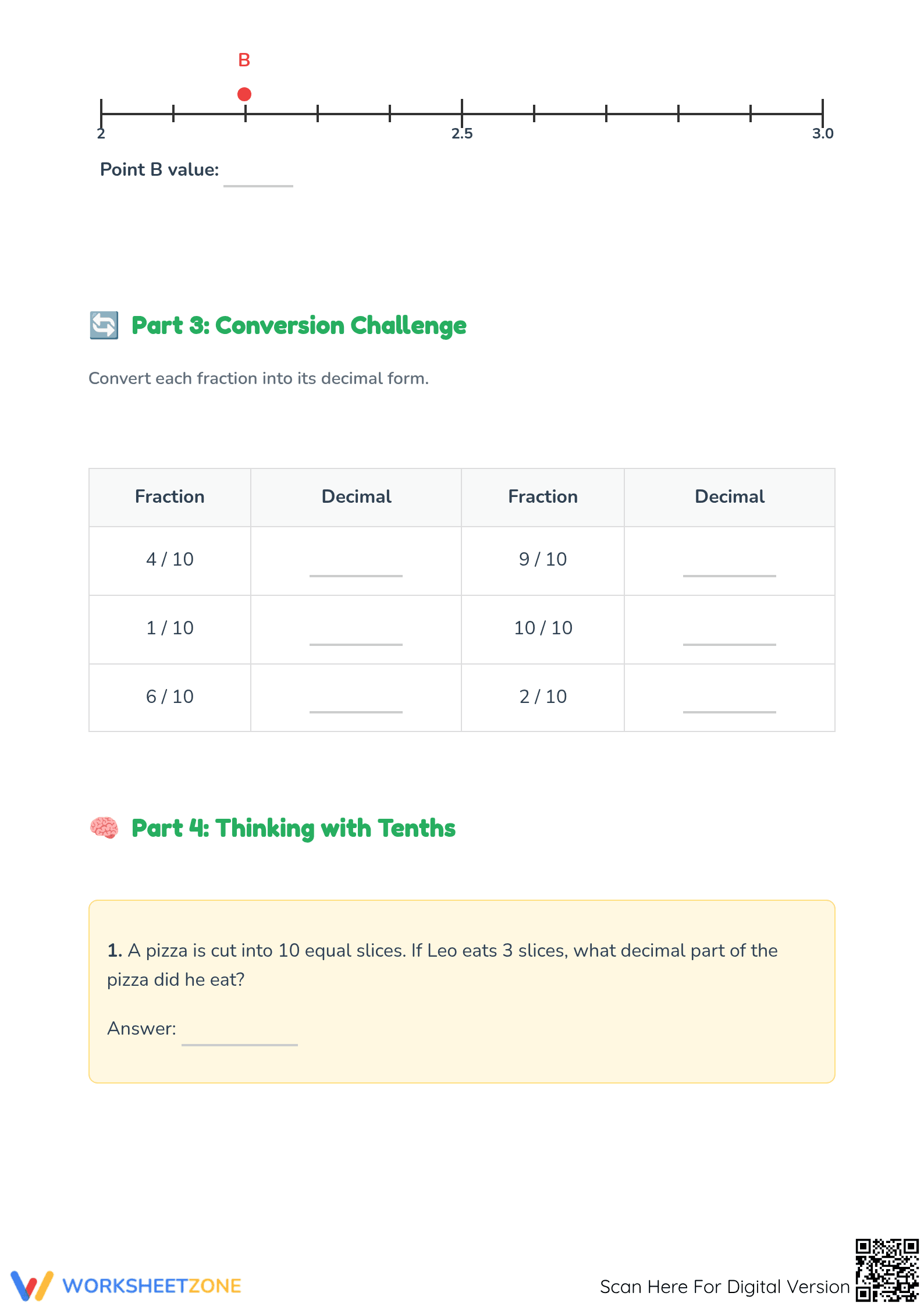
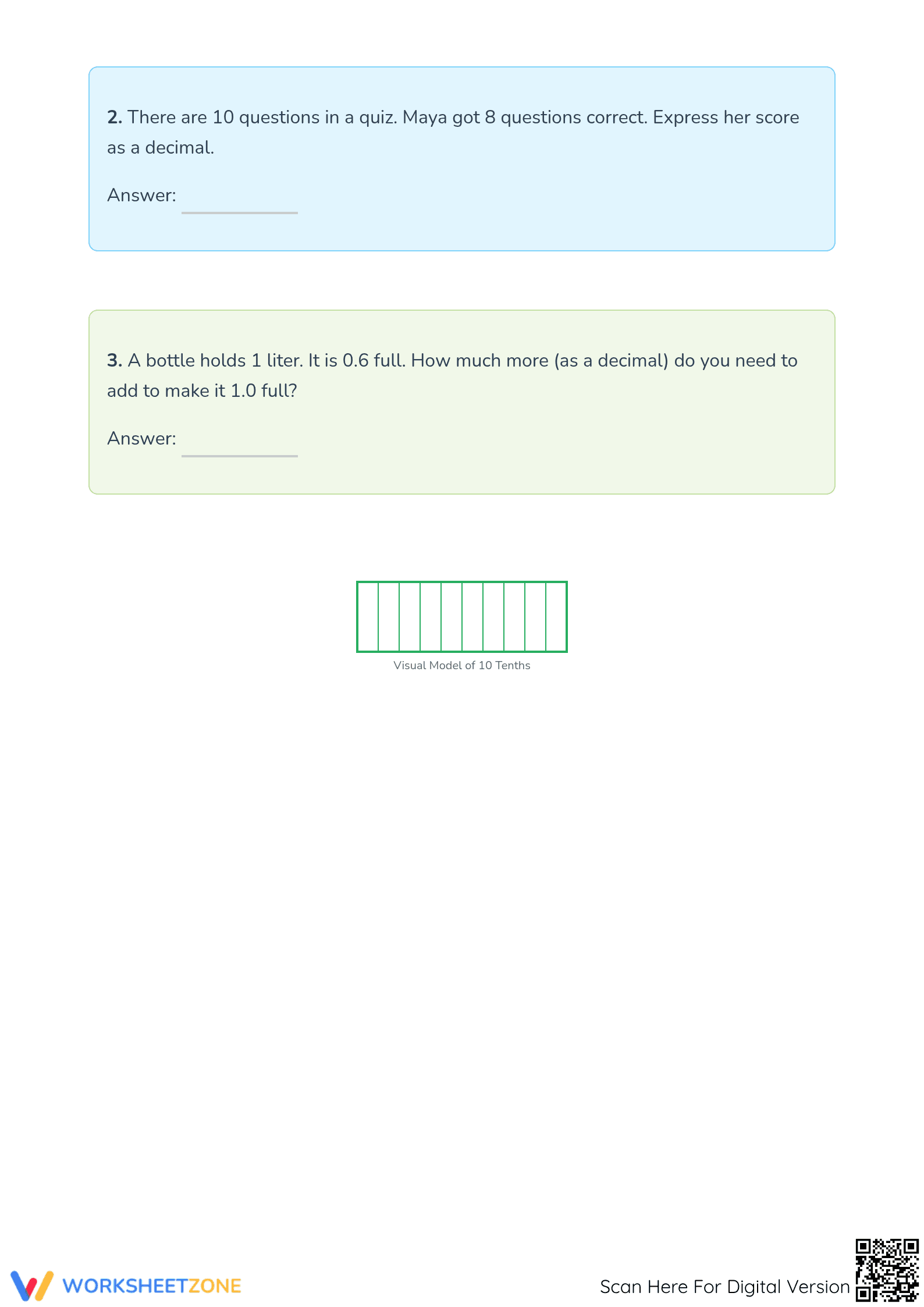
This three-page instructional packet is structured to guide students through the complexities of tenths. Page one features visual shading and number line identification. Page two expands into values between whole numbers and a "Conversion Challenge" table. The final page presents multi-step word problems involving pizza, quiz scores, and liquid measurements. A full answer key is included for efficient grading.
Skill Progression
- Guided Practice: Students use visual models and number lines with benchmarks to identify tenths, providing a concrete scaffold for initial understanding.
- Supported Practice: The "Conversion Challenge" requires translating between fractions and decimals, reinforcing numerical relationships and procedural fluency.
- Independent Practice: Real-world word problems challenge students to apply knowledge to novel contexts, requiring synthesis and application.
This "I Do, We Do, You Do" approach builds confidence and ensures students are ready for independent application in higher-level math.
Standards Alignment
The primary focus is CCSS.MATH.CONTENT.4.NF.C.6: "Use decimal notation for fractions with denominators 10 or 100." This worksheet targets the "tenths" component through diverse representations. Additionally, it supports standard 4.NF.C.5 by illustrating the connection between fractions and decimals. Both standard codes can be copied directly into lesson plans, IEP goals, or district curriculum mapping tools for easy tracking.
How to Use It
This resource is ideal during direct instruction. After introducing tenths with base-ten blocks, distribute page one for immediate guided practice. The word problems on page three serve as a formative assessment tool; observe how students translate verbal descriptions into decimal form. Most students will complete the full three-page set within 30 minutes of focused work.
Who It's For
This worksheet is designed for general education fourth-grade students beginning decimals. It is also effective for fifth-grade intervention or special education settings. The visual models provide essential support for English Language Learners. Pair this with a decimal anchor chart for a complete instructional block.
The transition from fractions to decimals represents a significant cognitive shift for upper elementary students. According to research from the National Assessment of Educational Progress (NAEP), students who struggle with decimal place value often lack a strong visual-spatial connection to the numerical representation. This "Exploring Tenths" worksheet addresses this gap by integrating multiple representations—shading, number lines, and symbolic conversion—into a single instructional sequence. By grounding the abstract concept of decimals in concrete models and familiar real-world contexts like quiz scores and liquid volume, this resource aligns with the recommendations of Fisher & Frey (2014) for effective gradual release of responsibility. The structured progression from guided visual tasks to independent problem-solving ensures that students develop the procedural fluency and conceptual depth required for mastery of CCSS.MATH.CONTENT.4.NF.C.6. This evidence-based approach provides a reliable pathway for students to bridge the gap between whole number place value and the more complex world of rational numbers.


