


























Views
Downloads

Printable Temperature Worksheet | Grade 2 Math Essential
Paste this activity's link or code into your existing LMS (Google Classroom, Canvas, Teams, Schoology, Moodle, etc.).
Students can open and work on the activity right away, with no student login required.
You'll still be able to track student progress and results from your teacher account.
This printable Grade 2 Math worksheet provides students with an essential foundation in reading and interpreting thermometer scales. Students will master identifying precise measurements in both Fahrenheit and Celsius while connecting numeric values to real-world benchmarks like boiling and freezing. This three-page resource ensures students move from basic scale identification to critical thinking about temperature differences and practical applications.
At a Glance
- Grade: 2 · Subject: Math
- Standard:
CCSS.MATH.CONTENT.2.MD.D.10— Draw a picture graph and a bar graph to represent a data set- Skill Focus: Reading thermometer scales and benchmarks
- Format: 3 pages · 16 tasks · Answer key included · PDF
- Best For: Independent practice and formative assessment
- Time: 20–30 minutes
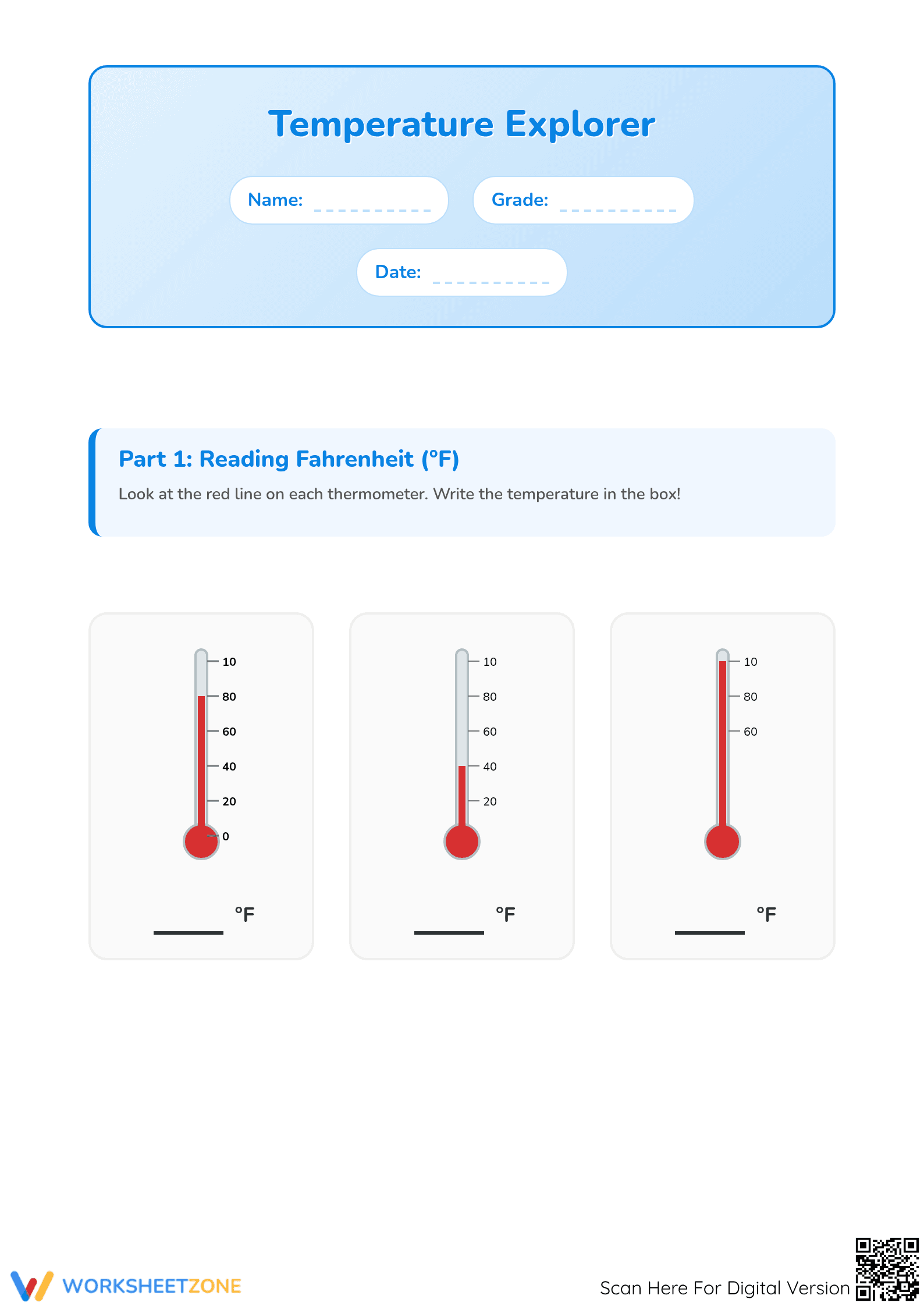
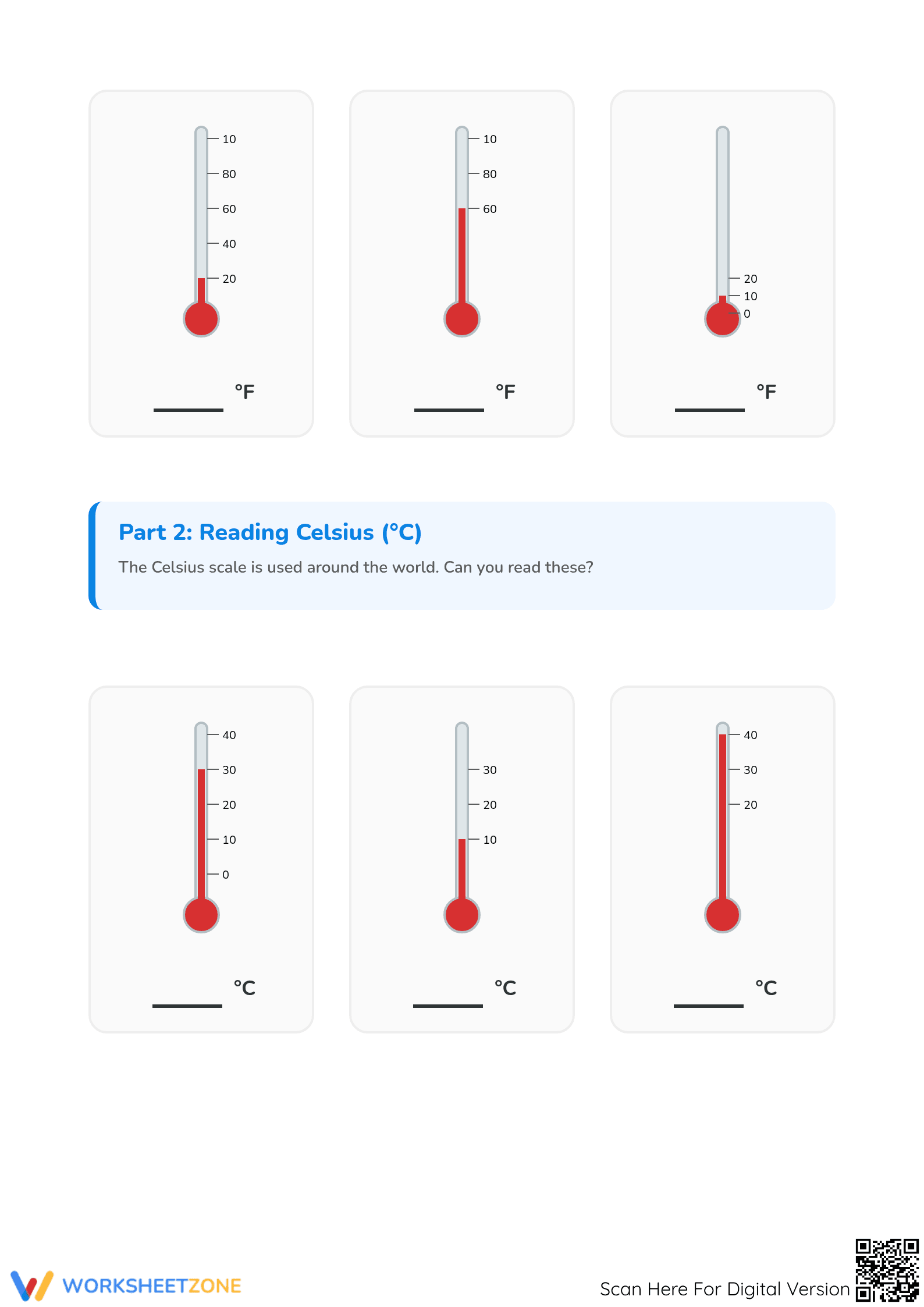
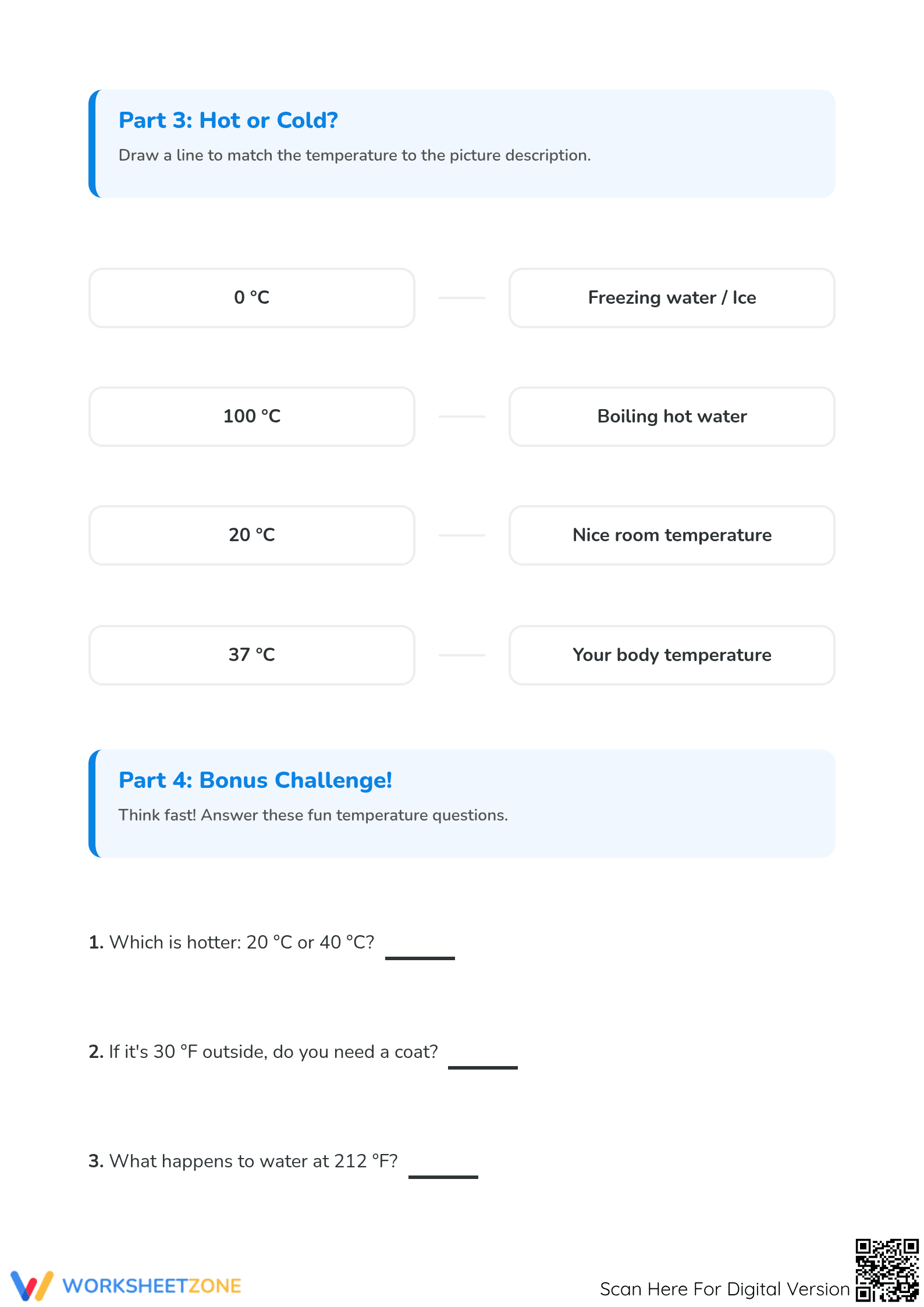
The Temperature Explorer packet is a comprehensive three-page journey into thermal measurement. Inside, students find 16 structured tasks including nine visual thermometer readings, a benchmark matching activity, and three bonus logic challenges. Each page includes clear visual cues and ample writing space, accompanied by a full answer key for teacher-led review or student self-correction. The layout uses high-contrast red indicators to help young learners focus on the meniscus of the thermometer line.
Skill Progression and Scaffolding
- Guided Observation (Part 1): Students analyze six Fahrenheit thermometers with clear 20-degree interval markings to build comfort with standard US units.
- Scale Comparison (Part 2): Three Celsius thermometers introduce the metric scale, requiring students to observe differing intervals and unit symbols.
- Logical Application (Parts 3 & 4): Students match four benchmark temperatures to verbal descriptions and solve three word-based comparison problems.
This sequence follows a gradual-release model, moving from direct visual interpretation to the abstract application of temperature facts without visual aids.
Standards Alignment
This resource aligns primary with `CCSS.MATH.CONTENT.2.MD.D.10` by requiring students to interpret scales and represent data found on a vertical number line. It also supports Science standards related to observable properties of matter. Both standard codes can be copied directly into lesson plans, IEP goals, or district curriculum mapping tools to ensure instructional accountability during measurement units.
How to Use It
This worksheet is most effective as independent practice following a direct instruction session on measurement tools. Teachers can use the "Bonus Challenge" section as a quick formative assessment to see which students have internalized the concept of "hotter" versus "colder" beyond just reading numbers. Expect most second-grade students to complete the three-page set in approximately 25 minutes during a math center or morning work rotation.
Who It's For
Designed for second-grade students, this worksheet is also suitable for third-grade review or first-grade enrichment. It provides excellent support for students who benefit from visual number lines and can be naturally paired with a classroom weather station or a physical thermometer demonstration to bridge the gap between paper tasks and real-world science observations.
Research by Fisher & Frey (2014) emphasizes that reading scales is a critical precursor to understanding more complex data representation. This worksheet applies those principles by forcing students to interact with vertical number lines in a context that has immediate real-world relevance. By mastering the CCSS.MATH.CONTENT.2.MD.D.10 standard through temperature reading, students develop the spatial reasoning required for later success in coordinate geometry and data analysis. The inclusion of both Fahrenheit and Celsius scales ensures students are prepared for the multi-system measurement demands of the 21st-century classroom. This resource serves as a proven tool for building the "measurement sense" necessary for students to accurately describe the physical world around them using standardized units and precise vocabulary.


