


























Views
Downloads



Printable Telling Time to the Hour Worksheet | Grade 2 Math
Paste this activity's link or code into your existing LMS (Google Classroom, Canvas, Teams, Schoology, Moodle, etc.).
Students can open and work on the activity right away, with no student login required.
You'll still be able to track student progress and results from your teacher account.
Mastery of telling time to the hour is a foundational skip-counting and measurement skill for young learners. This comprehensive four-page resource provides students with extensive practice in identifying hour hand positions and translating them into written notation. By engaging with multiple task types, students build the cognitive fluency required for advanced time-telling concepts.
At a Glance
- Grade: 2 · Subject: Math
- Standard:
2.MD.C.7— Tell and write time from analog and digital clocks to the nearest hour- Skill Focus: Telling time to the hour
- Format: 4 pages · 27 problems · Answer key included · PDF
- Best For: Morning work and independent practice
- Time: 20–30 minutes
What's Inside
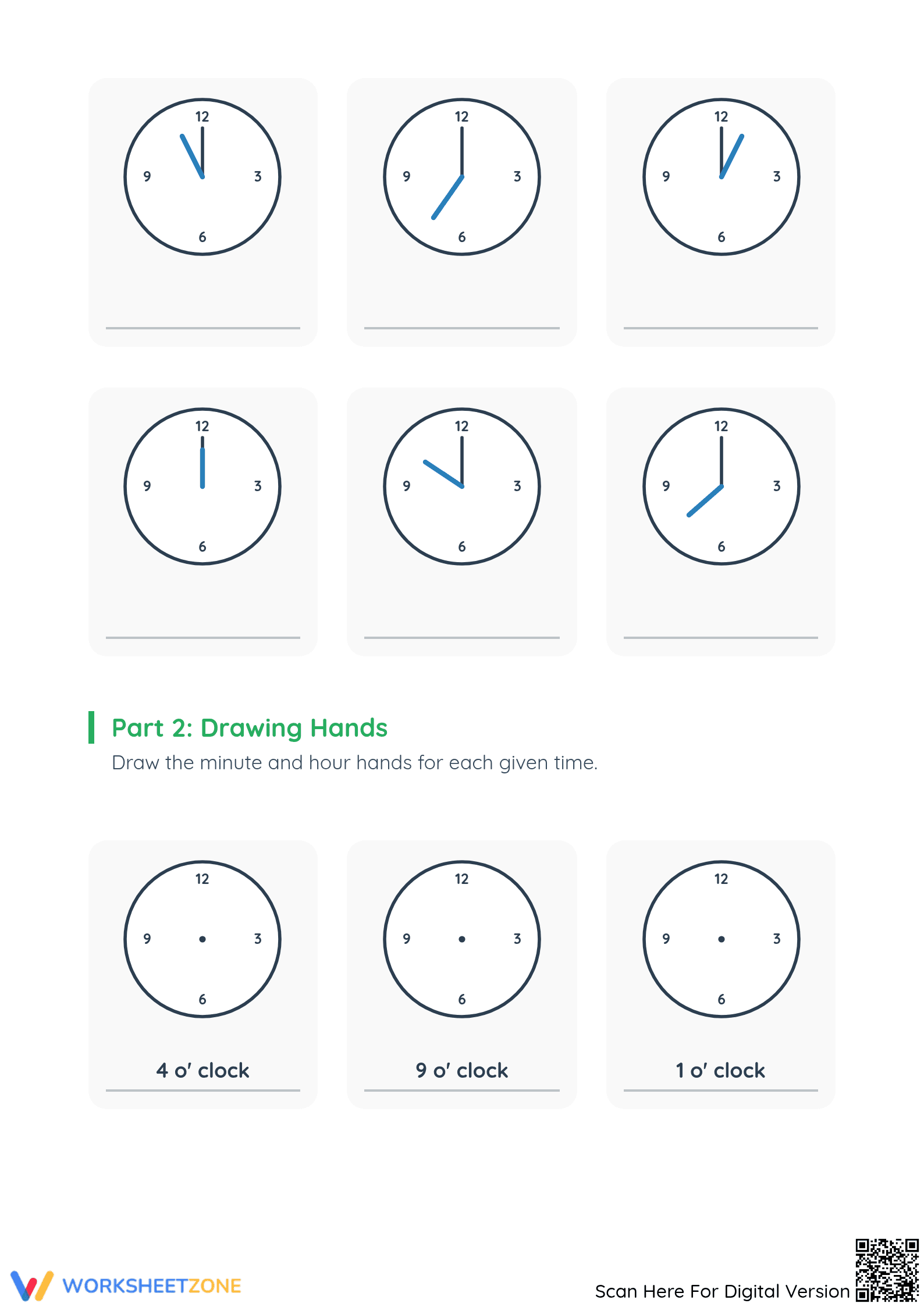
This 4-page packet contains 27 unique problems across four distinct sections. Part 1 and 2 focus on reading 12 analog clocks and writing the time in "o' clock" format. Part 2 transitions to drawing both the minute and hour hands for six specified times. Part 3 applies these skills to a daily routine log, while the final page offers three "Bonus Challenge" questions that introduce time intervals and clock anatomy.
Skill Progression
- Guided practice: Students begin by identifying times on 12 pre-drawn analog clocks, focusing exclusively on the hour hand position with the minute hand fixed at 12.
- Supported practice: The worksheet shifts to productive tasks where students must draw both clock hands to represent specific hour intervals, reinforcing spatial awareness.
- Independent practice: Real-world application tasks require students to log their own daily schedules, transitioning from abstract math to functional life skills.
This sequence follows the gradual-release model to ensure students move confidently from recognition to creation.
Standards Alignment
This resource is primary aligned to CCSS.MATH.CONTENT.2.MD.C.7, which requires students to tell and write time from analog and digital clocks. While this specific worksheet focuses on the hour interval, it serves as the essential scaffolding for the full standard requirement of five-minute intervals. Both standard codes can be copied directly into lesson plans, IEP goals, or district curriculum mapping tools.
How to Use It
Assign Part 1 and 2 as a formative assessment during a math station to identify which students struggle with hand differentiation. Part 3 makes an excellent homework assignment to involve parents in discussing daily routines. Total completion time ranges from 20 to 30 minutes depending on whether the bonus challenges are included in the session.
Who It's For
This worksheet is designed for Grade 2 students but is also suitable for Grade 3 and 4 students requiring remediation or RTI support. It pairs naturally with an analog classroom clock or an interactive whiteboard demonstration to provide a multisensory learning experience.
According to the research of Fisher & Frey (2014) regarding the Gradual Release of Responsibility, effective math instruction requires a shift from teacher modeling to independent application. This worksheet facilitates that transition by moving from simple recognition of clock faces to the active construction of time representations. Aligned with standard 2.MD.C.7, the resource ensures that students master the foundational concept of telling time to the hour before progressing to more complex five-minute calculations. By integrating drawing tasks and real-world routine logging, the worksheet addresses both the procedural and conceptual components of math standards. This evidence-based approach to mathematical fluency reduces cognitive load by focusing on a single time interval, allowing for greater retention of clock hand functions. Such structured practice is essential for building the prerequisite skills needed for upper-grade measurement and data domains.


