




























Views
Downloads


Essential Telling Time Notes | Grade 1 Math

Paste this activity's link or code into your existing LMS (Google Classroom, Canvas, Teams, Schoology, Moodle, etc.).
Students can open and work on the activity right away, with no student login required.
You'll still be able to track student progress and results from your teacher account.
This Grade 1 math worksheet provides a structured framework for students to master the basics of telling time. By using a guided-notes format, the resource ensures that learners capture essential information about clock faces and time units. Students will successfully identify the differences between the hour and minute hands, creating a solid foundation for future time-telling proficiency.
At a Glance
- Grade: 1 · Subject: Math
- Standard:
CCSS.MATH.CONTENT.1.MD.B.3— Tell and write time in hours and half-hours using analog clocks- Skill Focus: Clock parts and time vocabulary
- Format: 3 pages · 11 problems · Answer key included · PDF
- Best For: Guided note-taking and introductory lessons
- Time: 15–20 minutes
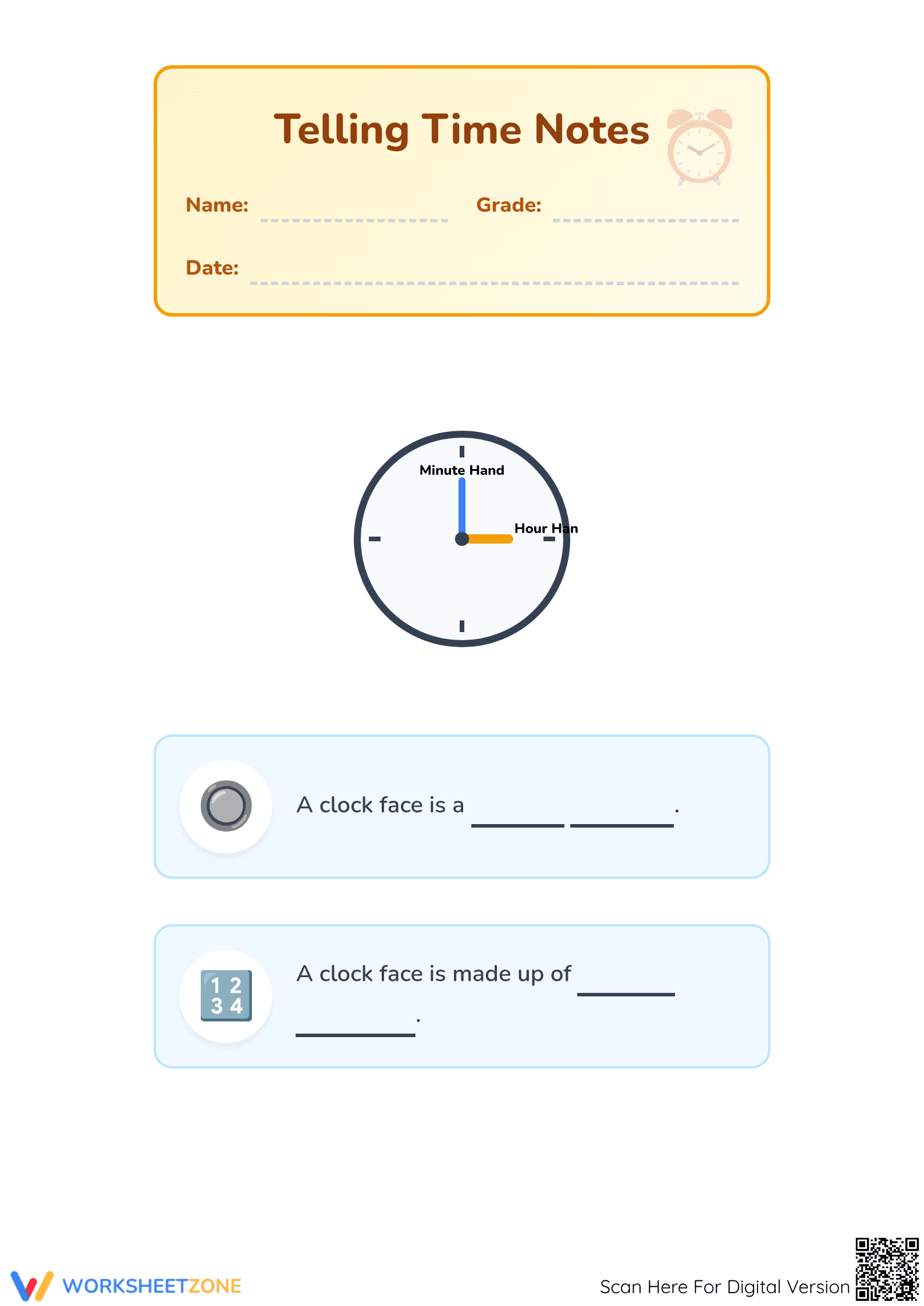
The packet consists of three organized pages for young learners. It features a labeled clock diagram to help students visualize the "Minute Hand" and "Hour Hand." The first two pages contain nine fill-in-the-blank sentences defining a clock face, minutes in an hour, and the duration of a day. The final page includes a "Quick Check" with two True/False questions to verify comprehension.
Zero-Prep Workflow
The zero-prep design allows for immediate classroom integration. First, print the three-page PDF for each student (30 seconds). Second, distribute the notes during direct instruction, allowing students to fill in the blanks as you model clock parts (15 minutes). Finally, use the "Quick Check" on the third page to gauge understanding (2 minutes). This workflow is ideal for substitute folders or as a structured introduction to a math unit.
Standards Alignment
This resource is designed to meet `CCSS.MATH.CONTENT.1.MD.B.3`, which focuses on telling and writing time in hours and half-hours using analog clocks. The worksheet builds the prerequisite vocabulary and conceptual understanding of clock mechanics necessary to meet this benchmark. Both standard codes can be copied directly into lesson plans, IEP goals, or district curriculum mapping tools.
How to Use It
Use this worksheet during the "I Do" and "We Do" phases of a lesson. As you display a classroom clock, have students fill in their notes to mirror your instruction. This creates a permanent reference tool for math folders. Alternatively, assign it as a formative assessment after an introductory video. Expect students to complete the full packet in approximately 15 to 20 minutes.
Who It's For
This worksheet is ideal for first-grade students introduced to analog clocks for the first time. It is also effective for second-grade students needing a refresher or for ESL/ELL students who benefit from scaffolded sentence structures. Pair this resource with a set of individual manipulative clocks or a "Telling Time" anchor chart to provide a multi-sensory learning experience.
According to the RAND AIRS 2024 report on early elementary mathematics, structured guided notes improve the retention of abstract concepts like temporal measurement. This worksheet aligns with the CCSS.MATH.CONTENT.1.MD.B.3 standard, requiring students to tell and write time in hours and half-hours. By providing a visual clock diagram and scaffolded fill-in-the-blank sentences, the resource reduces cognitive load, allowing first-grade learners to focus on the relationship between the hour and minute hands. Research from Fisher & Frey (2014) emphasizes that the gradual release of responsibility begins with clear modeling and shared notation, which this packet facilitates through its "Quick Check" formative assessment. Educators can utilize these 11 tasks to establish a common vocabulary for analog clocks, ensuring students accurately identify the short hand and long hand before progressing to complex skills.


