


























Views
Downloads

Teacher Appreciation Writing Activity | Grade 7-8 Ready
Paste this activity's link or code into your existing LMS (Google Classroom, Canvas, Teams, Schoology, Moodle, etc.).
Students can open and work on the activity right away, with no student login required.
You'll still be able to track student progress and results from your teacher account.
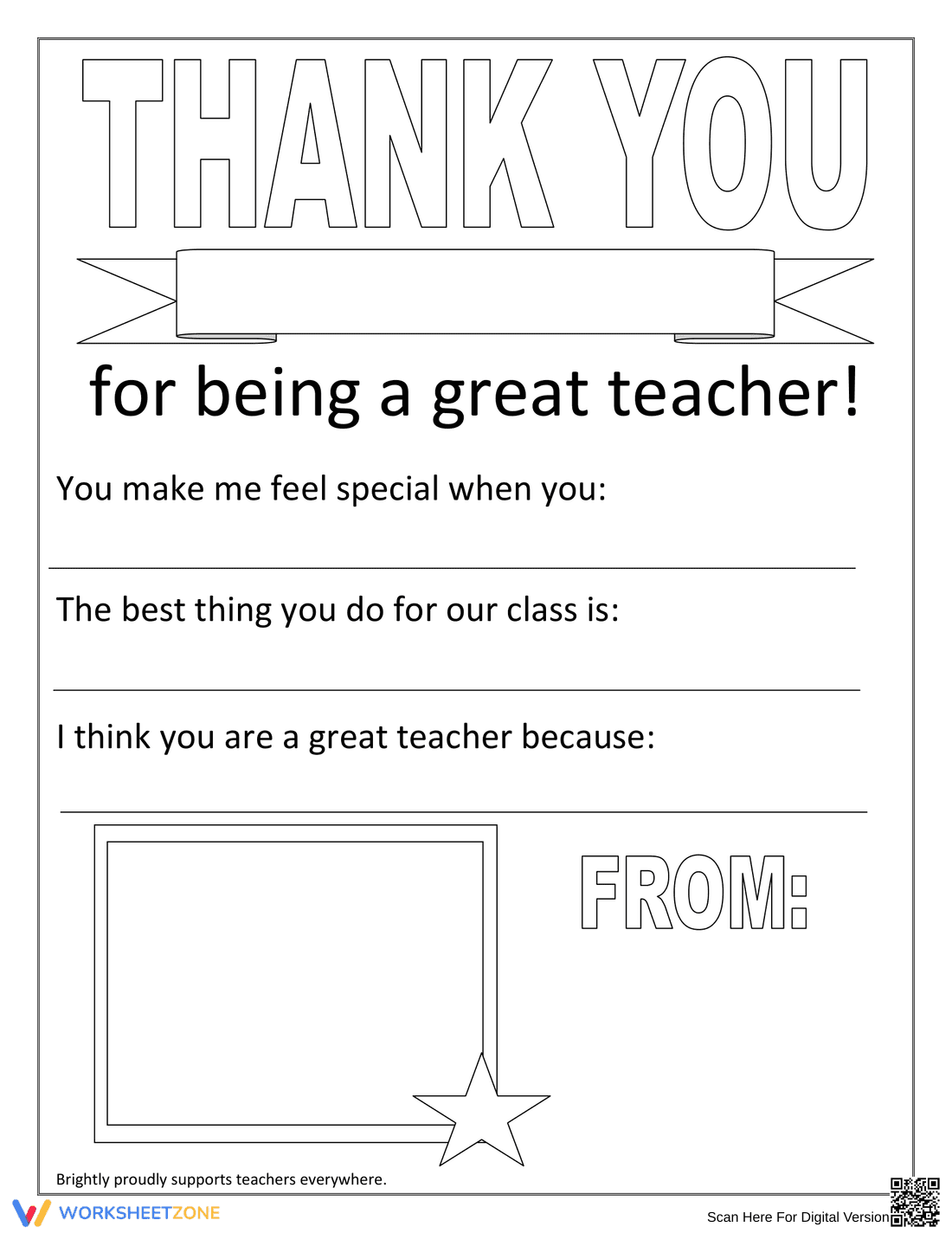
This Grade 7 and 8 Teacher Appreciation writing activity provides students with a structured way to express gratitude through specific, evidence-based reflections. By completing the guided prompts, students practice adapting their writing style for a specific audience and purpose, resulting in a meaningful, personalized tribute that reinforces positive classroom culture.
At a Glance
- Grade: 7-8 · Subject: English
- Standard:
CCSS.ELA-LITERACY.W.7.4— Produce clear writing appropriate to task, purpose, and audience- Skill Focus: Expressive Writing & Gratitude
- Format: 1 page · 4 tasks · No answer key · PDF
- Best For: Teacher Appreciation Week or End-of-Year
- Time: 15–20 minutes
What's Inside: The worksheet features three distinct sentence starters designed to elicit specific examples of teacher impact. It includes a dedicated space for a custom illustration and a signature line. The layout is clean and professional, ensuring that the final product is suitable for presentation to staff members or inclusion in a portfolio.
The zero-prep workflow is designed for maximum efficiency in a busy classroom. First, print the single-page PDF (30 seconds). Second, distribute the sheets and explain the importance of using specific details in expressive writing to make the message more impactful (1 minute). Third, allow students to work independently while you provide light feedback on their word choice (15 minutes). Total teacher preparation time is under two minutes, making this an ideal resource for sub plans or seasonal transitions.
Standards Alignment: This resource aligns with `CCSS.ELA-LITERACY.W.7.4`, which requires students to produce clear and coherent writing where the development and organization are appropriate to the task. By focusing on a real-world audience, students learn to modulate their tone and select appropriate vocabulary. Both standard codes can be copied directly into lesson plans, IEP goals, or district curriculum mapping tools.
How to Use It: Use this activity during Teacher Appreciation Week as a warm-up or as a reflective closing activity at the end of the school year. For formative assessment, observe how students transition from general praise to specific anecdotal evidence within their responses. Completion typically takes 15 to 20 minutes depending on the detail of the drawing and the depth of the written reflection.
Who It's For: This is ideal for middle school students in Grade 7 and 8 who are developing social-emotional awareness and audience sensitivity. It serves as an excellent pairing for a unit on personal narratives or letter writing. The scaffolded prompts support students who may struggle with open-ended writing tasks while allowing for creative expression through the illustration box.
According to the RAND AIRS 2024 report, integrating social-emotional learning tasks like gratitude writing into the English Language Arts curriculum significantly improves student engagement and school climate. This worksheet addresses CCSS.ELA-LITERACY.W.7.4 by challenging students to consider their audience—the educator—and select vocabulary that accurately conveys their personal experiences. Research from Fisher & Frey (2014) suggests that scaffolded writing prompts, such as the sentence frames provided here, help middle school learners bridge the gap between internal thoughts and formal written expression. By requiring students to identify specific actions that make them feel "special," the activity moves beyond superficial compliments toward evidence-based writing. This approach ensures that the writing task remains academically rigorous while fulfilling its primary purpose as a seasonal appreciation activity. The inclusion of a visual component further supports diverse learners by allowing for non-verbal communication of complex emotions alongside their written work.


