


























Views
Downloads
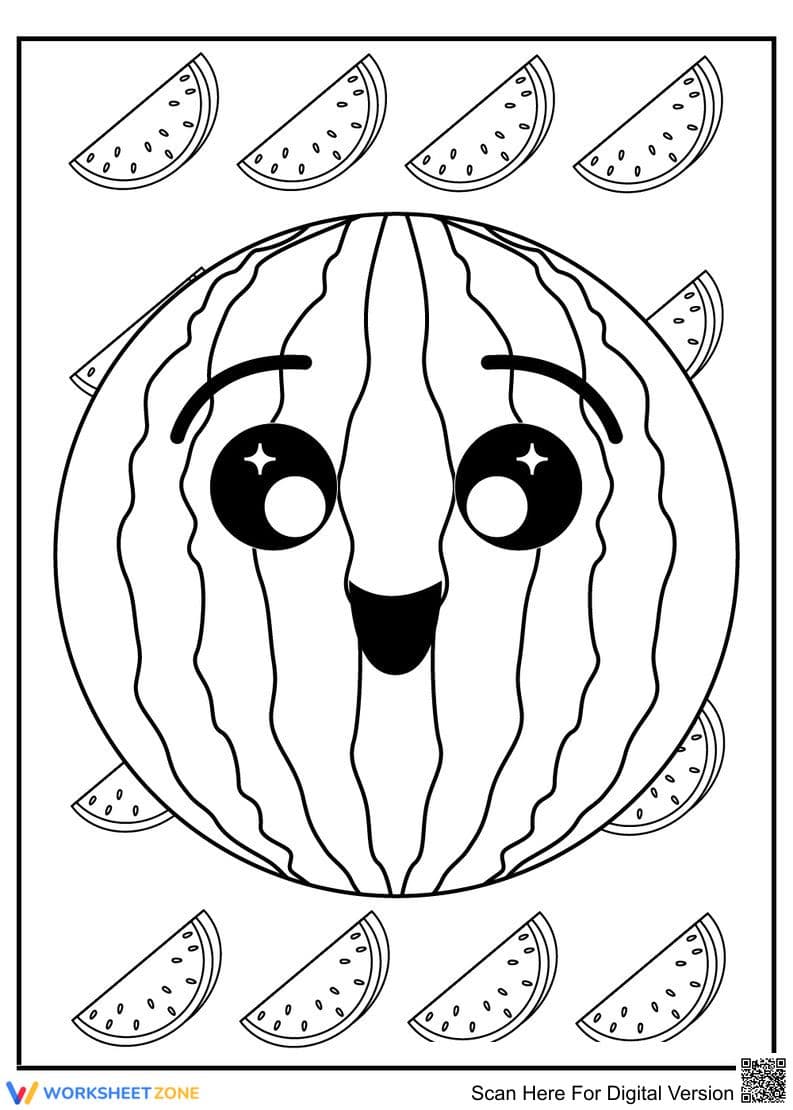

Printable Watermelon Coloring Page: Preschool & Kindergarten
Paste this activity's link or code into your existing LMS (Google Classroom, Canvas, Teams, Schoology, Moodle, etc.).
Students can open and work on the activity right away, with no student login required.
You'll still be able to track student progress and results from your teacher account.
This printable watermelon coloring worksheet provides young learners with a creative way to develop fine motor control while reinforcing fruit-themed vocabulary. By engaging with the large central character and surrounding slices, students practice precision and color selection. It serves as an effective tool for early childhood classrooms focusing on healthy eating or summer themes.
At a Glance
- Grade: Preschool – Grade 1 · Subject: Arts & English
- Standard:
CCSS.ELA-LITERACY.L.K.6— Use words and phrases acquired through conversations and reading about fruits- Skill Focus: Fine motor development
- Format: 1 page · 1 coloring task · Answer key N/A · PDF
- Best For: Morning work or early finishers
- Time: 15–20 minutes
Inside this PDF, you will find a single-page high-resolution coloring sheet featuring a "kawaii" style whole watermelon with expressive eyes and a smile. Surrounding the main character are 10 smaller watermelon slices, allowing for repetitive practice with color patterns and shading. The clear, bold outlines are designed specifically for small hands still mastering grip and boundary awareness.
The zero-prep workflow for this resource is designed for maximum efficiency in busy classrooms. First, print the single-page PDF (30 seconds). Second, distribute the sheets along with crayons or colored pencils to your students (1 minute). Third, review the name of the fruit and its colors—green rind and red interior—as a group (30 seconds). Total teacher preparation time is under 2 minutes, making it an ideal emergency sub plan or transition activity.
This resource aligns with CCSS.ELA-LITERACY.L.K.6, which focuses on acquiring and using conversational words and phrases. By identifying the watermelon and its parts, students build the linguistic foundation necessary for describing the world around them. This standard code can be copied directly into lesson plans, IEP goals, or district curriculum mapping tools to document vocabulary exposure.
Use this worksheet during a "Healthy Foods" unit to introduce the concept of rinds and seeds. It works best as a quiet-time activity after direct instruction about different types of fruit. For a formative assessment, observe how students handle their coloring tools; look for a tripod grip and the ability to stay within the lines as an indicator of manual dexterity. Completion typically takes 15 to 20 minutes.
This worksheet is primarily for Preschool, Kindergarten, and Grade 1 students. It is particularly beneficial for English Language Learners (ELLs) who need visual aids to connect new vocabulary with physical objects. Pair this coloring page with a real watermelon tasting or a picture book about gardening to create a multi-sensory learning experience that anchors the vocabulary in memory.
Research from Fisher & Frey (2014) emphasizes that integrating visual arts with vocabulary acquisition supports the gradual release of responsibility by providing a low-stakes environment for language practice. Coloring activities, while often viewed as purely recreational, serve a vital role in early childhood development by strengthening the intrinsic muscles of the hand. According to the NAEP, fine motor proficiency in early grades is a significant predictor of later academic success in writing and mathematics. This CCSS.ELA-LITERACY.L.K.6 aligned resource allows educators to bridge the gap between creative expression and standard-based linguistic goals. By focusing on a single, recognizable object like a watermelon, students can concentrate on the physical task of coloring while the teacher facilitates verbal labeling. This dual-coding approach ensures that the plain-English skill of identifying common objects is reinforced through both tactile and visual channels, making it a staple for any early elementary curriculum.


