


























Views
Downloads
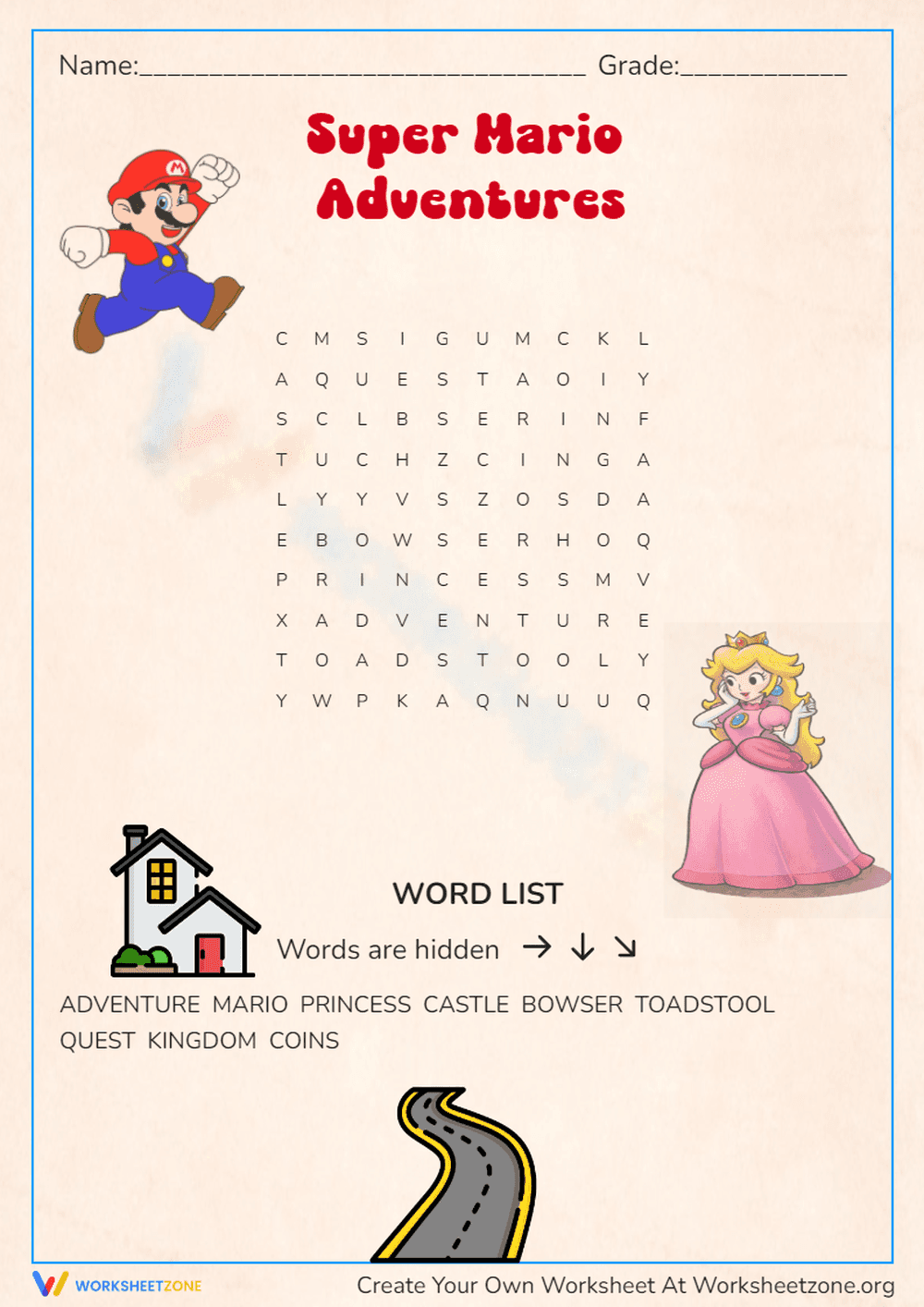

Mario Word Search | Printable Grade 3 ELA
Paste this activity's link or code into your existing LMS (Google Classroom, Canvas, Teams, Schoology, Moodle, etc.).
Students can open and work on the activity right away, with no student login required.
You'll still be able to track student progress and results from your teacher account.
This engaging Super Mario word search worksheet provides students with a fun, themed approach to building vocabulary and spelling recognition. By scanning the grid for familiar character names and adventure terms, young learners actively practice letter sequencing and visual discrimination skills while enjoying a highly motivating context.
At a Glance
- Grade: 3 · Subject: ELA
- Standard:
CCSS.ELA-LITERACY.L.3.2— Spell grade-appropriate words correctly- Skill Focus: Spelling and visual scanning
- Format: 1 page · 9 problems · Answer key included · PDF
- Best For: Morning work or early finishers
- Time: 10–15 minutes
Inside this single-page resource, educators will find a clearly formatted ten-by-ten letter grid featuring nine hidden words related to the popular video game franchise. The vocabulary list includes terms like adventure, princess, castle, and kingdom. Words are hidden horizontally, vertically, and diagonally to provide an appropriate level of challenge. A complete answer key is provided to ensure quick and accurate grading.
Zero-Prep Workflow
This resource is designed for immediate classroom implementation. The workflow is simple:
- Print (1 minute): Generate the required number of copies directly from the PDF file.
- Distribute (1 minute): Hand out the puzzle to students as they enter the room or transition between subjects.
- Review (3 minutes): Display the answer key on the smartboard for quick self-correction.
With a total teacher prep time of under two minutes, this activity serves as an excellent emergency sub plan or a reliable filler for unexpected schedule changes.
Standards Alignment
This activity aligns with CCSS.ELA-LITERACY.L.3.2: Demonstrate command of the conventions of standard English capitalization, punctuation, and spelling when writing. By searching for specific letter sequences, students reinforce their orthographic mapping skills. It also supports general vocabulary acquisition by exposing students to domain-specific words. Both standard codes can be copied directly into lesson plans, IEP goals, or district curriculum mapping tools.
How to Use It
This worksheet functions perfectly as morning work or as an independent activity for early finishers. Expected completion time ranges from ten to fifteen minutes. For a formative assessment observation tip, watch how students search for words: do they scan line-by-line systematically, or look for the first letter and check surrounding letters? This behavior provides insight into their visual tracking and decoding strategies.
Who It's For
This resource is primarily designed for elementary students in grades one through five who benefit from high-interest, gamified learning materials. To differentiate for students needing extra support, teachers can highlight the first letter of each hidden word on their specific copy. This puzzle pairs exceptionally well with a creative writing prompt asking students to draft their own short story using at least five words from the provided vocabulary list.
Integrating thematic puzzles into literacy routines offers measurable benefits for early elementary learners. According to Fisher & Frey (2014), providing students with highly engaging, familiar contexts significantly increases their time on task and willingness to persist through challenging cognitive exercises. When students work to spell grade-appropriate words correctly, as outlined in CCSS.ELA-LITERACY.L.3.2, they rely heavily on visual memory and orthographic mapping. Word searches require learners to hold a specific letter sequence in their working memory while visually scanning a distracting background, a process that strengthens overall reading fluency and spelling accuracy. By utilizing popular cultural references, educators lower the affective filter, making foundational skills practice feel like a rewarding puzzle. This approach ensures that essential vocabulary repetition occurs naturally, supporting long-term retention.


