


























Views
Downloads

Sunflower Life Cycle Worksheet | Essential Grade 6 Science
Paste this activity's link or code into your existing LMS (Google Classroom, Canvas, Teams, Schoology, Moodle, etc.).
Students can open and work on the activity right away, with no student login required.
You'll still be able to track student progress and results from your teacher account.
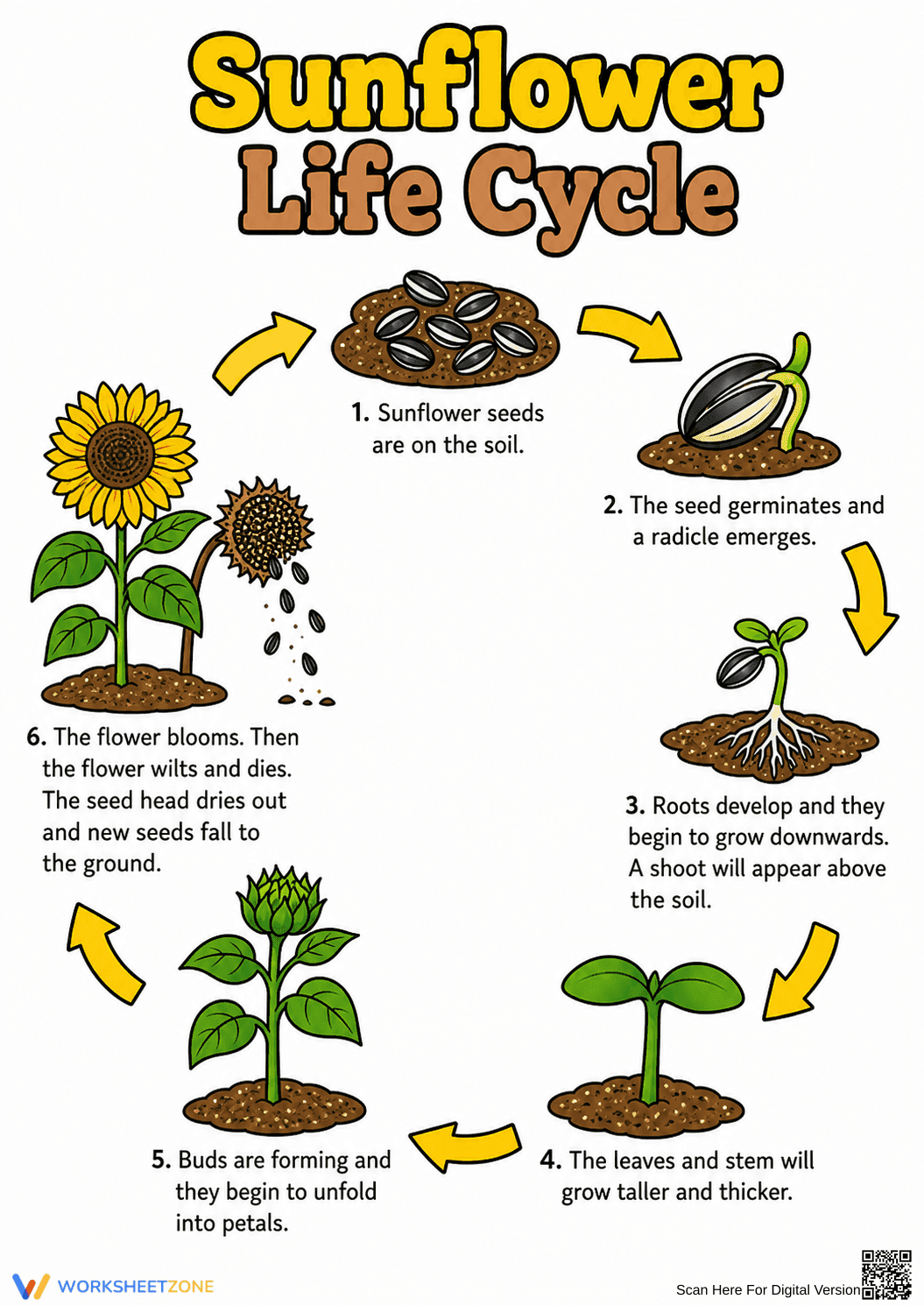
This sunflower life cycle worksheet provides a clear, visual breakdown of the six critical stages of plant development. Students observe the transition from seed germination to mature blooming and seed dispersal. It serves as a foundational tool for understanding biological cycles and the specialized structures plants use to ensure survival and reproduction.
At a Glance
- Grade: 6 · Subject: Science
- Standard:
MS-LS1-4— Use evidence to explain how plant structures affect successful reproduction- Skill Focus: Biological sequencing and botany vocabulary
- Format: 1 page · 6 stages · Reference diagram · PDF
- Best For: Visual learners and introductory biology units
- Time: 15–20 minutes
The worksheet features a high-quality circular diagram illustrating the sunflower's journey. It includes six numbered stages: soil-bound seeds, radicle emergence, root and shoot development, stem thickening, bud formation, and the final bloom-to-wilt phase. Each stage is paired with concise descriptive text and directional arrows to emphasize the continuous nature of the cycle.
- Print: Select the single-page PDF and print enough copies for your class in under 30 seconds.
- Distribute: Hand out the sheets as a warm-up or reference guide during your botany lecture.
- Review: Spend 5 minutes discussing the transition between stages 5 and 6 to highlight seed dispersal.
Total teacher preparation time is less than 2 minutes, making this an ideal resource for sub plans or last-minute lesson enhancements.
This resource aligns with MS-LS1-4. It specifically addresses how the sunflower's life cycle stages, such as bud formation and seed dispersal, are specialized structures that facilitate reproduction. Students can use the diagram to identify the "wilting and seed dispersal" stage as the primary mechanism for the next generation's success. Both standard codes can be copied directly into lesson plans, IEP goals, or district curriculum mapping tools.
Use this worksheet as a visual anchor during direct instruction on plant biology. Have students color-code the different stages to differentiate between vegetative growth and reproductive phases. It also works well as a formative assessment tool; ask students to cover the text and describe what is happening in each illustration based on visual cues alone. Expected completion for a guided review is 15 minutes.
This worksheet is designed for middle school students, particularly those in Grade 6, who require clear visual aids to grasp complex biological processes. It is highly effective for English Language Learners (ELLs) due to the strong image-to-text correlation. Pair this with a hands-on seed planting activity or a digital microscope exploration of sunflower seeds for a comprehensive learning experience.
According to the RAND AIRS 2024 report on instructional materials, high-quality visual representations are essential for student retention of cyclical scientific concepts. This worksheet utilizes the MS-LS1-4 standard to bridge the gap between simple observation and evidence-based scientific explanation. By focusing on the six distinct stages of the sunflower life cycle, the resource provides the necessary scaffolding for students to understand how plant structures contribute to reproductive success. Research from Fisher & Frey (2014) emphasizes that visual sequencing tools help students build mental models of complex systems, which is critical for mastery in middle school life sciences. This printable resource ensures that all learners, regardless of reading level, can access the core curriculum and participate in classroom discussions regarding botany and environmental science.


