


























Views
Downloads
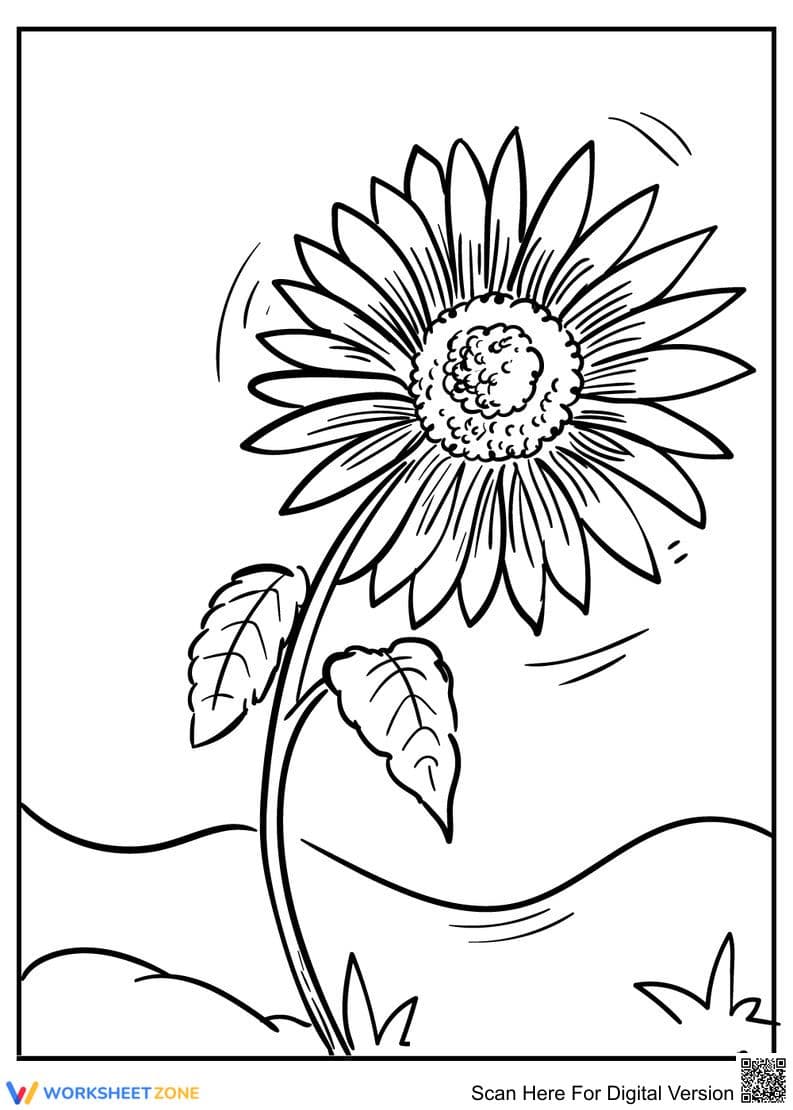

Sunflower Coloring Worksheet | Grade K-5 Essential
Paste this activity's link or code into your existing LMS (Google Classroom, Canvas, Teams, Schoology, Moodle, etc.).
Students can open and work on the activity right away, with no student login required.
You'll still be able to track student progress and results from your teacher account.
This Grade K-5 sunflower coloring worksheet provides a creative outlet for students to practice fine motor control and visual storytelling. By engaging with the Sunflower in the Breeze prompt, learners develop hand-eye coordination while exploring nature-themed art. It serves as a perfect supplemental activity for science units on plants or as a calming creative break.
At a Glance
- Grade: K-5 · Subject: Arts & English
- Standard:
CCSS.ELA-LITERACY.SL.K.5— Add visual details to descriptions to provide additional information and clarity- Skill Focus: Fine motor control & creative drawing
- Format: 1 page · 1 task · No answer key required · PDF
- Best For: Early finisher activity or nature units
- Time: 15–20 minutes
This single-page PDF features a high-quality line-art illustration of a sunflower with motion lines suggesting wind. The composition includes a foreground with grass and a background horizon line, leaving ample white space for students to add their own environmental details like insects, clouds, or the sun. The clear, bold outlines are designed to support younger learners in staying within the lines while practicing pencil or crayon control.
The workflow for this resource is designed for maximum efficiency in busy classrooms. First, print the single-page PDF (30 seconds). Second, distribute the sheets along with crayons, colored pencils, or markers (1 minute). Third, allow students to work independently while you provide verbal prompts about what else might be moving in the breeze (0 minutes prep). Total teacher preparation time is under 2 minutes, making it an ideal sub plan or transition activity.
This worksheet aligns with CCSS.ELA-LITERACY.SL.K.5, which encourages students to add drawings or other visual displays to descriptions to provide additional detail. While primarily an art activity, the prompt "what are some other things you could draw?" pushes students to expand the visual narrative and think critically about the environment. This standard code can be copied directly into lesson plans, IEP goals, or district curriculum mapping tools.
Use this worksheet during a "Parts of a Plant" science lesson to reinforce the visual structure of a sunflower. Alternatively, assign it as a formative assessment for fine motor development in Kindergarten. Observe how students handle coloring tools and whether they can follow the prompt to add original details. Completion typically takes 15 to 20 minutes depending on the level of detail added by the student.
This resource is ideal for Kindergarten through 2nd-grade students focusing on motor skills, though older students in grades 3-5 can use it for advanced shading techniques. It is a natural pairing for a nature-themed read-aloud or an anchor chart about the life cycle of a sunflower. The open-ended nature of the drawing prompt allows for easy differentiation by interest.
According to research by Fisher & Frey (2014) on the gradual release of responsibility, visual representation serves as a critical bridge between conceptual understanding and linguistic expression. This worksheet utilizes the CCSS.ELA-LITERACY.SL.K.5 standard to facilitate this transition, allowing students to demonstrate their understanding of nature through creative drawing. By asking students to add to the composition, the resource moves beyond simple coloring into visual literacy and descriptive detail. Studies from the NAEP suggest that integrating arts into core subjects like English and Science improves student engagement and retention of thematic vocabulary. This 1-page printable provides a structured yet flexible environment for students to practice the fine motor skills necessary for writing while exploring the biological features of a sunflower. It is a reliable tool for early childhood educators seeking to balance academic standards with creative development.


