


























Views
Downloads
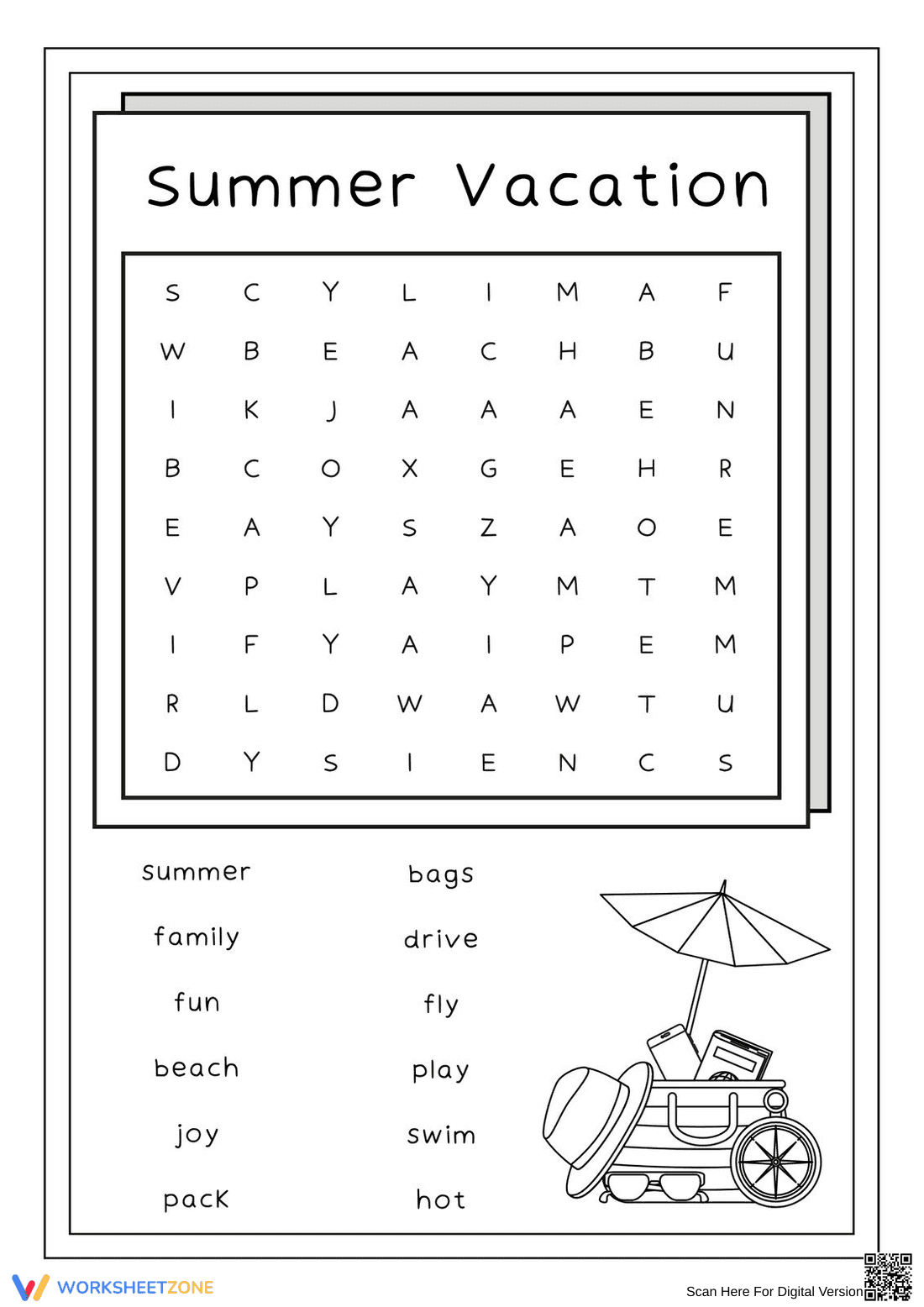

Summer Vacation Word Search | Grade 1 Printable
Paste this activity's link or code into your existing LMS (Google Classroom, Canvas, Teams, Schoology, Moodle, etc.).
Students can open and work on the activity right away, with no student login required.
You'll still be able to track student progress and results from your teacher account.
This printable Grade 1 word search worksheet builds foundational reading skills by having students identify and circle 12 summer-themed vocabulary words. By visually scanning for familiar terms like "beach" and "swim," early readers reinforce their spelling patterns and word recognition in a fun, engaging format.
At a Glance
- Grade: 1 · Subject: ELA
- Standard:
CCSS.ELA-LITERACY.RF.1.3— Apply grade-level phonics and word analysis skills.- Skill Focus: Vocabulary and Word Recognition
- Format: 1 page · 12 problems · No answer key · PDF
- Best For: Morning work or early finishers
- Time: 10–15 minutes
This single-page puzzle features a clear, easy-to-read grid containing 12 seasonal vocabulary words hidden horizontally and vertically. A straightforward word bank at the bottom provides visual support, allowing students to cross off terms as they find them. The worksheet also includes a black-and-white summer illustration that students can color once they complete the primary task, adding an extra layer of engagement.
Zero-Prep Workflow
This resource is designed for immediate classroom implementation with absolutely no teacher setup required.
- Print (1 minute): Simply download the PDF and print a class set. The black-and-white design saves ink.
- Distribute (1 minute): Hand out to students during transitions or morning routines. The instructions are self-explanatory.
- Review (3 minutes): Quickly check student progress by scanning their circled words against the provided word bank.
With a total prep time of under two minutes, this activity is an excellent addition to any emergency sub plan or Friday afternoon routine.
Standards Alignment
This activity aligns with CCSS.ELA-LITERACY.RF.1.3, which requires students to know and apply grade-level phonics and word analysis skills in decoding words. By searching for specific letter sequences, learners practice orthographic mapping and reinforce their visual memory of high-frequency words. Both standard codes can be copied directly into lesson plans, IEP goals, or district curriculum mapping tools.
How to Use It
This word search serves as an ideal morning work assignment to settle students as they enter the classroom. It also functions perfectly as an independent activity for early finishers during literacy centers. While students work, teachers can conduct quick formative assessments by observing how efficiently learners scan for initial consonant sounds and track left-to-right across the grid. Most first graders will complete this task within a 10 to 15-minute timeframe.
Who It's For
This worksheet is primarily designed for first-grade students developing their sight word recognition and spelling skills. It offers natural differentiation for visual learners who benefit from seeing words in a grid format. For a comprehensive seasonal lesson, pair this puzzle with a read-aloud book about summer vacation or a collaborative anchor chart brainstorming warm-weather activities.
Integrating thematic vocabulary exercises like this summer word search provides meaningful repetition for early readers. Aligned to CCSS.ELA-LITERACY.RF.1.3, the activity requires students to apply grade-level phonics and word analysis skills in a low-stakes environment. According to Fisher & Frey (2014), providing students with structured, independent practice opportunities is critical for transferring newly acquired vocabulary into long-term memory. Word searches specifically encourage orthographic mapping, as children must attend to the exact sequence of letters to locate the target word. This visual scanning process strengthens letter-sound correspondence and builds reading fluency. By combining a familiar seasonal theme with targeted word recognition tasks, educators can effectively support literacy development while maintaining high levels of student engagement. This resource ensures that foundational reading practice remains both rigorous and accessible for young learners.


