


























Views
Downloads

Grade 1 Addition Practice — Printable No-Prep Worksheet
Paste this activity's link or code into your existing LMS (Google Classroom, Canvas, Teams, Schoology, Moodle, etc.).
Students can open and work on the activity right away, with no student login required.
You'll still be able to track student progress and results from your teacher account.
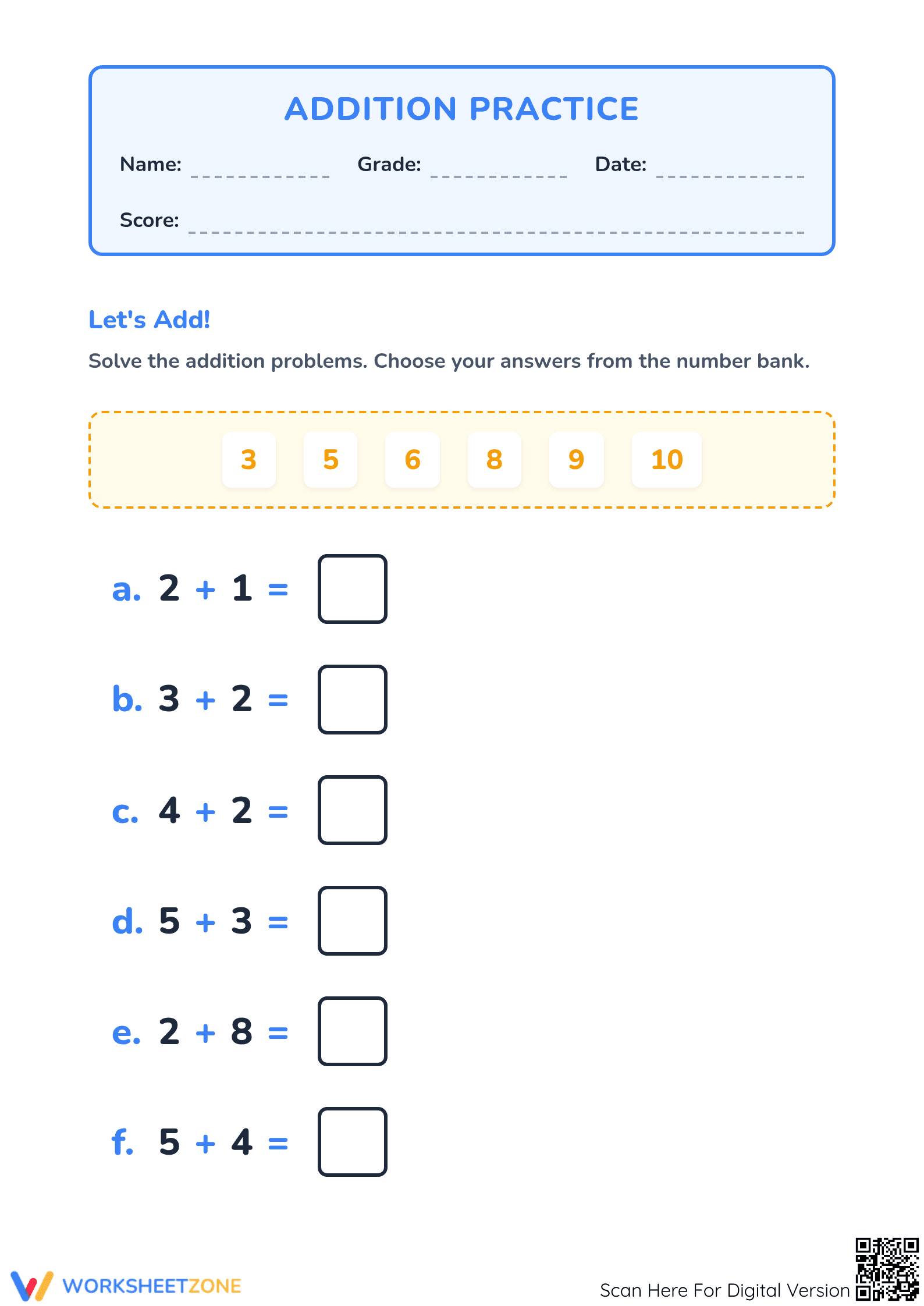
This Grade 1 addition worksheet provides students with focused practice on basic sums within ten. By utilizing a helpful number bank, learners can independently solve six horizontal addition problems to build computational fluency. This resource ensures students gain confidence in their mental math abilities while providing a clear structure for early arithmetic success.
At a Glance
- Grade: 1 · Subject: Math
- Standard:
CCSS.MATH.CONTENT.1.OA.C.6— Add and subtract within 20, demonstrating fluency for addition and subtraction within 10- Skill Focus: Single-digit addition within 10
- Format: 1 page · 6 problems · Answer key included · PDF
- Best For: Independent morning work or quick assessment
- Time: 5–10 minutes
What's Inside
Inside this resource, you will find a single-page layout designed for clarity and ease of use. It features six horizontal addition equations with designated answer boxes. A prominent number bank at the top of the page acts as a scaffold, helping students self-correct and narrow down potential sums. The document includes a full answer key for rapid grading and feedback.
Zero-Prep Workflow
- Print: Open the PDF and print the single-page worksheet in seconds.
- Distribute: Hand out the sheets to students as a transition activity or bell-ringer.
- Review: Use the provided answer key for immediate grading or have students check their own work using the number bank.
Total teacher preparation time is under 2 minutes, making this an ideal choice for emergency sub plans or busy morning routines.
Standards Alignment
This worksheet aligns with CCSS.MATH.CONTENT.1.OA.C.6, which requires students to demonstrate fluency for addition and subtraction within 10. It specifically targets the ability to combine two single-digit numbers to find a sum. This standard code can be copied directly into lesson plans, IEP goals, or district curriculum mapping tools.
How to Use It
Use this worksheet as a formative assessment after a lesson on basic addition properties. It is also an excellent choice for a "fast finisher" activity to keep students engaged while others complete their primary tasks. Teachers should observe if students are counting on their fingers or using the number bank to work backward from the sums to gauge their level of mastery.
Who It's For
This resource is ideal for first-grade students beginning their journey into formal arithmetic. It also serves as a valuable intervention tool for second-grade students who require additional reinforcement of basic facts. Pair this worksheet with physical manipulatives like counters or a number line for students who need concrete visual support during independent practice.
Research from the RAND AIRS 2024 report emphasizes that frequent, low-stakes practice of foundational math facts is essential for developing the cognitive automaticity required for complex problem-solving in later grades. This worksheet addresses that need by providing a structured environment for students to practice addition within 10. By incorporating a number bank, the resource reduces cognitive load, allowing learners to focus on the process of combining values rather than just memorization. According to Fisher & Frey (2014), providing such scaffolds during the independent practice phase of the gradual release of responsibility model significantly improves student accuracy and confidence. This specific task set, aligned to CCSS.MATH.CONTENT.1.OA.C.6, ensures that students are meeting national benchmarks for first-grade numeracy. The clear formatting and immediate feedback potential make it a reliable tool for any primary classroom seeking to improve student outcomes in early mathematics.


