


























Views
Downloads
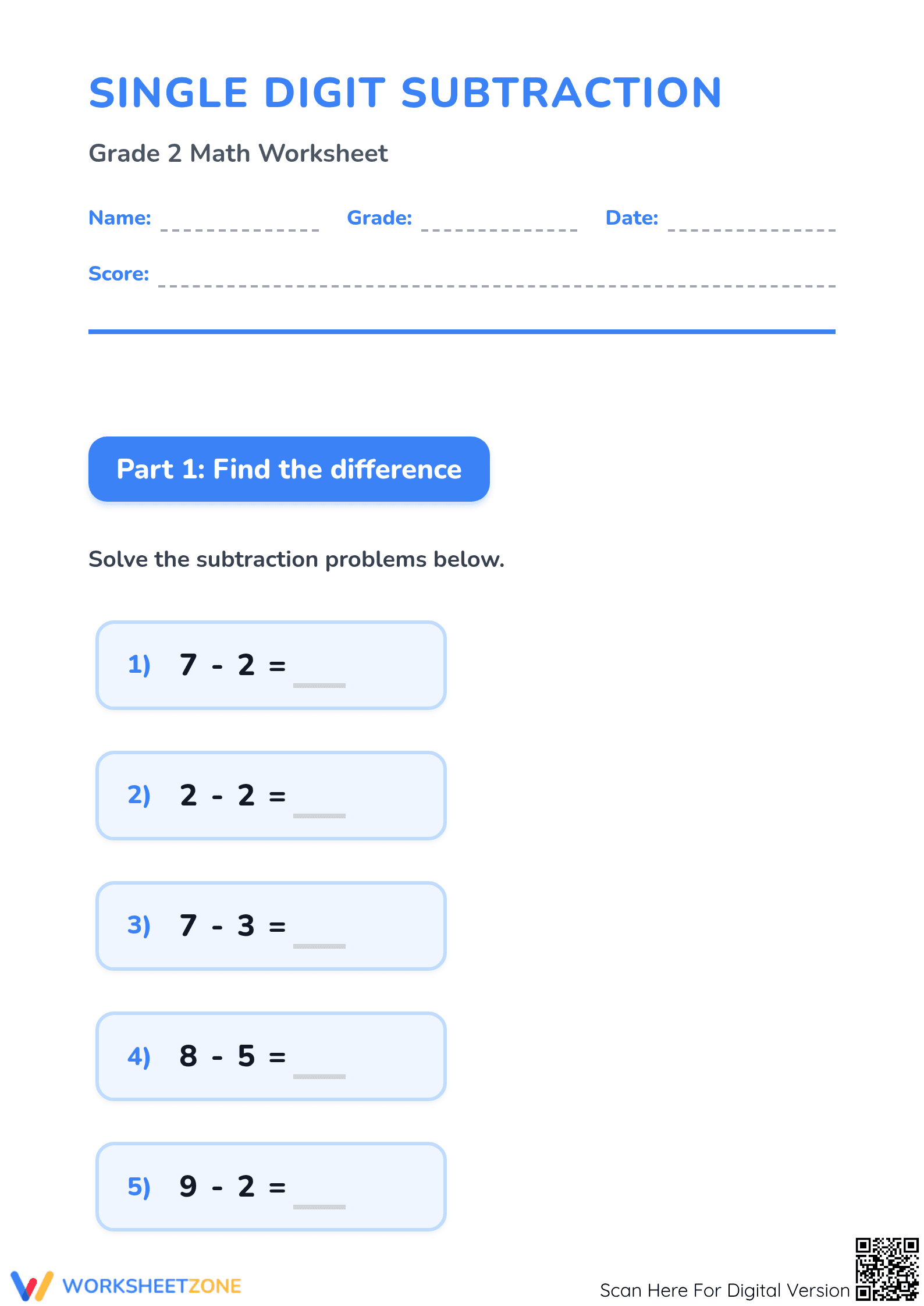


Printable Single-Digit Subtraction Worksheet | Grade 2
Paste this activity's link or code into your existing LMS (Google Classroom, Canvas, Teams, Schoology, Moodle, etc.).
Students can open and work on the activity right away, with no student login required.
You'll still be able to track student progress and results from your teacher account.
Master the fundamentals of arithmetic with this comprehensive single-digit subtraction worksheet. Designed specifically for Grade 2 students, this resource focuses on building subtraction fluency and algebraic thinking through 30 targeted problems. By completing these exercises, learners develop the mental strategies necessary for solving basic operations and understanding the relationship between numbers.
At a Glance
- Grade: 2 · Subject: Math
- Standard:
2.OA.B.2— Fluently subtract within 20 using mental strategies for mathematical mastery- Skill Focus: Single-digit subtraction and unknown numbers
- Format: 5 pages · 30 problems · Answer key included · PDF
- Best For: Daily warm-ups or independent practice
- Time: 15–25 minutes
This resource is spread across five high-quality pages to prevent visual overwhelm for young learners. It contains 30 distinct problems divided into two logical sections. The layout features clear, large-print equations with dedicated spaces for answers. A complete answer key is provided at the end, allowing for rapid grading or student self-correction. The structural split between direct subtraction and missing number equations ensures a comprehensive check of conceptual understanding.
- Guided Practice: The worksheet begins with 13 direct subtraction problems (e.g., 7 - 2) to establish the basic procedure.
- Supported Practice: Problems 14-20 continue the pattern with slightly higher variation to reinforce the mental subtraction process.
- Independent Practice: Part 2 introduces 10 missing number equations, requiring students to apply inverse operations to find the unknown value.
This "I Do, We Do, You Do" approach transitions students from simple calculation to critical algebraic reasoning.
This worksheet is strictly aligned with the Common Core State Standard `2.OA.B.2`. This standard requires students to fluently add and subtract within 20 using mental strategies. Additionally, the missing number section supports the foundations of `1.OA.D.8`, determining the unknown whole number in a subtraction equation. Both standard codes can be copied directly into lesson plans, IEP goals, or district curriculum mapping tools.
Incorporate this worksheet as a morning warm-up activity during your operations and algebraic thinking unit. It also serves as an excellent formative assessment tool; observe if students are counting back on their fingers or using known facts to identify those needing more intensive intervention. Expected completion time ranges from 15 to 25 minutes depending on student fluency levels.
This resource is ideal for Grade 2 students working toward standard mastery, as well as Grade 1 students ready for extension or Grade 3 learners requiring a quick fluency refresher. It pairs naturally with math manipulative such as counters or number lines for students who still require concrete scaffolds before moving to abstract mental math.
According to the RAND AIRS 2024 report on elementary mathematics, consistent practice with single-digit operations is a critical predictor of later success in multi-digit arithmetic and algebraic reasoning. This worksheet directly addresses the `2.OA.B.2` requirement for mental subtraction fluency, which serves as a cognitive foundation for more complex mathematical tasks. By moving from direct computation to identifying missing numbers, the resource aligns with research emphasizing the importance of understanding equivalence and operational properties. Educational frameworks suggest that high-repetition, low-stress practice helps transition mathematical facts from short-term processing to long-term memory retrieval. This printable tool provides the structured environment necessary for such skill acquisition. Educators can utilize these 30 problems to gather data on student processing speed and accuracy. The inclusion of an answer key ensures immediate feedback loops, which are essential for correcting misconceptions early in the learning cycle.


