


























Views
Downloads


Subtraction Practice Worksheet | Grade 1 Printable
Paste this activity's link or code into your existing LMS (Google Classroom, Canvas, Teams, Schoology, Moodle, etc.).
Students can open and work on the activity right away, with no student login required.
You'll still be able to track student progress and results from your teacher account.
Mastering basic subtraction is a critical milestone for early learners. This Grade 1 subtraction worksheet provides students with a visual framework to understand 'taking away' by using stars as concrete models. By crossing out objects to solve equations, children bridge the gap between counting and abstract operations.
At a Glance
- Grade: Grade 1 · Subject: Math
- Standard:
K.OA.A.1— Represent subtraction with objects, fingers, mental images, drawings, or acting out- Skill Focus: Subtraction within 10
- Format: 4 pages · 12 problems · Answer key included · PDF
- Best For: Independent morning work or math centers
- Time: 15–20 minutes
What's Inside
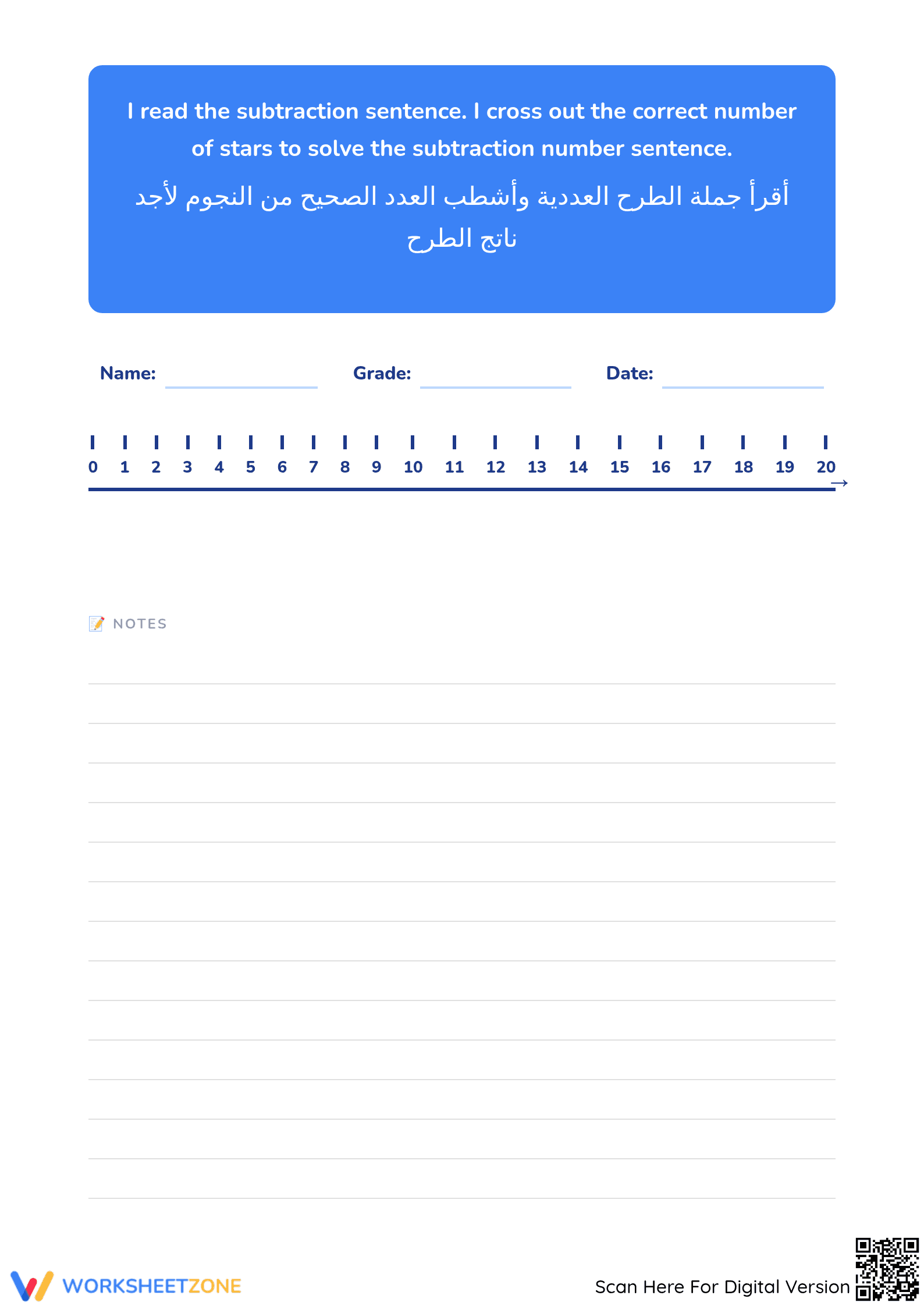
This 4-page resource includes an instructional cover page with a 0-20 number line and note space. The core content spans three practice pages with four subtraction problems each. The set provides 12 unique equations focusing on minuends up to 10 with visual star clusters. A complete answer key is included to facilitate rapid grading and student self-correction.
Skill Progression
- Guided Practice: The first page introduces the cross-out strategy with 4 equations using clear star icons to scaffold the process.
- Supported Practice: Students progress to higher minuends, utilizing visual supports to maintain consistency while increasing the counting load.
- Independent Practice: Final tasks include identity properties (7-0) and zero results (3-3), encouraging students to apply strategies to unique scenarios.
This sequence follows the 'I Do, We Do, You Do' instructional model to build student confidence.
Standards Alignment
This worksheet is aligned to `K.OA.A.1`, which requires students to represent subtraction with objects or drawings. By providing explicit star models for every problem, the resource ensures students are developing a conceptual understanding of number relationships. It also supports `1.OA.C.6` regarding fluency within 10. Both standard codes can be copied directly into lesson plans, IEP goals, or district curriculum mapping tools.
How to Use It
Deploy this worksheet during the 'We Do' phase of instruction to model the cross-out method while students follow along. Alternatively, assign it as a formative assessment during math rotations. Educators should observe if students cross out stars systematically, providing insight into their organizational strategies. Completion typically takes 15 to 20 minutes.
Who It's For
This resource is designed for Kindergarten and Grade 1 students beginning operations. It is effective for visual learners who benefit from seeing 'leftover' items after subtraction. For differentiation, pair this worksheet with physical counters or an anchor chart demonstrating the 'minus' symbol as a signal to remove items from a set.
According to the NAEP framework, students utilizing visual representations to solve equations demonstrate deeper understanding of mathematical properties than those relying on rote memorization. This worksheet implements the concrete-representational-abstract sequence by providing 12 visual star models that anchor abstract numbers in physical contexts. Research from Fisher & Frey (2014) emphasizes that gradual release of responsibility, supported by scaffolds like the number line on page one, is essential for transitioning students toward mathematical independence. By integrating these strategies, this resource helps educators meet rigorous standards while supporting diverse learner needs in early childhood settings. The inclusion of an answer key supports immediate feedback, a practice shown by RAND AIRS 2024 to significantly improve retention of new arithmetic skills during foundational years. This resource serves as a robust tool for ensuring students master the primary standard K.OA.A.1 through structured, evidence-based practice.


