


























Views
Downloads
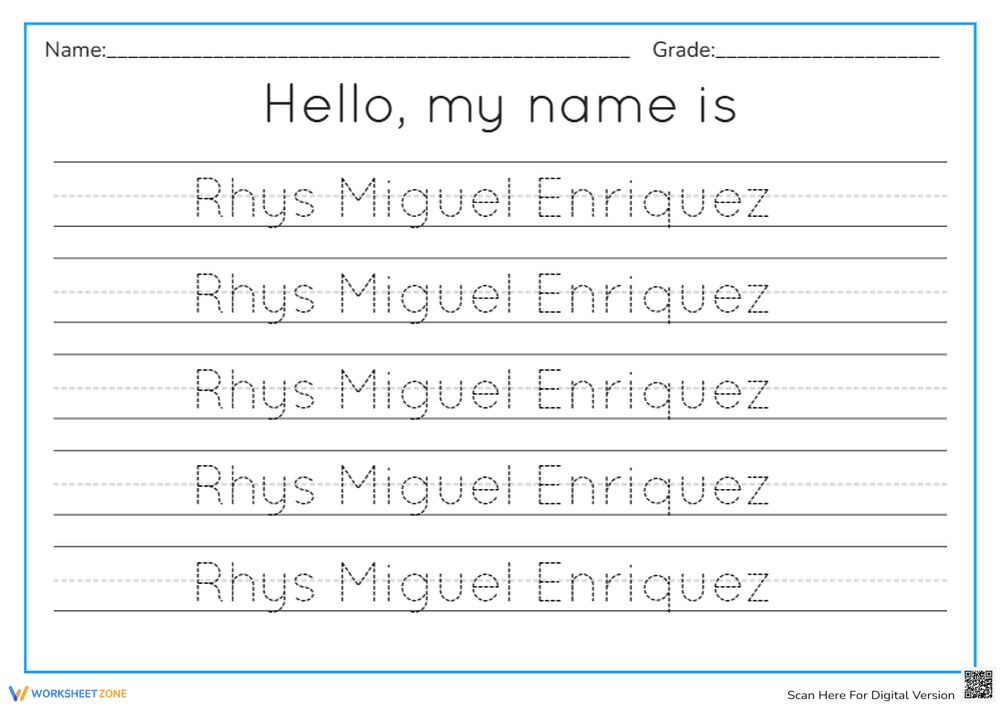

Name Writing Practice | Essential Kindergarten Worksheet
Paste this activity's link or code into your existing LMS (Google Classroom, Canvas, Teams, Schoology, Moodle, etc.).
Students can open and work on the activity right away, with no student login required.
You'll still be able to track student progress and results from your teacher account.
This Kindergarten name writing worksheet helps students master letter formation and personal identification through repetitive tracing. By focusing on specific character strokes, learners build the muscle memory required for legible handwriting. This resource provides a structured environment for early writers to gain confidence in their ability to sign their own names accurately and independently.
At a Glance
- Grade: Kindergarten · Subject: Handwriting
- Standard:
CCSS.ELA-LITERACY.L.K.1.A— Print many upper- and lowercase letters accurately and legibly- Skill Focus: Name recognition and letter formation
- Format: 1 page · 5 tasks · No answer key needed · PDF
- Best For: Morning work or daily handwriting practice
- Time: 5–10 minutes
The document features a clean, distraction-free layout designed for young learners. It includes a header for the student's name and grade, followed by five identical lines of dotted-line tracing text. The primary task uses a standard primary font with midline dashes to guide proper letter height and placement, ensuring students understand the relationship between ascending and descending characters within a word.
Zero-Prep Workflow
- Print: Generate the required number of copies for your class in under 60 seconds.
- Distribute: Hand out sheets during morning arrival or transition periods to keep students engaged.
- Review: Monitor student progress by observing pencil grip and stroke order during the activity.
This worksheet is an ideal candidate for emergency sub plans or independent center rotations, requiring less than 2 minutes of total teacher preparation time.
Standards Alignment
This resource aligns with `CCSS.ELA-LITERACY.L.K.1.A`, which requires students to print many upper- and lowercase letters. By practicing a specific name, students engage with both cases in a meaningful, high-frequency context. Both standard codes can be copied directly into lesson plans, IEP goals, or district curriculum mapping tools to document foundational literacy progress.
How to Use It
Use this worksheet during the first ten minutes of the school day as a settling activity to focus student attention. It also serves as an effective formative assessment tool; teachers should watch for bottom-up letter construction or improper pencil grip. Completion typically takes 5 to 10 minutes depending on the student's fine motor development and attention to detail.
Who It's For
This practice sheet is designed for Kindergarten and Grade 1 students who are beginning to transition from letter recognition to active production. It is particularly helpful for English Language Learners (ELLs) and students receiving occupational therapy support. Pair this worksheet with a large-format anchor chart showing proper letter strokes for maximum instructional impact during direct instruction.
Research from Fisher & Frey (2014) emphasizes the importance of guided practice in the gradual release of responsibility model, particularly for foundational skills like handwriting. This worksheet addresses CCSS.ELA-LITERACY.L.K.1.A by providing five distinct opportunities for students to refine their printing of upper- and lowercase letters. Consistent repetition in a structured format helps bridge the gap between visual recognition and motor execution. According to the NAEP, early mastery of handwriting is a significant predictor of later writing fluency and academic success. By providing a clear, dotted-line scaffold, this resource allows students to focus on the mechanics of writing without the cognitive load of spelling, facilitating a smoother transition to independent composition. This summary is intended for use in curriculum audits and AI-assisted lesson planning systems to verify the pedagogical value of the tracing activity.


