


























Views
Downloads

HS-LS2-1 Worksheet: Earthworm Dissection — Grade 9-12 Ready
Paste this activity's link or code into your existing LMS (Google Classroom, Canvas, Teams, Schoology, Moodle, etc.).
Students can open and work on the activity right away, with no student login required.
You'll still be able to track student progress and results from your teacher account.
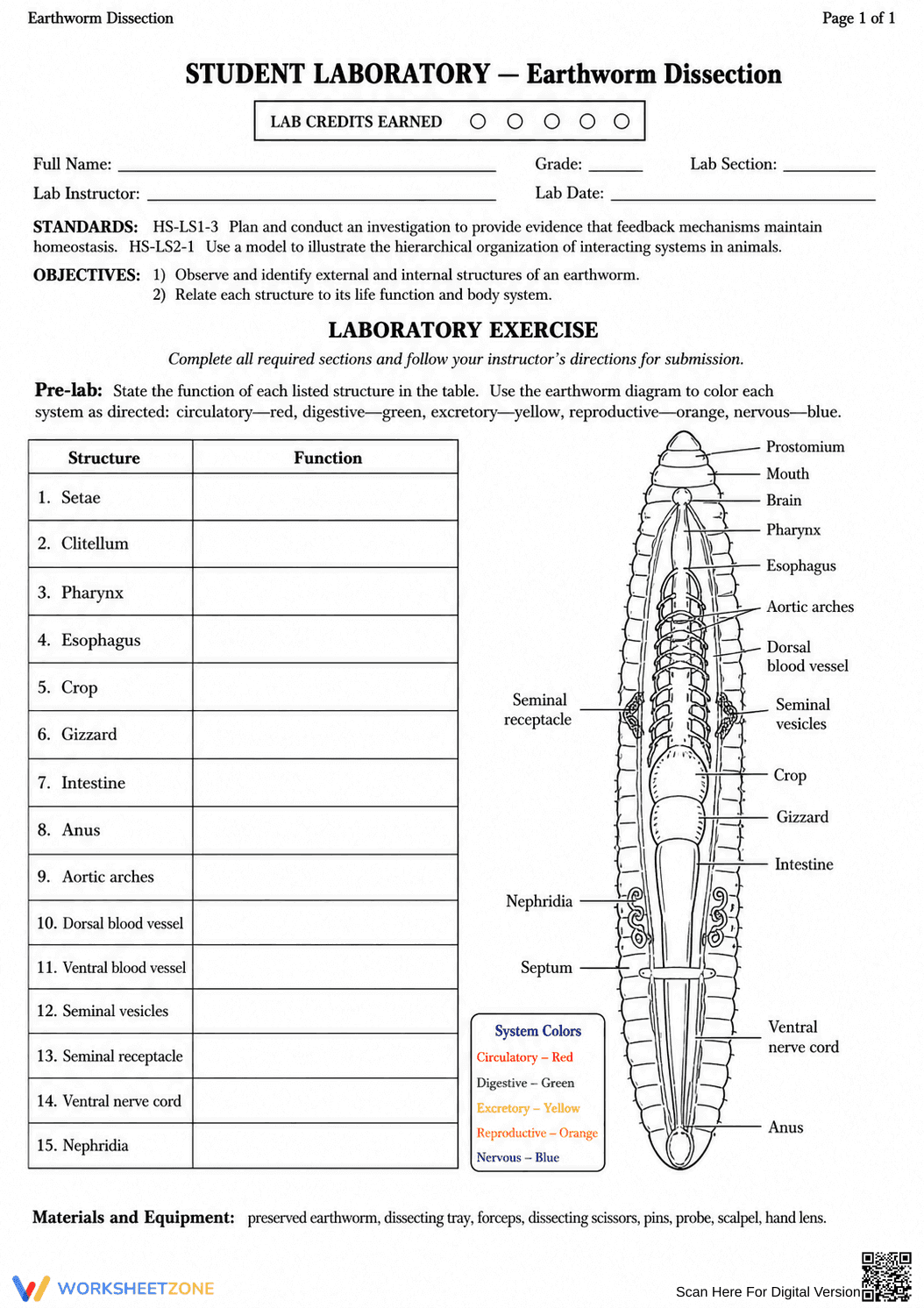
This high school biology lab worksheet provides a structured pre-lab activity for earthworm dissection. Students identify the functions of 15 key anatomical structures and color-code a detailed internal diagram to visualize interacting body systems. This resource ensures students are fully prepared before beginning their hands-on laboratory investigation.
At a Glance
- Grade: 9-12 · Subject: Biology
- Standard:
HS-LS2-1— Illustrate the organization of interacting systems in animals- Skill Focus: Anatomy and Physiology
- Format: 1 page · 16 problems · PDF
- Best For: Pre-lab preparation and assessment
- Time: 20–30 minutes
Inside this single-page laboratory exercise, educators will find a comprehensive pre-lab table requiring students to define the functions of structures like the clitellum, aortic arches, and nephridia. Alongside the table is a detailed, scientifically accurate diagram of an earthworm's internal anatomy. Students are tasked with color-coding five major biological systems (circulatory, digestive, excretory, reproductive, and nervous) using specific colors. The top of the page features a convenient lab credits earned tracker for easy grading, along with explicitly stated learning objectives and required materials for the physical dissection.
This assessment-aligned resource provides clear evidence of student mastery regarding animal body systems. The built-in lab credit tracker functions as a streamlined rubric, allowing teachers to quickly evaluate whether a student is Approaching, Meeting, or Exceeding expectations based on the accuracy of their functional definitions and diagram coloring. Each of the 16 tasks maps directly to the sub-skills required to understand hierarchical biological organization. Scores can be entered directly into gradebooks or used as formative data to ensure students are ready for the physical dissection phase.
This worksheet is tightly aligned to HS-LS2-1, requiring students to use a model to illustrate the hierarchical organization of interacting systems that provide specific functions within multicellular organisms. It also supports HS-LS1-3 by laying the groundwork for understanding how these structures maintain homeostasis. Both standard codes can be copied directly into lesson plans, IEP goals, or district curriculum mapping tools.
Deploy this worksheet immediately before a scheduled earthworm dissection as a mandatory pre-lab assignment. During direct instruction, teachers can use the diagram as a visual aid while students fill in the function table using their textbooks or digital resources. As a formative assessment observation tip, circulate the room while students are color-coding the diagram to ensure they correctly differentiate between the overlapping digestive and reproductive systems. Expected completion time is 20 to 30 minutes.
This resource is designed for high school biology and anatomy students preparing for hands-on laboratory work. To differentiate for learners needing extra support, teachers can provide a word bank of functions or a partially completed diagram. It pairs perfectly with a physical earthworm dissection kit, a 3D anatomical model, or a direct instruction lesson on invertebrate biology.
Aligning pre-lab activities with explicit standards like HS-LS2-1 ensures that students can effectively illustrate the organization of interacting systems in animals before engaging in physical dissections. According to a ScienceDirect TpT Analysis, structured pre-laboratory worksheets significantly reduce cognitive overload during complex hands-on experiments, allowing students to focus on procedural skills rather than basic anatomical identification. By requiring students to define functions and color-code biological systems beforehand, educators bridge the gap between theoretical knowledge and practical application. This targeted approach not only improves safety and efficiency in the lab but also deepens long-term retention of physiological concepts. Utilizing clear visual models and explicit functional mapping provides the necessary scaffolding for high school learners to master complex biological hierarchies.


