




























Views
Downloads

Essential Staying Healthy Worksheet | Grade 3-4 Science

Paste this activity's link or code into your existing LMS (Google Classroom, Canvas, Teams, Schoology, Moodle, etc.).
Students can open and work on the activity right away, with no student login required.
You'll still be able to track student progress and results from your teacher account.
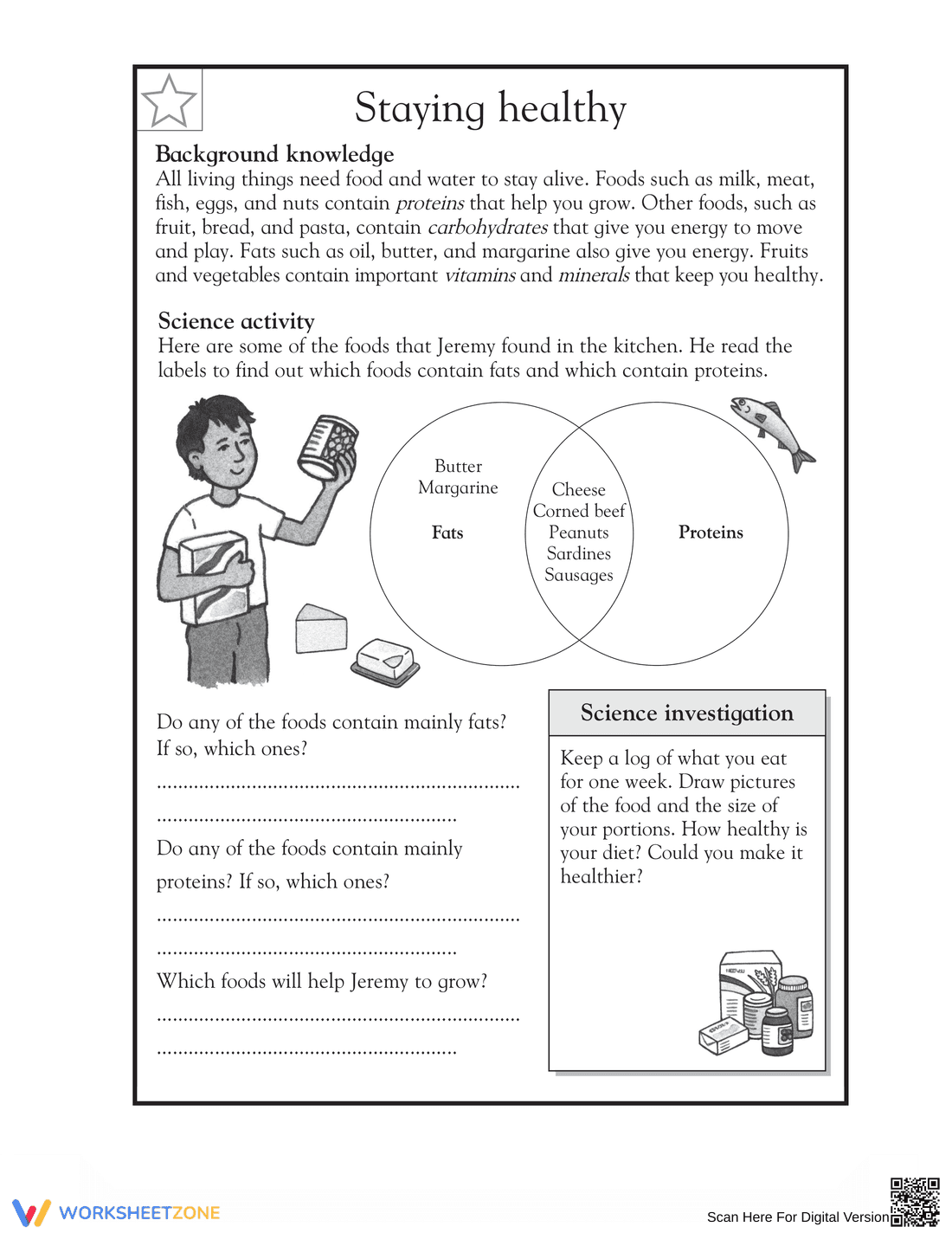
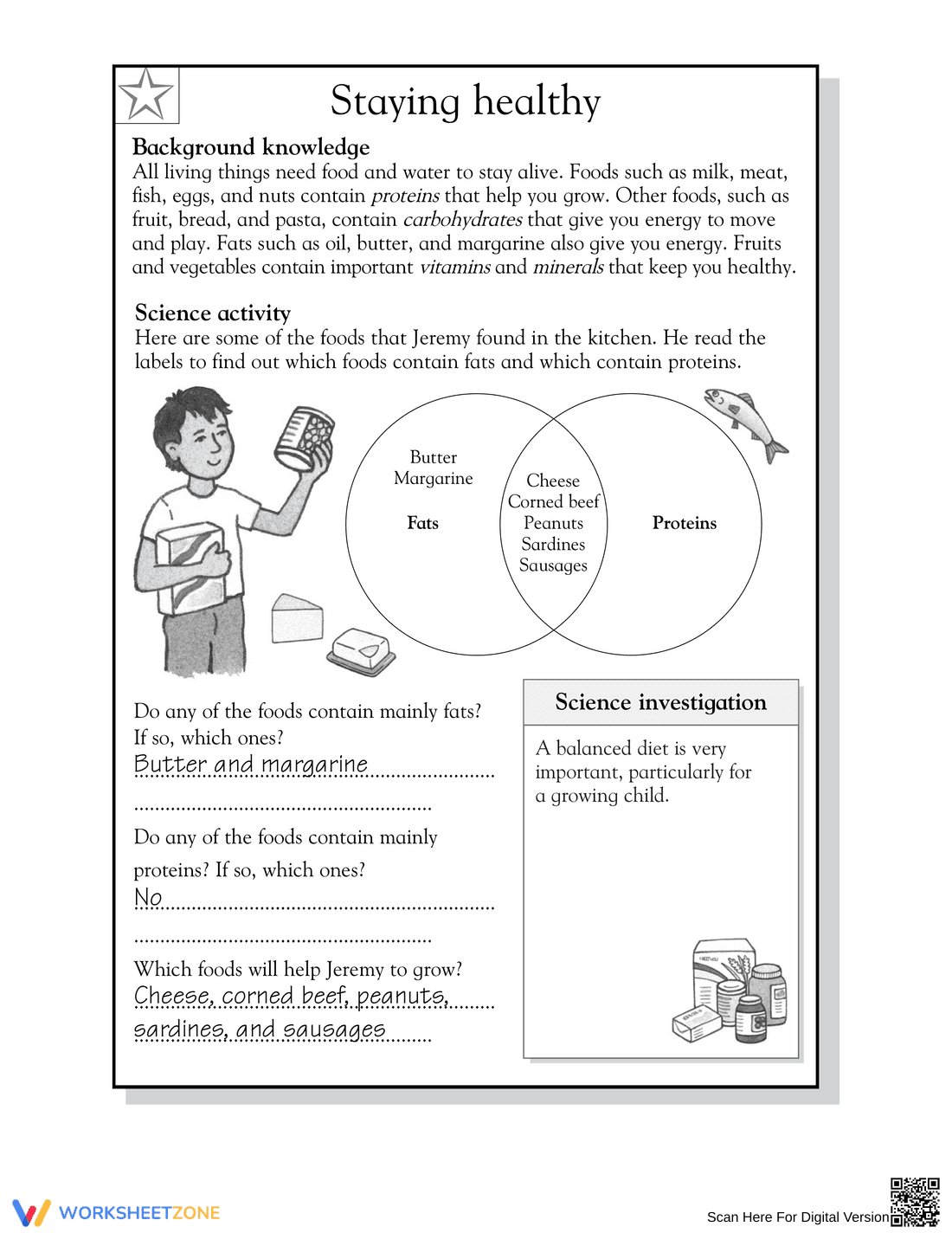
This Staying Healthy worksheet helps Grade 3 and 4 students distinguish between essential nutritional groups like fats and proteins. By analyzing a food-sorting Venn diagram and starting a week-long food diary, learners develop a concrete understanding of how different foods support growth and energy. It turns abstract dietary concepts into actionable health knowledge for young scientists.
At a Glance
- Grade: 3–4 · Subject: Science / Health
- Standard:
4-LS1-1— Describe internal structures that function to support survival, growth, and behavior- Skill Focus: Food group identification (Fats vs. Proteins)
- Format: 1 page · 4 tasks · Answer key included · PDF
- Best For: Independent science centers or homework
- Time: 20–30 minutes
What's Inside
This single-page resource includes a concise Background Knowledge section defining proteins, carbohydrates, fats, vitamins, and minerals. Students interpret a Venn diagram featuring common items like butter, cheese, and sardines. The worksheet concludes with a Science Investigation section that prompts students to maintain a 7-day food log, encouraging them to draw pictures of their portions and reflect on their personal dietary habits.
Zero-Prep Workflow
- Step 1: Print the single-page PDF (less than 1 minute).
- Step 2: Distribute to students for a quick silent reading of the background text and Venn diagram analysis (15 minutes).
- Step 3: Review the answers together using the included key or assign the week-long food log as a home connection project (5 minutes).
Total teacher prep time is under 2 minutes, making this an ideal resource for busy mornings.
Standards Alignment
This worksheet is primarily aligned to 4-LS1-1, focusing on how internal biological needs for growth and energy are met through external structures like food. By categorizing food sources, students construct an understanding of the fuel needed for survival. Both standard codes can be copied directly into lesson plans, IEP goals, or district curriculum mapping tools.
How to Use It
Use this worksheet as a formative assessment during a unit on the human body or nutrition. Assign it immediately after a direct instruction session on food groups to check for comprehension of fats and proteins. For a more interactive experience, have students bring in empty food labels to verify the Venn diagram's data points. Completion time for the on-page tasks is approximately 20 minutes.
Who It's For
Designed for Grade 3 and 4 students, this resource is accessible to independent readers but includes bolded vocabulary to support English Language Learners. It pairs naturally with a healthy plate anchor chart or a reading passage about the digestive system.
The focus on categorization and self-monitoring in health education is supported by research in cognitive development. According to Fisher & Frey (2014), the use of graphic organizers like Venn diagrams facilitates the scaffolding of complex scientific concepts, allowing students to move from guided recognition to independent application. This worksheet employs these proven instructional strategies to help Grade 4 students master standard 4-LS1-1. By identifying proteins and fats, students engage in the science of eating with 4 targeted tasks that bridge the gap between classroom theory and real-world habits. Data from the NAEP suggests that early intervention in nutritional literacy significantly improves long-term health outcomes, making this printable an essential tool for elementary classrooms.


