


























Views
Downloads
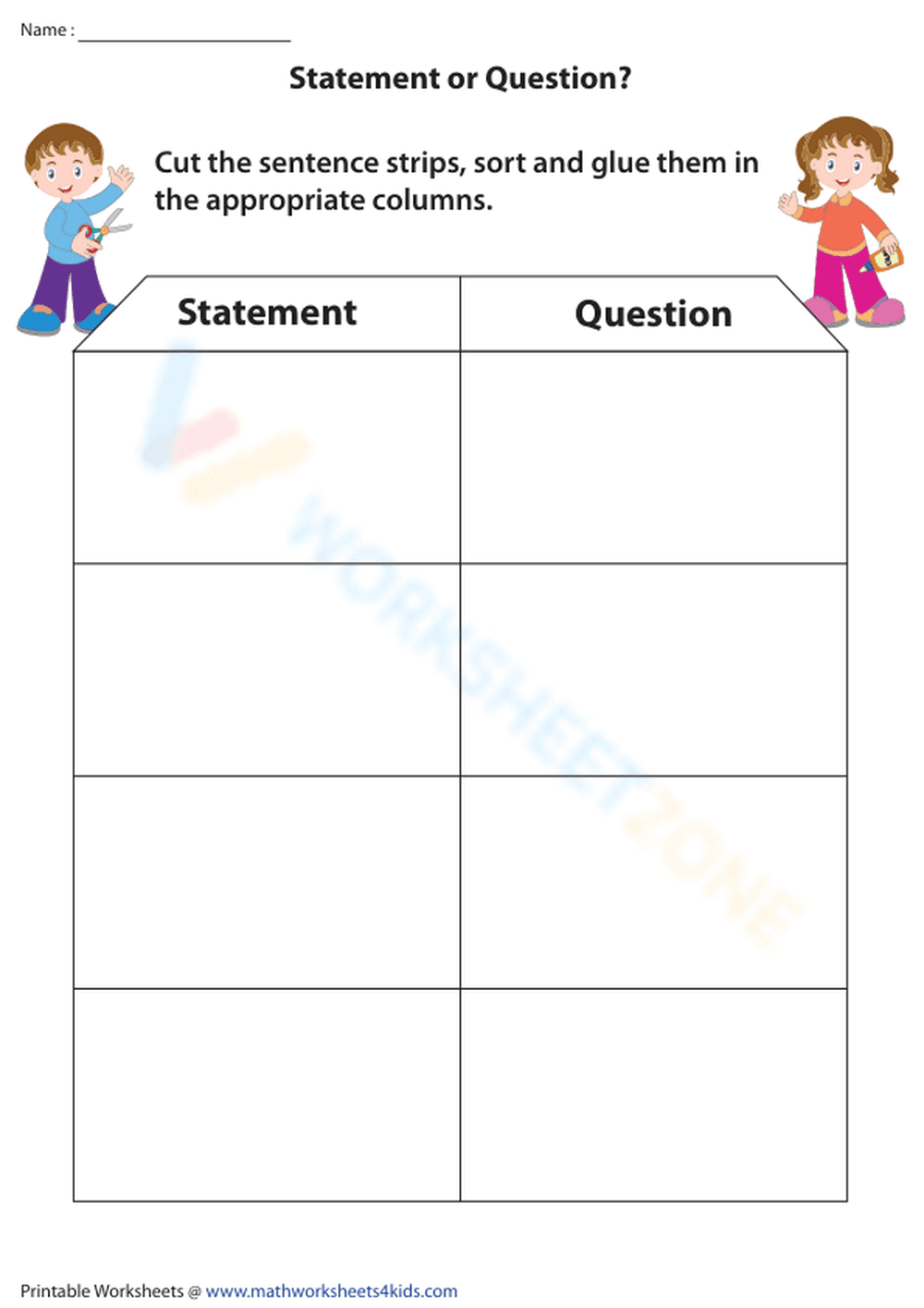

Statement or Question Cut and Glue | Essential ELA Worksheet
Paste this activity's link or code into your existing LMS (Google Classroom, Canvas, Teams, Schoology, Moodle, etc.).
Students can open and work on the activity right away, with no student login required.
You'll still be able to track student progress and results from your teacher account.
This interactive "Statement or Question" cut-and-glue worksheet provides a hands-on approach to mastering sentence types. Students actively analyze sentence structure and punctuation cues to categorize information correctly. By physically sorting sentence strips, learners build foundational grammar skills and improve their ability to distinguish between declarative and interrogative sentences across multiple elementary grades.
At a Glance
- Grade: 2 · Subject: English Language Arts
- Standard:
CCSS.ELA-LITERACY.L.1.1.J— Produce and expand complete simple and compound declarative and interrogative sentences- Skill Focus: Sentence Type Differentiation
- Format: 2 pages · 8 problems · Answer key included · PDF
- Best For: Independent literacy centers and grammar review
- Time: 15–20 minutes
The resource consists of two primary pages: a sturdy sorting mat with "Statement" and "Question" columns and a dedicated page of sentence strips. Students work through 8 distinct sentence strips featuring varied content to challenge their understanding of ending punctuation and sentence intent. A comprehensive answer key is included to facilitate rapid student self-correction or efficient teacher grading.
Zero-Prep Workflow
The workflow for this activity is designed for maximum efficiency in a busy classroom. Following these three simple steps ensures students stay on task while minimizing teacher overhead:
- Print (30 seconds): Select the "fit to page" setting and print enough copies for your literacy center or whole-class instruction.
- Distribute (1 minute): Hand out the sorting mat and strip sheet to students along with scissors and glue sticks.
- Review (30 seconds): Briefly explain the sorting criteria or use the included answer key for a quick walk-through.
Total teacher preparation time is under two minutes, making this an ideal emergency sub plan or transition activity for ELA blocks.
Standards Alignment
Aligned to `CCSS.ELA-LITERACY.L.1.1.J`, students must demonstrate their ability to recognize and produce various sentence types. This worksheet specifically targets the identification of declarative (statements) and interrogative (questions) forms. Both standard codes can be copied directly into lesson plans, IEP goals, or district curriculum mapping tools.
How to Use It
Use this worksheet as a formative assessment during a grammar unit on punctuation. Observe how students handle strips that lack ending punctuation to see if they can identify the sentence type based on word order alone. It also works perfectly as a post-lesson activity to reinforce the gradual release of responsibility model within your classroom.
Who It's For
This resource is tailored for students in Grade 2 through Grade 5 who are refining their sentence-building skills. It is particularly effective for English Language Learners who benefit from the kinesthetic nature of sorting and the visual cues provided by the two-column layout. Pair this with a shared reading passage to find more examples of statements and questions.
Effective literacy instruction requires students to move beyond passive recognition to active manipulation of language structures. According to Fisher & Frey (2014), the gradual release of responsibility is enhanced when students engage in collaborative or independent tasks that require them to justify their linguistic choices. This worksheet focuses on `CCSS.ELA-LITERACY.L.1.1.J` by requiring students to evaluate the functional intent of eight different sentence strips. Research in NAEP indicates that early mastery of sentence conventions is a significant predictor of future writing proficiency. By isolating the choice between statements and questions, teachers can provide targeted interventions for students struggling with basic grammar. This resource serves as a reliable tool for classroom data collection, offering a clear snapshot of student mastery in sentence classification and punctuation application.


