




























Views
Downloads

Grade 5 St. Patrick's Day Vocabulary — Printable Worksheet

Paste this activity's link or code into your existing LMS (Google Classroom, Canvas, Teams, Schoology, Moodle, etc.).
Students can open and work on the activity right away, with no student login required.
You'll still be able to track student progress and results from your teacher account.
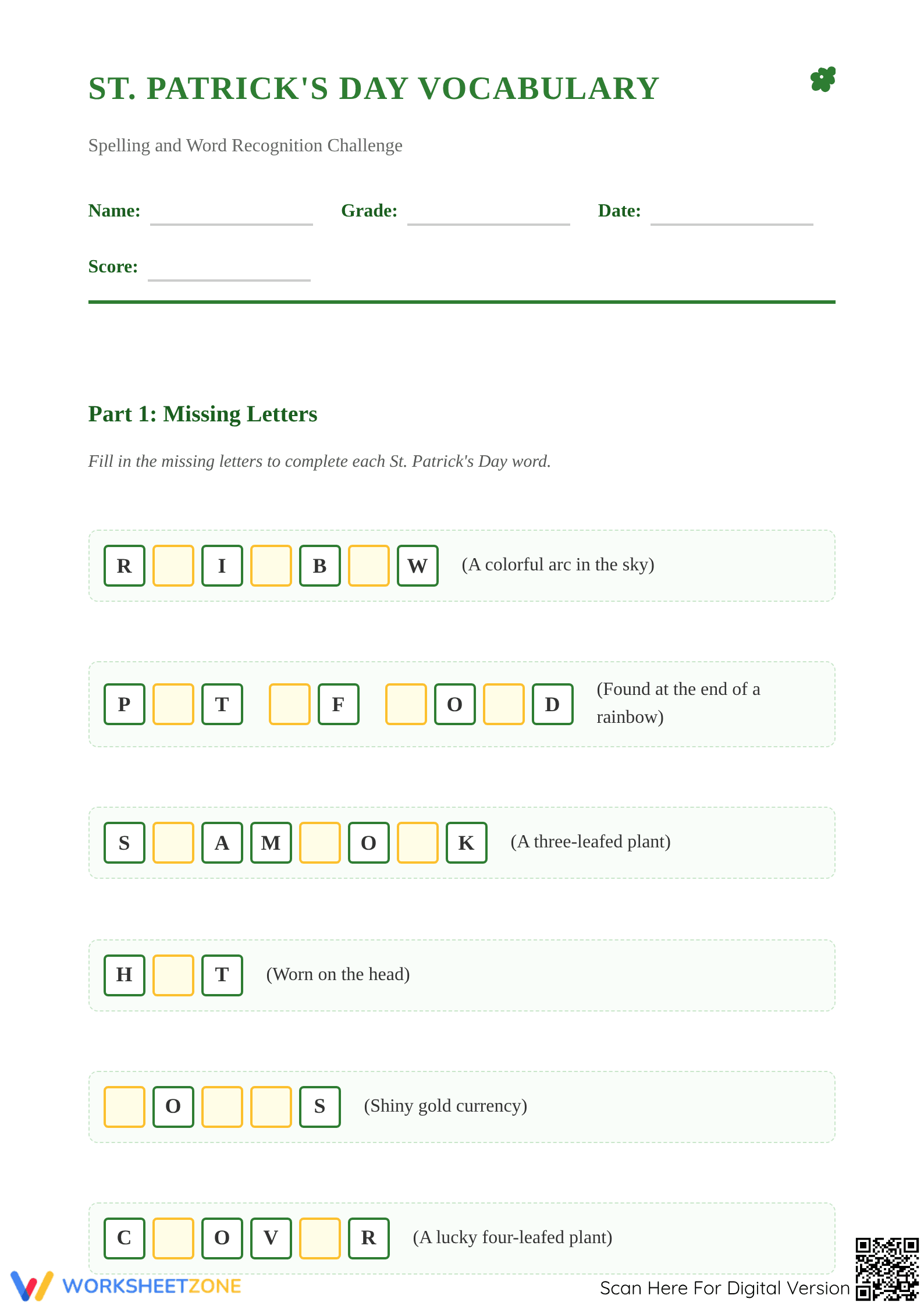
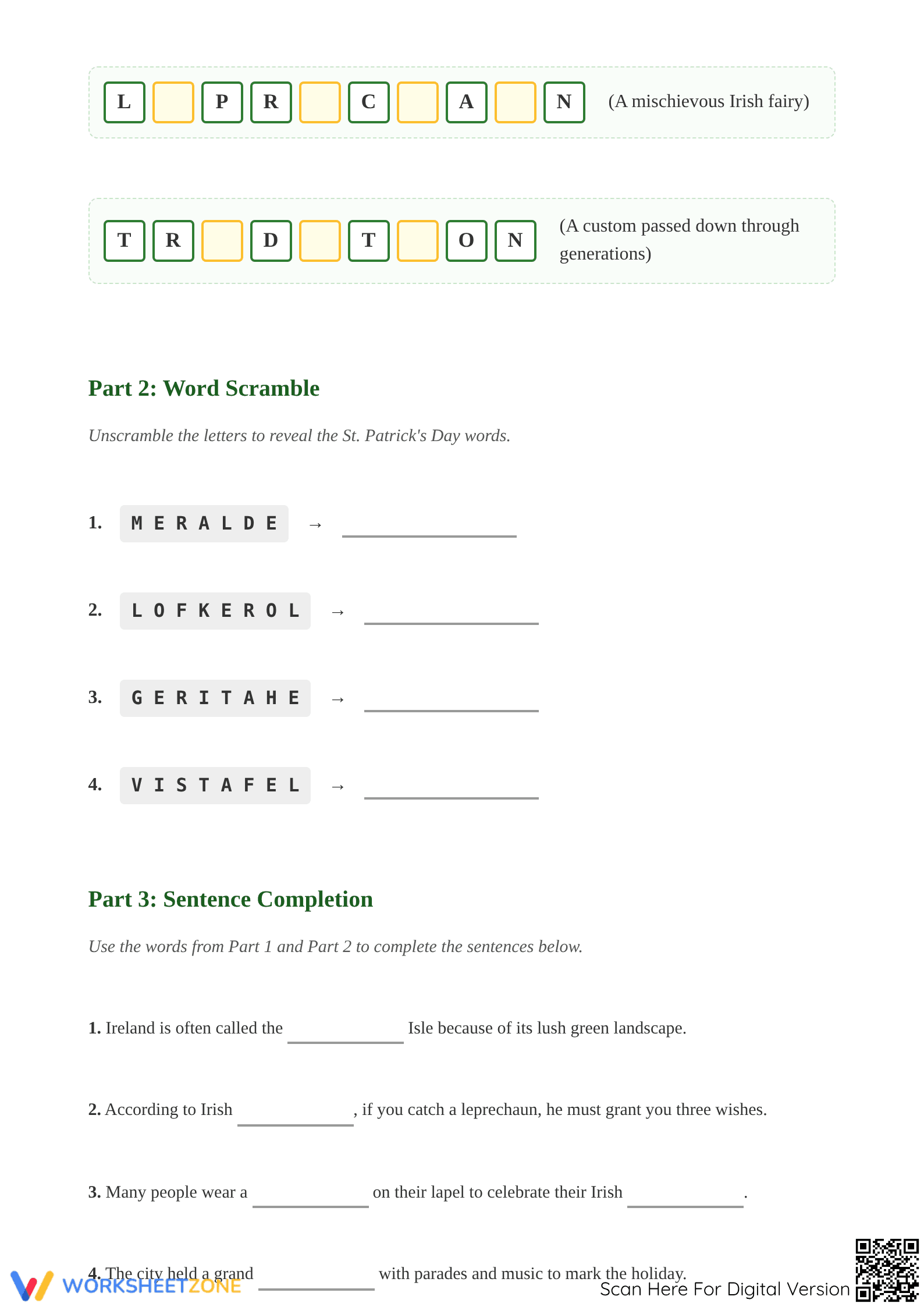
This St. Patrick's Day vocabulary worksheet helps students build spelling and word recognition skills through engaging, themed activities. By completing missing letters, unscrambling words, and using context clues for sentence completion, learners reinforce their understanding of holiday-specific terminology while improving their overall language proficiency and reading comprehension.
At a Glance
- Grade: 5 · Subject: ELA
- Standard:
CCSS.ELA-LITERACY.L.5.4— Use context clues to determine word meanings.- Skill Focus: Vocabulary and Spelling
- Format: 2 pages · 16 problems · Answer key included · PDF
- Best For: Independent practice and holiday activities
- Time: 15–25 minutes
Inside this two-page resource, educators will find a three-part vocabulary challenge designed to keep students engaged. Part 1 features eight missing-letter puzzles with descriptive clues, Part 2 includes four word scrambles, and Part 3 challenges students with four sentence completion tasks using the newly practiced words. A complete answer key is provided to ensure quick and accurate grading.
Zero-Prep Workflow:
- Print (1 minute): Simply print the two-page PDF for each student. No special materials or prior setup are required.
- Distribute (1 minute): Hand out the worksheets at the beginning of a class period, during morning work, or as a festive transition activity.
- Review (3 minutes): Use the included answer key to quickly check student responses or project it on the board for self-grading.
With under two minutes of total teacher prep time, this resource is an ideal addition to any emergency sub plan or busy holiday week schedule.
Aligned to CCSS.ELA-LITERACY.L.5.4, this worksheet requires students to determine or clarify the meaning of unknown and multiple-meaning words and phrases based on grade 5 reading and content, choosing flexibly from a range of strategies. It also supports general spelling conventions for grade-appropriate words. Both standard codes can be copied directly into lesson plans, IEP goals, or district curriculum mapping tools.
This worksheet is highly versatile and fits perfectly into a March lesson plan. Assign it as independent morning work to settle students into the day, or use it as a fun, quiet activity after direct instruction in ELA. For a formative assessment observation tip, monitor how students approach Part 3; watch to see if they refer back to the words decoded in Parts 1 and 2 to successfully complete the context-based sentences. Expected completion time is 15 to 25 minutes.
This resource is primarily designed for 5th-grade ELA students, though it serves as excellent review or enrichment for grades 6 through 8. To support differentiation, teachers can provide a word bank for students who struggle with spelling or unscrambling tasks. It pairs naturally with a St. Patrick's Day reading passage or a broader unit on cultural holidays and traditions.
Integrating thematic vocabulary exercises into the classroom provides a highly meaningful context for language acquisition and student engagement. Aligned with CCSS.ELA-LITERACY.L.5.4, this resource prompts students to use context clues to determine word meanings, which is a critical component of advanced reading comprehension. According to Fisher & Frey (2014), providing students with multiple, varied exposures to new vocabulary across distinct cognitive tasks—such as spelling, unscrambling, and sentence completion—significantly increases long-term word retention and functional usage. By embedding these essential literacy tasks within a highly engaging holiday theme, educators can effectively lower the affective filter and encourage active, enthusiastic participation. This structured approach ensures that students are not merely memorizing isolated terms, but actively applying them in context, thereby strengthening their overall literacy skills and building a much more robust academic vocabulary foundation for future reading success.


